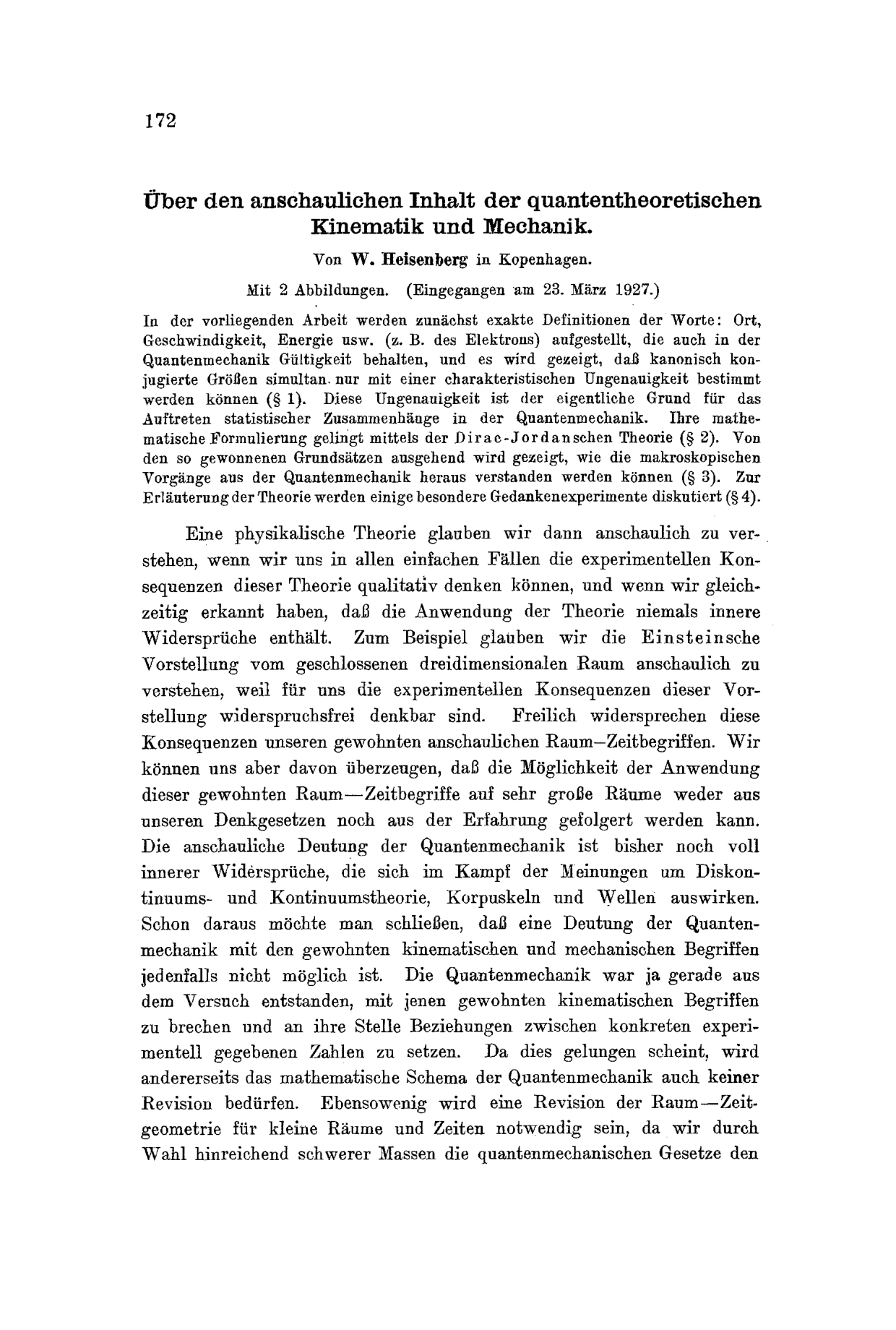
불확정성 원리와 가격·모멘텀 오차: 하이젠베르크 1927년 논문의 재해석
불확정성 원리와 가격·모멘텀 오차: 하이젠베르크 1927년 논문의 재해석 우리는 시장과 입자의 위치를 동시에 알 수 있을까요? 우리는 흔히 정확한 분석이 정확한 결과를 담보한다고 믿습니다. 차트의 픽셀 하나, 호가창의 숫자 하나까지 놓치지 않으려는 강박은 어쩌면 자연의 섭리를 거스르는 행위일지 모릅니다. 1927년, 베르너 하이젠베르크가 발표한 논문은 우리가 '본다'는 행위 자체가 대상을 어떻게 교란시키는지에 대한 근원적인 물음을 던졌습니다. 이 학습 노트는 그 물리학적 통찰을 빌려와, 시장이라는 거대한 입자의 흐름 속에서 우리가 필연적으로 마주할 수밖에 없는 '오차'의 본질을 탐구합니다. 이것은 단순한 과학 이야기가 아닙니다. 당신의 자산이 움직이는 궤적에 대한 가장 정교하고도 철학적인 해설서입니다. 물리학도에게는 익숙한 개념을, 거래자에게는 새로운 시장의 눈을, 그리고 일반 독자에게는 인간 지성의 한계에 대한 따뜻한 위로를 전달합니다.
Why can't we perfectly predict the trajectory of a particle—or a market trend? Based on Heisenberg's groundbreaking 1927 paper, we explore the fundamental limits of measurement and how the trade-off between position (price) and momentum (trend) dictates the reality of error.
Have you ever tried to catch a falling knife in the stock market? Or perhaps, simply tried to pinpoint exactly where an electron is while simultaneously figuring out where it is going? It is a frustrating endeavor. You feel that if you just had better tools, a faster computer, or sharper eyes, you could know it all. But here is the hard truth: nature does not work that way.
Back in 1927, a young physicist named Werner Heisenberg published a paper that shattered our comfortable, deterministic view of the universe. The paper, titled "Über den anschaulichen Inhalt der quantentheoretischen Kinematik und Mechanik", argues that the very act of observing changes reality. Today, we are going to walk through this masterpiece step-by-step. We will see how his logic applies not just to subatomic particles, but to any system where observation interferes with the state—including the chaotic dance of price and momentum in financial markets.
1. Concepts of Measurement: Redefining Reality
Before we can discuss errors, we must agree on what we are actually measuring. In classical mechanics, we assumed that terms like "position" and "velocity" had absolute, clear-cut meanings. A planet has a definite orbit; a car has a definite speed. However, Heisenberg starts his 1927 treatise by dismantling this assumption. He posits that a physical concept only makes sense if we can describe the experimental method used to measure it.
Think about the concept of "position" for an electron. In the classical world, we might imagine a tiny ball sitting at coordinates (x, y, z). But Heisenberg challenges us: how do you know it is there? You must look at it. To look at it, you must shine light on it. This interaction—the photon hitting the electron—is the crux of the matter.
"If one wants to be clear about what is meant by the words 'position of an object,' for example of an electron... one must specify definite experiments with which one intends to measure the 'position of an electron'; otherwise, this word has no meaning."
This is where the transition from classical to quantum concepts occurs. In the classical view, measurement is a passive act. You look at a clock, and your looking does not slow down time. In the quantum view (and interestingly, in high-frequency trading), measurement is an active interference.
Let's translate this to our secondary code: Price and Momentum.
Price (q) is the position. It is where the asset is right now.
Momentum (p) is the velocity or mass-times-velocity. It is the trend, the direction, the rate of change.
Heisenberg argues that when we try to define these physical quantities, we run into a discontinuity. In classical theories, we could conceptually divide time into infinitely small slices and know everything at every slice. In quantum kinematics, the "path" comes into existence only through the discrete moments of observation. Between two measurements, the electron does not have a "path" in the ordinary sense. It exists in a probabilistic state.
This leads to a profound realization: the "orbit" of an electron is not a continuous line drawn in space, but a series of fuzzy dots created by our clumsy attempts to see it. The more we try to connect the dots (measure continuously), the more we disturb the system.
2. The Limits of Accuracy: The Gamma Ray Microscope
To make this abstract idea concrete, Heisenberg introduces his famous thought experiment: the Gamma Ray Microscope. This is the centerpiece of the paper's intuitive argument.
Imagine you want to see an electron. To see something small, you need light with a very short wavelength. If the wavelength is long (like radio waves), it will just wash over the electron without bouncing back effectively; you won't get a sharp image. It is like trying to feel the texture of a vinyl record while wearing boxing gloves.
So, you choose light with an incredibly short wavelength: Gamma rays.
- The Precision Benefit: The short wavelength (λ) allows you to determine the position (q) of the electron with high accuracy. The error in position, Δq, is roughly proportional to the wavelength λ.
- The Momentum Cost: According to the Compton effect, light carries momentum. A photon of short wavelength has very high energy (and high momentum). When this energetic photon hits the tiny electron to "illuminate" it, it delivers a massive kick.
This kick changes the electron's velocity discontinuously. The moment you know "where" it is (position), you have dramatically altered "how fast" it is moving (momentum). You can no longer know its momentum (p) with precision because the very act of measuring position destroyed that information.
If you use longer wavelength light (lower energy) to avoid kicking the electron, you disturb the momentum less (Δp is small). However, the long wavelength gives you a blurry image, so you don't know the position accurately (Δq is large). You cannot win.
Heisenberg formulates this intuitive trade-off mathematically. The product of the uncertainty in position and the uncertainty in momentum is related to Planck's constant (h). This is not a technological limit; it is not about building a better microscope. It is a fundamental property of the universe.
Consider the market analyst again. If you zoom in on the "tick data" (the exact price at a microsecond), you are using the equivalent of gamma rays. You have the exact price, but the "momentum" (the trend) is overwhelmed by noise (the kick). If you look at a monthly chart (long wavelength), you see the trend (momentum) clearly, but the precise price position at any specific moment is blurred into a large candle bar.
3. The Mathematical Engine: Dirac-Jordan Theory
Heisenberg was not content with just a thought experiment. He needed to ground this in the rigorous mathematics of the new quantum theory, specifically the transformation theory developed by Paul Dirac and Pascual Jordan.
In classical math, $A \times B$ is always equal to $B \times A$. $3 \times 4$ is the same as $4 \times 3$. This property is called commutativity.
However, in quantum mechanics, the variables for position (q) and momentum (p) do not commute. The order matters.
(Position × Momentum is not Momentum × Position)
The mathematical relation is expressed as:
pq - qp = (h / 2πi) × I
This "non-commutativity" is the mathematical engine of uncertainty. Heisenberg explains that this equation implies we cannot simultaneously diagonalize the matrices for q and p. In simpler terms, a state that has a definite value for q must essentially be a superposition of all possible values for p, and vice versa.
In his 1927 paper, Heisenberg uses this Dirac-Jordan transformation theory to show that the probability amplitude for a particle being at position q depends on its momentum p in a way that mathematically forces the spread. The wavefunction in position space is the Fourier transform of the wavefunction in momentum space.
This is a dense section of the paper, but the takeaway is elegant: Uncertainty is not an accident; it is baked into the algebra of reality. If you want to know "where" (q), you lose information about "change" (p). The math forbids a world where both are perfectly sharp.
4. Derivation of the Uncertainty Relation
Now we arrive at the most famous result. Heisenberg derives the quantitative relationship known today as the Uncertainty Principle. He considers a Gaussian wave packet—a bell curve that represents the probability of finding the particle.
If the width of the bell curve representing position is Δq, and the width of the bell curve representing momentum is Δp, Heisenberg shows that their product has a lower limit.
The Relation
Δp · Δq ≈ h
(In modern textbooks often ≥ h/4π, but Heisenberg used ≈ h)
Heisenberg interprets this as follows: precise determination of position allows for a check of the conservation laws (energy and momentum) only with limited accuracy. The more precisely we verify the position coordinate, the less precise our verification of the momentum conservation becomes for that instant.
Let's try a mental simulation. Imagine you are trying to measure the "price" of an asset.
- Scenario A: You freeze the market. You know the exact price is $100.00. But because it is frozen, there is no movement. The momentum is undefined. You have zero error in q, infinite error in p.
- Scenario B: You watch the market for an hour. You see it moved from $90 to $110. You know the momentum (+$20/hour) very well. But what was "the" price? It was a smear ranging from 90 to 110. You have low error in p, high error in q.
This derivation proves that error is not a bug; it is a feature. It is the minimal "pixel size" of the universe. We cannot resolve reality finer than Planck's constant.
Uncertainty Calculator
Enter your precision for Position (Δq) and Momentum (Δp). Let's see if you violate the laws of physics (or market dynamics). We will use a normalized constant h = 1.0 for simplicity.
5. Philosophical Implications: The Death of Causalitity
The conclusion of Heisenberg's paper is perhaps the most shocking part. He addresses the concept of causality—the idea that if we know the present exactly, we can calculate the future.
Heisenberg writes: "In the strong formulation of the causal law: 'If we know the present exactly, we can calculate the future,' it is not the conclusion that is wrong, but the premise."
We cannot know the present exactly. Therefore, strictly speaking, we cannot calculate the future. This was a direct strike against the heart of Newtonian physics, which viewed the universe as a giant clockwork mechanism.
What does this mean for us?
- Loss of Trajectory: The concept of a defined "path" (Bahn) for an electron only makes sense when we observe it. In between, it is a ghost. Similarly, market trends are often retrospective narratives we impose on chaotic data.
- Statistical Necessity: Because we cannot know individual parameters precisely, nature is fundamentally statistical. Quantum mechanics is not just "hard to measure"; it is intrinsically probabilistic.
- The Observer Effect: We are not separate from the universe we observe. Our questions dictate nature's answers.
Summary of Heisenberg's 1927 Insight
To wrap up this dense journey, here are the key takeaways from the paper:
- Measurement Defines Reality: Concepts like position and velocity only have meaning if defined by the measurement process.
- Gamma Ray Microscope: Demonstrates the unavoidable physical trade-off. High precision in position requires high energy, which disturbs momentum.
- Non-Commutativity: The math ($pq \neq qp$) dictates that position and momentum cannot be simultaneously diagonalized (known).
- The Limit: The product of uncertainties is bounded by Planck's constant ($\Delta p \cdot \Delta q \approx h$).
- Causality: We cannot predict the future because we cannot fully know the present.
Quantum Limit Card
Frequently Asked Questions ❓