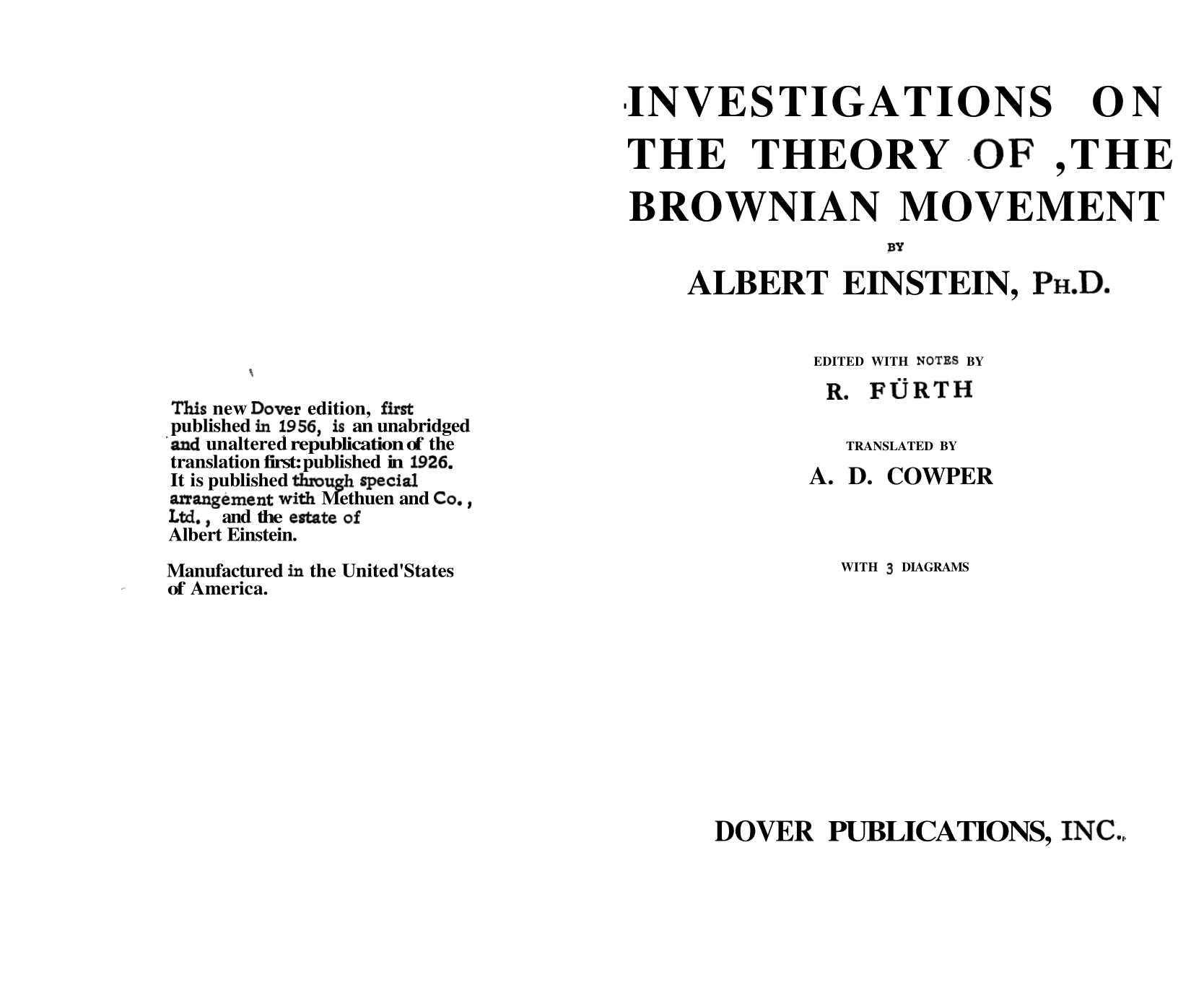
To be honest, looking at the modern financial markets recently, I have often felt a sense of stifling suffocation. We are bombarded with news of flash crashes, liquidity crises, and complex derivatives that seem to have lost their tether to reality. Sometimes, staring at the flickering screens of high-frequency trading algorithms, I wonder, "Is there any fundamental order left in this chaos?" It was in this moment of intellectual fatigue that I turned back to the classics. Not the financial classics, but the true foundation of stochastic calculus. I opened Albert Einstein's 1905 masterpiece, Investigations on the Theory of the Brownian Movement.
Reading this text again was not just a study session; it was a revelation. It completely overturned my perspective on randomness. Einstein did not just describe chaos; he quantified it. He proved that what looks like erratic, unpredictable dancing of particles is actually driven by a deterministic, thermodynamic necessity. For us in the quantitative world, this is the Genesis. This text holds the secrets to the Diffusion Coefficient, which we now casually call "volatility." Today, I want to take you on a deep dive into this paper. We will strip away the complex modern interpretations and look at the raw logic of Einstein, explaining why understanding his derivation is the only way to distinguish between real market movement and "fake volatility." Let me share this journey of intellectual redemption with you.
1. The Hidden Kick: Osmotic Pressure and the Scale of Reality
Let's start where Einstein started. It is 1905. The existence of atoms is still debated by some serious physicists.Einstein takes a bold, almost arrogant stance: if the molecular-kinetic theory of heat is correct, then microscopic particles suspended in a liquid must move.He notes that if these movements can be observed, classical thermodynamics—which treats fluids as continuous static media—cannot be applied with precision to these microscopic bodies.
The brilliance here is his refusal to differentiate between a "dissolved molecule" and a "suspended particle" based on anything other than size.He argues that a dissolved molecule is differentiated from a suspended body solely by its dimensions. This is a profound moment of "scaling." In the quant world, we often argue whether high-frequency tick data behaves differently from daily closing prices. Einstein tells us: it is all the same mechanics, just different scales.
Einstein posits that suspended particles, if prevented from leaving a volume V, exert an osmotic pressure p on the partition, exactly like molecules in solution.
He establishes the equation for osmotic pressure p. If there are n suspended particles in volume V, the pressure is given by:
p = (RT / V) × (n / N) = (RT / N) × v
Here, v is the number of particles per unit volume. This equation is the bridge. It links the macroscopic observable (Pressure, Temperature) to the microscopic reality (Avogadro's number N). Why does this matter to a trader? Because "Osmotic Pressure" in physics is "Order Flow" in finance. It is the statistical force exerted by the swarm of participants. Einstein proved that this pressure isn't magic; it comes from the heat (volatility) of the system.
The derivation involves a beautiful statistical mechanics argument involving Entropy and Free Energy.He defines the free energy F based on the probability of the particles' positions.He proves that the probability integral J is independent of the volume, leading to the conclusion that osmotic pressure forces are maximizing entropy. This tells us that "drift" in a market isn't just a trend; it's a thermodynamic necessity to restore equilibrium.
2. The Friction of Reality: Stokes' Law vs. Market Liquidity
Now, things get physically gritty. Einstein considers the dynamic equilibrium. We have two opposing forces. On one side, we have the osmotic pressure trying to spread the particles out (diffusion). On the other side, we have the friction of the liquid trying to stop them (viscosity).
He assumes a force K acts on the single particles.In equilibrium, the force K is balanced by the osmotic pressure forces.
Kν - (∂p / ∂x)= 0
This is the "Market Balance" equation. The external force (news, alpha) moves the price, but the internal pressure (limit orders, arbitrageurs) pushes back.
Here is where the "Diffusion Coefficient" D is born. Einstein uses Stokes' Law.If the particles are spheres of radius P, and the liquid has viscosity k, the force K gives the particle a velocity of K / (6πkP).
| Component | Physics Meaning | Quant Analogy |
|---|---|---|
| Viscosity (k) | Resistance to flow | Market Illiquidity / Bid-Ask Spread |
| Radius (P) | Size of the particle | Block size of the trade |
| Temperature (T) | Energy of the system | Overall Market Volatility |
By equating the flow caused by the force K and the flow caused by diffusion, Einstein derives the holy grail formula for the Diffusion Coefficient D:
D = (RT / N) × (1 / 6πkP)
This equation is profound. It says that diffusion (volatility) is driven by Heat (T) but reduced by Viscosity (k) and Size (P). In modern finance, we often forget the denominator. We look at volatility as an abstract number. But Einstein reminds us: Volatility is the struggle between information arrival (Heat) and market depth (Viscosity). If you ignore liquidity (k), your volatility estimate is "fake."
3. The Square Root Rule: Deriving the Heart of Stochastic Calculus
Now we arrive at the section that birthed the Black-Scholes model. Einstein moves from physical forces to pure probability.He introduces a time-interval τ, which is very small compared to observation time but large enough for movements to be independent. This "independence" assumption is the Markov property we cherish in finance.
He defines a probability law φ(Δ) for the displacement Δ of a particle. Crucially, he assumes φ(Δ) = φ(-Δ), meaning the movement is symmetric. He then expands the function f(x, t+τ) using the Taylor series. This is where the magic happens.
The expansion leads to the heat equation (diffusion equation):
∂f / ∂t = D × (∂2f / ∂x2)
Recognize this? This is the core of the Black-Scholes PDE (without the drift term). The solution to this differential equation is the Gaussian (Normal) distribution.
Einstein proves that the mean displacement λx is not proportional to time, but to the square root of time.
λx = √(2Dt)
The mean displacement is therefore proportional to the square root of the time. This is the "Square Root of Time Rule" we use to scale daily volatility to annual volatility. But read Einstein carefully.This result depends strictly on the independence of movements and the specific time interval τ. In real markets, correlations exist (movements are not independent), and "viscosity" changes. When we blindly apply √t, we are assuming a perfect Einsteinian liquid that doesn't exist. This is the source of "Fake Volatility."
4. From Pollen to Portfolio: The Reality Check
In the final section, Einstein connects everything to find the real size of the atom. He combines his derived Diffusion Coefficient D with the mean displacement formula. By eliminating D, he finds a way to calculate Avogadro's number N:
N = (1 / λx2) × (RT / 3πkP) × t
He calculated that for a particle of 0.001 mm diameter in water at 17°C, the mean displacement in one minute would be about 6 microns. This was a verifiable prediction. It moved physics from "atoms might exist" to "here is exactly how they push things."
For us, the lesson is humility. Einstein didn't just curve fit. He derived the motion from first principles of thermodynamics and fluid mechanics. In quantitative finance, we often curve fit "implied volatility" without understanding the underlying mechanics of "viscosity" (liquidity) or "temperature" (market activity).
The "Fake Volatility" Trap: When prices jump because of a lack of liquidity (high k in Einstein's model), the observed λx increases. Models assume this is high D (high intrinsic volatility). But looking at equation (7), high viscosity k should lower D. There is a divergence between the physical reality and the statistical observation. Einstein teaches us to look at the cause of the movement (Heat vs. Viscosity), not just the displacement.
5. Einstein's Diffusion Lab: Simulate the Motion
Let's apply Einstein's formula directly. Use this calculator to see how Temperature (Market Heat) and Viscosity (Liquidity) affect the "Volatility" (Diffusion) of a particle.
Brownian Motion Calculator
6. Summary: The Humanistic Quant's Takeaway
Revisiting Einstein's 1905 paper reminds us that even the most random chaos has a structure. He didn't just accept "jittery motion" as a fact; he asked "why?" and "how much?"
- Micro is Macro: Suspended particles behave exactly like invisible molecules, proving that statistical laws scale up.
- Volatility has Physics: The Diffusion Coefficient D isn't just a number; it's a balance of Temperature (Energy) and Viscosity (Friction).
- The Square Root Rule: The rule λ = √t assumes independent, unhindered events.Using it in sticky markets creates "Fake Volatility.
If you feel overwhelmed by market noise, remember this: Noise is information. It's the "Thermal Motion" of the market. Our job isn't to fear it, but to measure it with the humble precision of Einstein.
FAQ: Brownian Motion & Finance ❓
Human progress is built on understanding the small things. If you have any questions about applying this to your models, leave a comment below!
Einstein & Volatility Summary