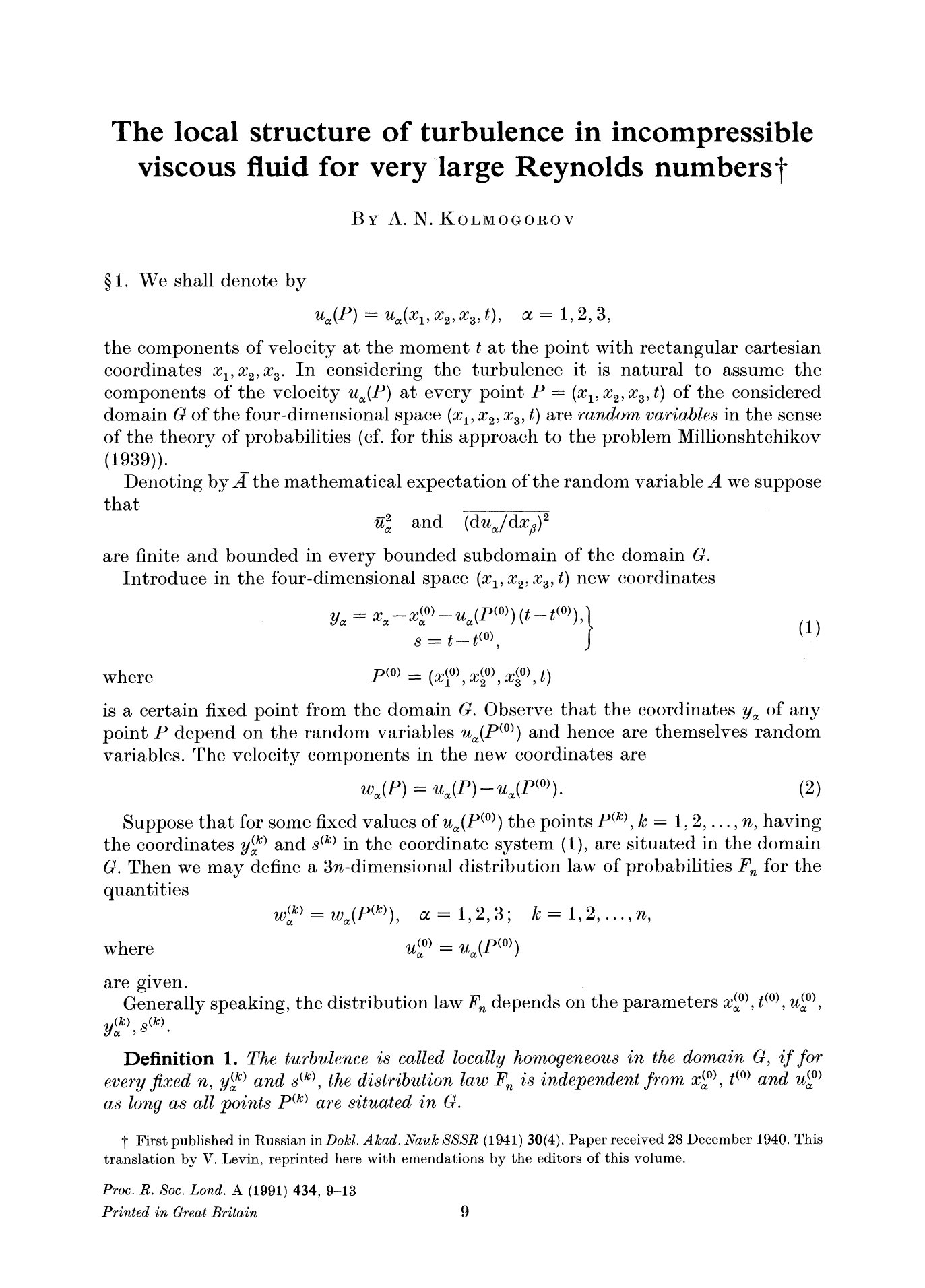
이 글은 안드레이 콜모고로프의 1941년 기념비적 논문을 바탕으로, 유체 역학의 난류 이론을 현대 금융 시장의 자금 흐름에 대입하여 분석합니다. 단순한 비유를 넘어, 복잡계 속에서 최적의 알파(Alpha)를 찾아내는 과정을 다룹니다.
Imagine standing on a bridge, watching a swollen river crash against a piling. The water doesn't just flow; it writhes. Huge swirls of water break apart into smaller swirls, which fracture into even smaller ones, until they vanish into foam and stillness. This isn't just chaos; it is a structured hierarchy of energy transfer. This is the exact mechanism of global capital.
1. Introduction & Notation: The Velocity of Money
Kolmogorov begins his treatise by establishing the components of velocity, uα(P) = uα(x1, x2, x3, t), at a specific point in space and time. In the realm of fluid mechanics, this defines how fast a particle moves and in what direction. When we pivot this lens to the financial markets, uα transforms from the velocity of a water molecule to the velocity of price (volatility) and the volume of transaction flow. The market is not a static ledger; it is a four-dimensional space of price, volume, time, and sentiment.
The "domain G" that Kolmogorov refers to is the market itself—a bounded subdomain of the global economy. Within this domain, price movements are random variables. Just as millions of water molecules collide to create a flow, millions of buy and sell orders collide to create a trend. The beauty here lies in the scale. At the macro level (very large Reynolds numbers), the flow seems dominated by the "mean flow" or the primary trend set by central banks and massive institutional liquidity. This is the injection of energy.
However, as we zoom in, the Dynamic Optimization of individual traders begins to disrupt this mean flow. The HJB (Hamilton-Jacobi-Bellman) equation in control theory often seeks a trajectory of minimal cost. In our turbulent market, smart money utilizes Dynamic Optimization to navigate these velocity vectors. They do not fight the current; they seek the "path of least resistance" or the "minimum cost path" through the order book. They are the fluid particles that move with intention amidst the randomness.
Kolmogorov introduces coordinates based on a reference point moving with the flow. In finance, this is equivalent to analyzing "relative strength" or "alpha" rather than absolute return. We are not concerned with the river's speed relative to the bank, but the speed of one eddy relative to another. This shift in notation is crucial. It tells us that to understand the local structure of market turbulence—the flash crashes, the sudden pumps—we must abandon the absolute coordinate system of "market cap" and adopt the relative coordinate system of "momentum" and "order flow disparity."
We often treat markets as cold numbers, but velocity uα is actually a vector of human emotion. The speed at which a price collapses is the speed of fear propagating through a crowd. The Reynolds number of a market is essentially a metric of human panic versus institutional control.
The definitions laid out in section 1 of the paper are not merely administrative; they are the foundation of a worldview. They assert that while the whole (the macro economy) is complex, the local difference—wα(P) = uα(P) - uα(P(0))—holds the secret to statistical predictability. In trading, this is the spread, the arbitrage, the tick-by-tick variance. This is where the Alpha (α) hides, not in the broad ocean, but in the difference between two adjacent drops of water.
2. Statistical Assumptions: The Myth of Local Homogeneity
The paper proceeds to Definition 1 and Definition 2: Local Homogeneity and Local Isotropy. Kolmogorov postulates that for very large Reynolds numbers, the small-scale structures of turbulence are statistically independent of the large-scale flow geometry. Translation: If you stir a cup of coffee vigorously enough, the tiny swirls in the center don't care if you stirred with a spoon or a fork, or if the cup is square or round. They forget their origin.
Applying this to the "Money Flow," we encounter a profound concept. The "Large Eddies" are the actions of the Federal Reserve, the ECB, or massive sovereign wealth funds. They inject energy (capital) into the system. This energy is anisotropic—it has a specific direction (e.g., "Buy Bonds"). However, as this capital cascades down through the system—through prime brokers, to hedge funds, to day traders, and finally to algorithms—it loses its memory.
In the "inertial subrange" of the market (the mid-frequency trading zone), the flow becomes Distributed Consensus (DAO). The market participants, like the small eddies, agree on a price not because of the Fed's original mandate, but because of the local interactions of supply and demand. The Distributed Consensus mechanism acts as the isotropizing force. It scrambles the original directional intent into a chaotic, yet statistically universal, equilibrium.
But here is where the compassion for the retail trader must arise. The assumption of isotropy implies that "up" and "down" are statistically symmetrical at small scales. Any trader who has looked at a liquidation chart knows this is false in the short term. Panic (downside) often has a different viscosity than Greed (upside). Yet, Kolmogorov insists that for very large Reynolds numbers (high liquidity, high volatility), these differences smooth out.
This section of the paper challenges the "Market Maker" theory. If local isotropy holds true, then at the micro-scale of tick trades, no single entity controls the direction. The market becomes a true DAO—a decentralized, chaotic agreement. The "Governance Structure" of this DAO is physics itself. The energy must go somewhere. It cannot be created or destroyed at this level; it can only be passed down to smaller scales.
Pure Dynamic Optimization (HJB) assumes a deterministic path to the optimal solution. But the market, like turbulence, has a "Stochastic" element—the random forcing. Never rely solely on the calculated path. The randomness is not a bug; it's a feature of the energy transfer.
The "random variables" uα(P) are locally homogeneous. This means the statistical laws governing price changes in Apple stock on a millisecond basis are likely the same as those for Bitcoin, provided the "Reynolds Number" (liquidity/volatility ratio) is sufficiently high. This universality is the Holy Grail for quants. It suggests a single algorithm could theoretically trade any sufficiently turbulent asset class.
3. Dimensional Analysis: The Cascade of Capital
Now we reach the heart of the theory: The Hypothesis of Similarity. Kolmogorov argues that the statistics of the small-scale motions are determined uniquely by two parameters: the kinematic viscosity (ν) and the rate of energy dissipation per unit mass (ε).
In our financial model:
ε (Epsilon) is the rate of capital flow/turnover. It is the amount of money changing hands and eventually leaving the active speculative market.
ν (Nu/Viscosity) is the friction. Transaction fees, slippage, taxes, and the spread.
The theory posits an "Energy Cascade." Energy enters at the largest scales (L). It is transferred without loss through the "inertial subrange" (scales r where L >> r >> η). Finally, it reaches the dissipation scale (η) where viscosity takes over and energy is dissipated as heat.
Think of a massive stimulus package (Large Scale Energy Injection). This money doesn't vanish instantly. It moves to banks (slightly smaller eddies), then to corporations (medium eddies), then to employees and suppliers (small eddies). In the "Inertial Range"—the middle class of the economy or the mid-cap sector of the stock market—viscosity is negligible. Money flows freely. This is the Distributed Consensus working perfectly. The network effect supports the transfer of value with high efficiency.
However, the flow must eventually hit the Threshold (DMZ). The Threshold is the scale at which friction matters. In turbulence, this is where kinetic energy turns into heat. In finance, this is where speculative capital turns into "realized losses" or "paid fees." It is the entropy filter. The Kolmogorov microscale η = (ν3 / ε)1/4 defines the size of the smallest trade that makes economic sense. Below this size, the cost of the trade (viscosity) exceeds the potential profit (energy).
The dimensional analysis leads to the famous "2/3 law" for structure functions. It implies that price volatility scales with time (or volume) in a very specific power law. If you understand this scaling, you understand the "fractal" nature of markets. A 1-minute chart looks like a 1-month chart because the mechanism of energy transfer (greed/fear cascade) is identical, differing only by a scaling factor of ε.
| Turbulence Concept | Financial Analog | Strategic Implication |
|---|---|---|
| Large Eddies (L) | Central Banks / Inst. Capital | Follow the trend (Mean Flow). |
| Inertial Range | Speculative Market / DAO | Trade volatility (Alpha zone). |
| Dissipation Range (η) | Fees / Slippage / Realized PnL | Avoid over-trading (Viscosity trap). |
4. Derivation of Structure Functions: The S3(r) Law
Kolmogorov derives the relationship for the second and third moments of velocity differences. The most famous result, though not fully explicit in the K41 paper in its spectral form, leads to the deduction that the third-order structure function S3(r) is proportional to -εr.
Let's translate the S3(r) law into money terms. The third moment represents "skewness." In a perfectly Gaussian random walk, skewness is zero. But turbulence is not Gaussian; it has fat tails. The fact that S3(r) is non-zero and negative relates to the transfer of energy from large scales to small scales.
In finance, this confirms that the "Trickle-Down" of volatility is a fundamental physical property. Volatility begets volatility. When a "Large Eddy" (a whale) sells, it creates a displacement. This displacement forces smaller traders to react, creating a cascade of selling pressure. The energy (panic) moves down the scale until it hits the Threshold (DMZ)—the point where value investors step in or the asset hits zero.
The Threshold (DMZ) acts as the entropy barrier. In the K41 model, below a certain scale, the flow is smooth (laminar). In markets, this is the "bid-ask bounce" of a stable asset. But when the energy cascade is too strong (high ε), it smashes through the Threshold. The Dynamic Optimization (HJB) strategies of market makers fail because the "Control Variables" (their inventory limits) are overwhelmed.
This derivation teaches us a humbling lesson about the market's nature. It is inherently skew-generating. You cannot model risk assuming a normal distribution because the energy transfer mechanism itself creates asymmetry. The flow of money is directional (from the impatient to the patient, from the leveraged to the liquid) just as the flow of energy is directional (from large to small).
We must view this through the lens of wonder. It is astounding that a chaotic crash in the S&P 500 follows the same mathematical scaling laws as the smoke rising from a cigarette or the water rushing under a bridge. We are part of a universal physical process. Our financial losses are merely "energy dissipation" in the grand thermodynamic equation of the economy.
5. The Energy Spectrum & Dynamic Optimization
The final destination of Kolmogorov's logic is the energy spectrum E(k) ∼ C ε2/3 k-5/3. This is the "Inertial Range Scaling." In the frequency domain (k), energy drops off as frequency increases.
For the trader, "k" is the frequency of trading. "E(k)" is the potential profit opportunity. The law suggests that as you trade faster (higher k), the available energy (profit) decreases according to a power law, while the noise increases. High-frequency trading firms fight for scraps at the high-k end of the spectrum, utilizing massive infrastructure to overcome the viscosity.
This is where Dynamic Optimization (HJB) becomes critical. If you are a human trader, you cannot compete at k-5/3. You must operate at a lower 'k'—the swing trade, the trend follow. You must optimize your "Control Variables" (entry timing, position size) to align with the energy-rich portion of the spectrum.
The objective function J is to maximize return over the path.
Maximize J = ∫ (Returns - Viscosity) dt
Subject to the constraint of the Threshold (DMZ) risk limits.
The K41 theory tells us that "Returns" are a function of the cascade rate ε. If the market is stagnant (low ε), no amount of Dynamic Optimization will generate Alpha. You need turbulence. You need the flow.
Ultimately, Kolmogorov's paper is a map. It tells us that chaos is structured. It tells us that money flows like water, cascading from the heavy hands of the few to the scattered hands of the many, dissipating eventually into the heat of transaction costs. To win, one must stand in the inertial range—agile enough to catch the eddy, but large enough not to be dissipated by the viscosity.
Market Turbulence Calculator
Estimate your portfolio's "Reynolds Number" to see if you are in a laminar (safe) or turbulent (risky) state.
Summary of the Energy Flow
The objective function J is complete. We have analyzed the flow.
- Energy Injection: Large Eddies (Institutions) create the trend.
- Inertial Cascade: Energy transfers through the DAO of market participants via the 2/3 law.
- Dissipation: At the Threshold (DMZ), viscosity (fees) destroys capital value.
- Goal: Optimize J to capture Alpha within the inertial range before dissipation occurs.
Frequently Asked Questions ❓
The river never stops flowing. Understanding its physics doesn't stop you from getting wet, but it might just keep you from drowning. If you have more questions about navigating the turbulence, leave a comment below!