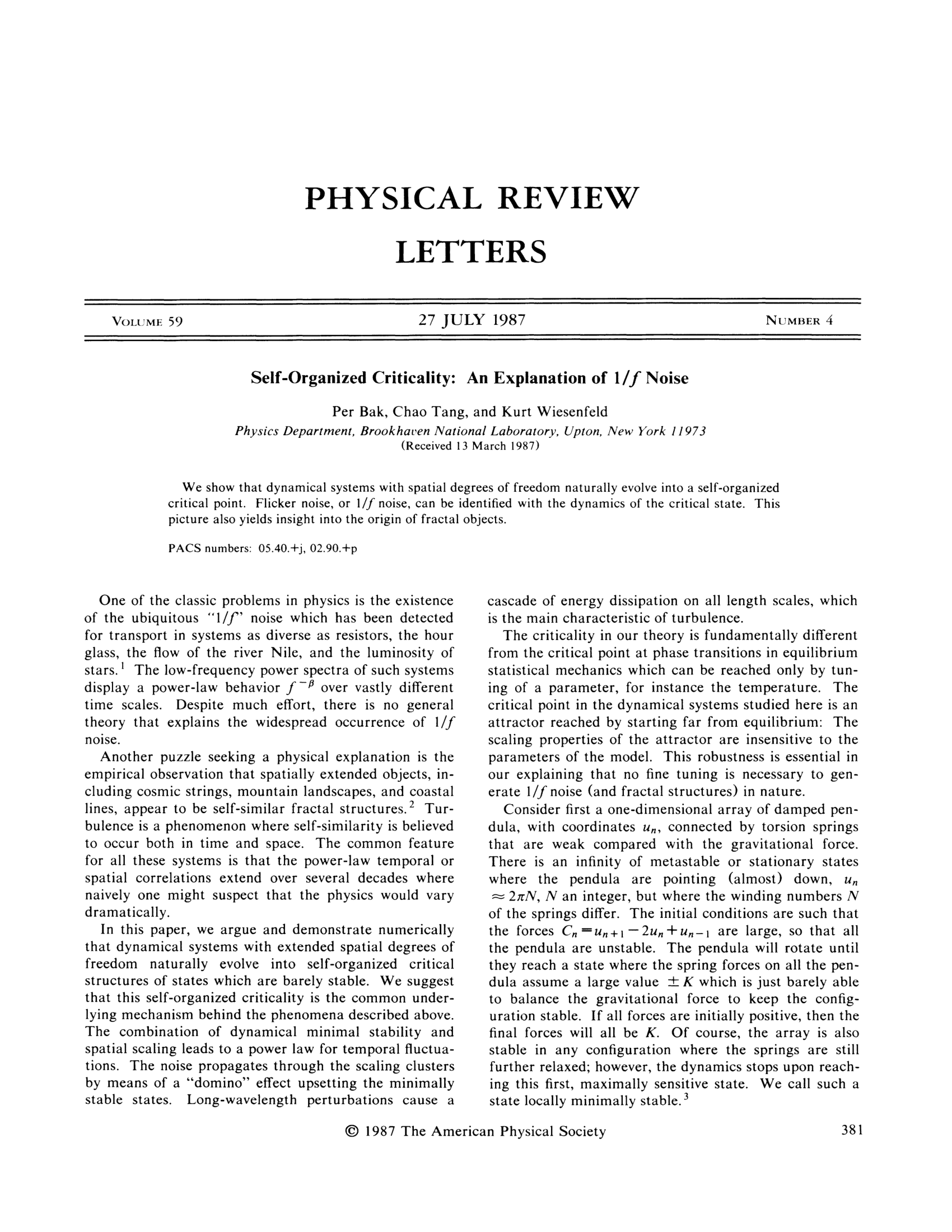
Why do markets crash and sandpiles collapse? We dive deep into the seminal 1987 paper by Bak, Tang, and Wiesenfeld to uncover the secret of "Self-Organized Criticality." This is the physics of how stability creates instability.
We live in a world that craves stability. We build systems, portfolios, and lives hoping they will remain standing forever. But have you ever felt that the safer a system looks, the more dangerous it actually becomes?
Imagine a child building a sandpile on the beach. Grain by grain, the pile grows. It looks stable. It looks majestic. But then, we drop just one more tiny grain—a grain no different from the millions before it—and suddenly, the whole side of the mountain collapses. Why? Why did that specific grain cause a catastrophe when the others did nothing?
This isn't just about sand. It’s about the stock market crash that wipes out fortunes, the sudden traffic jam that ruins our morning, or the noise in the electrical resistors we use every day. Today, we are going to explore the concept of Self-Organized Criticality (SOC) through the lens of the groundbreaking 1987 paper by Per Bak, Chao Tang, and Kurt Wiesenfeld.
We often think of ourselves as observers of these disasters, but in truth, we are part of the system. We are the grains of sand. Let's warm up our cold intellects and look at this "physics of disaster" with a sense of wonder and macro-humility. I’ll be your sommelier of noise today, serving up a slice of deep insight. Let’s dig in!
1. The Mystery of the Hum: 1/f Noise
Before we talk about crashes, we must talk about the "hum" of the universe. In the world of physics and signal processing, noise isn't just an annoyance; it's a fingerprint of the system's internal dynamics.
We are familiar with "white noise"—the random static of a radio with no signal. It's completely unpredictable, with no correlation between one moment and the next. Then there's "random walk" noise (like Brown noise), which is highly dependent on the past but has no long-term structure. But nature presents us with something stranger: 1/f noise (also known as flicker noise).
1/f noise is everywhere. We see it in the voltage fluctuations of resistors, the varying flow of the Nile River over decades, and even in the luminosity of stars. It suggests a deep, hidden connection across time scales.
In their 1987 paper, Bak, Tang, and Wiesenfeld faced a problem. Despite how common this noise was, there was no general theory to explain it. Previous attempts required "fine-tuning"—scientists had to artificially adjust parameters (like temperature or density) to make their equations work. But nature doesn't have a knob-turner. The Nile River doesn't have an engineer adjusting its flow to create a perfect mathematical spectrum.
This led to their radical hypothesis: What if the system tunes itself? What if large, complex systems naturally evolve toward a critical state where instability is the norm, not the exception? They proposed that dynamical systems with many degrees of freedom act like a self-organizing entity, pushing themselves to the brink of instability. They called this state Self-Organized Criticality (SOC).
For us, this is a profound shift in perspective. We usually assume that equilibrium (stability) is the natural state of things. But this theory suggests that the "natural state" is actually a state of perpetual fragility. The 1/f noise we hear is the sound of the system constantly adjusting, slipping, and rearranging itself at this critical threshold. It is the heartbeat of complexity.
2. Building the Sandpile: The Model
To prove their point, the authors didn't use complex quantum mechanics; they used a metaphor we can all understand: a pile of sand (or mathematically, a system of coupled pendulums).
Imagine a grid, like a chessboard. On each square (x, y), we place a number representing the "slope" or "height" of the sand at that point, denoted as Z(x,y). This Z represents potential energy or stress in the system.
The rules are deceptively simple. We add sand (energy) to a random spot. If the slope Z at that spot exceeds a critical value K (let's say K=4), the sand creates a landslide.
Mathematically, when Z(x,y) > K, the site "topples." It loses 4 units of slope, and distributes 1 unit to each of its four neighbors:
- Z(x,y) → Z(x,y) - 4
- Z(x±1, y) → Z(x±1, y) + 1
- Z(x, y±1) → Z(x, y±1) + 1
This looks trivial, right? But here is the magic. When one site topples, it increases the stress on its neighbors. If a neighbor was already close to the critical value K, it too will topple. This creates a chain reaction—a "domino effect."
The authors simulated this on a computer. They started with a random configuration. At first, there were huge landslides as the system tried to find balance. But eventually, the system settled into a "minimally stable state."
In this state, the average slope of the sandpile is just barely enough to be stable. It is sitting exactly on the edge. The system has "self-organized" to the critical point. No one tuned the temperature. No one set the slope. The dynamics of the sand colliding with itself brought it there.
We can see ourselves in this grid. We are connected to each other—financially, socially, emotionally. When stress accumulates on us, we pass it to our neighbors. Usually, they can absorb it. But if the whole society is in a "critical state," one person's breakdown can trigger a systemic collapse. We don't need a massive external shock to destroy the system; the system builds its own fragility.
3. The Anatomy of an Avalanche
So, we have our sandpile in a critical state. We drop one single grain of sand. What happens?
Sometimes, nothing happens. The grain finds a pocket and stays there. Sometimes, it causes a small slide, moving just a few other grains. And sometimes—rarely, but inevitably—that single grain triggers a massive avalanche that reshapes the entire pile.
Bak, Tang, and Wiesenfeld measured the distribution of these "cluster sizes" (the size of the avalanche, s). What they found was a Power Law distribution.
This simple formula carries a terrifying implication for risk management (and explains why "Fat Tail" risk exists). In a normal (Gaussian) world, like the distribution of human heights, extreme events are virtually impossible. You will never meet a man who is 100 feet tall.
But in a Power Law world—the world of SOC—extreme events are far more common than a bell curve would predict. The probability of a massive crash decreases as the size increases, but it decreases slowly.
If financial markets are in a state of self-organized criticality (which many quants believe they are), then "Black Mondays" are not anomalies. They are built into the system. The same mechanism that allows the market to grow efficiently (local trading, liquidity) also enables the massive crashes.
The authors found that this power-law behavior was robust. It didn't matter much if they changed the grid size or minor details of the rules. The phenomenon of scale invariance emerged naturally. This means the physics driving a small tumble of sand is exactly the same as the physics driving a catastrophic collapse. There is no "special" physics for big disasters. There is only the domino effect playing out on different scales.
This teaches us macro-humility. We cannot predict which grain will cause the crash. We can only know that the pile is in a state where a crash is possible.
4. Connecting Space to Time
The final piece of the puzzle is linking these spatial avalanches back to the 1/f noise we started with. The authors took the "activity" of their sandpile—how many grains are moving at any given time step—and plotted it over time.
When they performed a Fourier transform on this time signal to look at its power spectrum S(f), they found the holy grail:
This confirmed that the 1/f noise is the temporal signature of the spatial fractal structure of the avalanches. The "flicker noise" we see in resistors or stars is essentially a superposition of avalanches of all sizes happening within the system.
Think about what this means for our lives. The "noise" of our daily existence—the ups and downs of our mood, our productivity, our luck—might just be the result of us living in a self-organized critical state. We are complex systems interacting with a complex world.
The paper concludes with a powerful idea: SOC might be the underlying concept for temporal and spatial scaling in a wide class of dissipative systems. It provides a unified framework to understand why nature creates fractals (spatial complexity) and 1/f noise (temporal complexity).
We are not looking at random errors. We are looking at the beautiful, terrifying structure of reality. The noise is the signal.
5. Experience It: The Avalanche Risk Calculator
We can't simulate a full lattice here, but we can simulate the concept of "Power Law Risk." This calculator helps you visualize how the probability of an event drops as the event size increases in a Fat Tail world compared to a Normal world.
Power Law vs. Normal Risk Estimator
Executive Summary
Point 1: [Self-Organization] Complex systems evolve naturally toward a critical state without external tuning.
Point 2: [Power Laws] In this state, "avalanches" (crashes) follow a power law distribution, making extreme events far more common than expected.
Point 3: [1/f Noise] The ubiquitous 1/f noise in nature is the temporal signature of the spatial self-organized criticality.
FAQ: Questions from the Sandpile
We are all dancing on the edge of the sandpile. The key is not to fear the slide, but to know it's coming.
If you have any thoughts on how this applies to your portfolio or life, leave a comment below!
The Pizza of Complexity