요약 및 제언
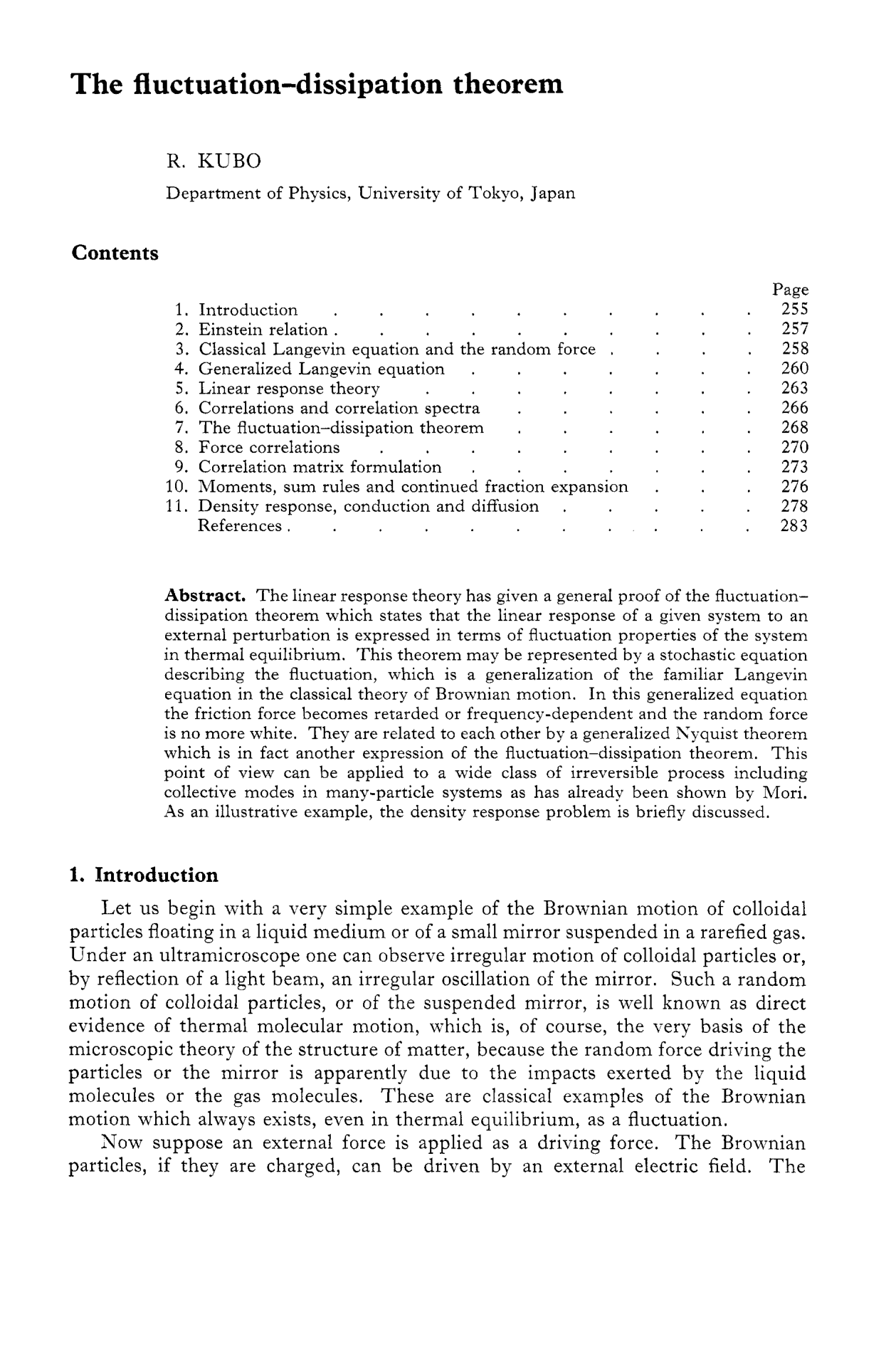
본 글은 Ryogo Kubo의 1966년 논문 "The fluctuation-dissipation theorem"을 기반으로, 기억 커널(Memory Kernel)을 포함한 일반화된 랑주뱅 방정식(GLE)의 물리적 의미와 그 응용을 심층 분석했습니다. 고전적인 백색 잡음(White Noise) 가정의 한계를 지적하고, 시스템의 과거 이력이 현재의 저항(마찰)에 미치는 영향을 수학적으로 규명했습니다. 특히 요동-산일 정리(FDT)가 미시적 요동과 거시적 산일 과정을 어떻게 연결하는지, 그리고 이것이 비마르코프(Non-Markovian) 시스템 해석에 어떤 통찰을 제공하는지를 재해석했습니다.
0. Preface: The Burden of History in Complex Systems
We often perceive the world as a series of disconnected snapshots, assuming that what happens next is solely a function of where we are right now. This is the comfort of the Markov property—the idea that the present state contains all necessary information to predict the future. However, anyone who has observed the chaotic dance of pollen in water or the erratic yet clustered volatility of asset prices knows that this is a convenient lie. Systems have memory. The path taken to arrive at the current state matters just as much as the state itself.
In the realm of statistical physics, few works capture this tension between the instantaneous push of randomness and the dragging weight of history better than Ryogo Kubo’s seminal 1966 paper, "The fluctuation-dissipation theorem." While the title suggests a focus solely on the theorem itself, the text serves as a masterclass in modeling dynamics where the clean separation of time scales breaks down. For those of us navigating the Distributed Consensus of market microstructures or the Dynamic Optimization problems of control theory, Kubo’s formulation of the Generalized Langevin Equation (GLE) offers a theoretical bedrock. It teaches us that "noise" is not merely a nuisance to be filtered out through a Buffer Zone; it is the very essence of the system's internal mechanism, intimately tied to how the system dissipates energy.
Today, we will dissect this masterpiece not merely as a historical artifact of physics but as a living framework for understanding non-equilibrium complex systems. We will explore how the memory kernel—the mathematical manifestation of a system's trauma and history—rewrites the rules of randomness.
1. Introduction: The Irreversible Arrow from Reversible Laws
Kubo opens his treatise with a philosophical conundrum that has plagued physicists since Boltzmann: How do we reconcile the time-reversible laws of microscopic mechanics with the irreversible reality of macroscopic thermodynamics? When we observe a drop of ink dispersing in water, it never spontaneously gathers back into a drop. Yet, if we were to reverse the velocity of every molecule, Newton’s laws say it should.
Kubo frames this through the lens of fluctuation. In a system at equilibrium, macroscopic variables like pressure or voltage are constant on average, but they fluctuate microscopically. These fluctuations are not errors; they are the heartbeat of the system. The paper posits that the very mechanism that causes these spontaneous fluctuations is identical to the mechanism that dissipates energy when the system is disturbed. This is the essence of the Fluctuation-Dissipation Theorem (FDT).
From a Dynamic Optimization perspective, nature is solving a control problem. It minimizes the cost of disturbance by spreading energy through the same channels it uses to generate thermal noise. Understanding this duality is the first step in moving beyond static models. We are looking at a system where the Protocol of interaction guarantees that every kick you give the system is dissipated by the same crowd of particles that buffets you when you are standing still. This insight is crucial because it suggests that by observing the "noise" (fluctuations) of a system in equilibrium, we can predict how it will react to a "signal" (external force) without actually applying that force. It is a non-invasive way to probe the hidden Governance Structure of the material.
If we understand the "dissipation" (how a price shock decays), we mathematically know the "fluctuation" (the volatility structure). They are two sides of the same coin.
2. Einstein Relation: The Primordial Link
Before diving into the complexities of memory, Kubo grounds us in the classic Einstein relation. This is the foundational logic that connects diffusion (a fluctuation phenomenon) with mobility (a dissipation phenomenon).
Consider a particle undergoing Brownian motion. Einstein realized that the diffusion coefficient, D, which characterizes how far the particle spreads out over time due to random thermal kicks, is directly proportional to the mobility, μ, which characterizes how easily the particle moves under a steady external force. The bridge between them is temperature, T. The relation D = μ ksubT is elegant in its simplicity but profound in its implication.
Kubo uses this to illustrate the Distributed Consensus of the medium. The fluid molecules do not know if they are kicking the particle because of random thermal motion or because the particle is being dragged through them. They simply interact. If the particle is easy to drag (high mobility), it implies the fluid offers little resistance. Consequently, the random thermal kicks will also send the particle flying further (high diffusion).
In our modern context, think of this as a Threshold concept. The magnitude of the background noise defines the Buffer Zone of the system. If the noise is high, the system is "loose," and it responds distinctively to external pressures. This establishes the baseline for the more complex Linear Response Theory that follows later. Einstein’s insight was limited to Markovian (memoryless) processes, but it set the stage for Kubo to ask: "What happens when the fluid is thick, viscoelastic, or when the particle moves so fast that the fluid cannot get out of the way in time?" This is where the simple scalar drag coefficient must evolve into something more sophisticated.
3. Classical Langevin Equation and the Random Force
The classical Langevin equation is the starting point for stochastic modeling. It decomposes the force acting on a particle into two distinct parts: a systematic frictional force and a rapidly fluctuating random force. Here, Kubo introduces the classical Langevin equation:
Here, ζ is the friction constant, and R(t) is the random force. The standard assumption, and the one Kubo critiques for its limitations, is that R(t) is "white noise." This means the random force at time t has absolutely no correlation with the random force at any other time t'. It is a purely impulsive, forgetful kick.
This assumption implies a clear Time Scale Separation or a Buffer Zone between the macroscopic particle and the microscopic bath. It assumes the bath relaxes infinitely fast compared to the particle. In this idealized world, the friction ζ is just a number. It is constant. The system has no memory of its past velocity; it only knows its current state.
However, Kubo points out that this is an approximation. In reality, no physical interaction is instantaneous. When a heavy particle pushes a fluid molecule, that molecule pushes back, but it also pushes its neighbors, creating a ripple. That ripple might bounce back and hit the particle later. The classical Langevin equation ignores this feedback loop. It assumes a Path Independence that simplifies the math but strips the physics of its richness. For systems involving high-frequency dynamics or viscoelastic materials (or indeed, high-frequency market microstructure), the white noise assumption fails. We need a model that accounts for the time it takes for the Network Effects of the bath to propagate and return.
4. Generalized Langevin Equation (GLE): Introducing the Memory Kernel
This section is the intellectual core of the paper and the specific focus of our inquiry. Kubo introduces the Generalized Langevin Equation to correct the deficiencies of the classical model. He argues that the friction force cannot simply be proportional to the current velocity. Instead, the friction at time t depends on the history of the velocity at all previous times t'.
The equation transforms: m(dv/dt) = - ∫ γ(t - t') v(t') dt' + R(t)
Here, the constant friction ζ is replaced by the memory kernel, γ(t - t'). This integral term represents the "retarded" effect of the medium. It says: "The resistance I feel right now is a weighted sum of my past movements." If I moved fast 5 seconds ago, the fluid is still churning from that motion, and that turbulence affects me now.
This is a profound shift in Dynamic Optimization. The system is no longer Markovian; it is non-Markovian. The Path Dependence is explicit. The memory kernel γ(τ) dictates how long the system "remembers" a disturbance.
- If γ(τ) is a delta function: We recover the classical Langevin equation (instantaneous memory).
- If γ(τ) decays slowly: The system has long-term memory. This is typical in polymeric fluids, supercooled liquids, and complex financial markets where volatility clusters.
The random force R(t) also changes character. It is no longer white noise. It becomes "colored noise," meaning its value at time t is correlated with its value at time t'. Kubo shows that there is an intrinsic link between this memory kernel and the correlation function of the random force. This internal consistency is what makes the GLE a rigorous physical law rather than just a phenomenological curve-fitting exercise. The Protocol of the bath dictates that if you have memory in friction, you must have correlation in noise. You cannot have one without the other. This is the essence of the Second Fluctuation-Dissipation Theorem, which defines the memory kernel γ(t) essentially as the autocorrelation function of the random force R(t).
5. Linear Response Theory: The Theoretical Framework
Having established the equation of motion, Kubo zooms out to build the general theoretical framework: Linear Response Theory (LRT). This is the machinery that allows us to calculate how a system responds to a weak external perturbation.
The central idea is that if the external force is small (the perturbation is within the Safety Margin), the response of the system is linear. We can describe the change in any physical quantity as a convolution of the external force and a "response function" (or after-effect function), ϕ(t). B(t) = ∫ ϕ(t - t') F(t') dt'
Kubo derives this rigorously using the Liouville equation and quantum mechanical perturbation theory. He shows that the response function is not arbitrary. It is determined entirely by the properties of the system in equilibrium. Specifically, the response function is related to the correlation function of the fluctuations in the absence of the force.
This is a powerful Minimum Cost Path logic. Instead of simulating the system under every possible external force, we only need to watch the system fluctuate in equilibrium. The Distributed Consensus of the equilibrium state contains all the information needed to predict the non-equilibrium response. This implies that the "noise" we see in a quiet system is actually the system exploring its phase space, rehearsing its reaction to future disturbances. The LRT formalizes the Input-Output relation of the system, treating the material as a black box defined by its correlation functions.
6. Correlations and Correlation Spectra
To make these concepts usable, Kubo transitions from the time domain to the frequency domain using Fourier transforms. He introduces the concept of the spectral density or power spectrum. The Wiener-Khintchine theorem plays a starring role here, linking the time correlation function C(t) to the power spectrum S(ω).
S(ω) = ∫ C(t) e-iωt dt
This spectral view is critical for identifying the characteristic timescales of the system. A broad spectrum implies a fast-decaying correlation (short memory), while a narrow, peaked spectrum implies a slow-decaying correlation (long memory/oscillatory behavior).
In the context of the GLE, the memory kernel γ(t) has its own spectral representation. The real part of this spectrum corresponds to frequency-dependent dissipation (resistance), while the imaginary part corresponds to frequency-dependent dispersion (reactance/elasticity). This separation allows us to see how the system handles energy at different frequencies. Does it absorb energy (dissipation) or store and return it (elasticity)? For a complex system, the "noise" is not just a uniform static; it has a structure, a color, a rhythm. Analyzing this spectrum allows the Scholar to decode the internal Governance Structure of the medium. It tells us which frequencies pass through the DMZ and which are absorbed.
7. The Fluctuation-Dissipation Theorem: The Grand Unification
Here, Kubo presents the crown jewel: The Fluctuation-Dissipation Theorem (FDT) in its general form. The theorem states: Im[χ(ω)] = (ω / 2ksubT) S(ω) (Classical Limit)
Here, χ(ω) is the complex susceptibility (the response function in frequency domain), and S(ω) is the fluctuation spectrum. Simply put: The dissipative part of the response (Imaginary susceptibility) is directly proportional to the fluctuation power spectrum.
This confirms the intuition built in the Introduction. The capacity of a system to absorb energy (dissipate) is mathematically identical to its capacity to fluctuate spontaneously.
- High fluctuation at frequency ω → High absorption of energy at frequency ω.
- Low fluctuation → Low absorption.
This theorem is the Protocol that binds the micro and macro worlds. It implies that there is no free lunch (no dissipation without noise) and no silence without perfect rigidity. For a Quant Leader analyzing markets, this suggests that periods of high volatility (fluctuation) are intrinsically linked to the market's capacity to absorb large orders (liquidity/dissipation). You cannot separate the two. The "risk" is the "capacity."
8. Force Correlations: The Second FDT
Kubo circles back to the Generalized Langevin Equation to formalize the relationship between the random force R(t) and the memory kernel γ(t). This is often called the Second Fluctuation-Dissipation Theorem.
γ(t) = (1 / mksubT) <R(0)R(t)>
This equation is the smoking gun of the memory effect. It says that the friction coefficient at time t is exactly the autocorrelation function of the random force. If the random force is uncorrelated (white noise), the correlation function is a delta function, and thus friction is instantaneous (constant). If the random force is correlated (colored noise), the friction has a memory kernel.
This section highlights the Self-Consistency of the GLE. The random force arises from the Distributed Consensus of the bath molecules. Their collective motion exerts a force on the particle. But the particle's motion disturbs the bath. The "memory" is essentially the bath remembering that it was disturbed and pushing back later. From a modeling perspective, this means we cannot simply graft a memory term onto a white noise equation. If we introduce a memory kernel to model Path Dependence, we are mathematically obligated to color the noise to match. Failing to do so violates the HJB optimality condition of the thermodynamic equilibrium—essentially, it would allow for a perpetual motion machine of the second kind. The balance must be preserved.
Memory Kernel Decay Calculator
Visualize how "memory" (γ) decays over time based on the relaxation time (τ). This simulates how long a market shock persists.
9. Correlation Matrix Formulation: The Multivariate Expansion
Real-world systems are rarely described by a single variable. We have coupled oscillators, chemical reaction networks, or portfolios of correlated assets. Kubo generalizes the theory to a multivariate case using vector and matrix notation.
The variables become a vector A. The Langevin equation becomes a matrix equation. The friction becomes a friction matrix, and the random force becomes a vector of random forces. The correlation function becomes a correlation matrix: Cij(t) = <Ai(t) Aj(0)>
This expansion is trivial mathematically but crucial conceptually. It allows for the analysis of Cross-Correlations. How does the fluctuation of variable i affect the dissipation of variable j? In this framework, the Network Effects become visible. The memory kernel is now a matrix of kernels, describing how the history of one variable affects the current state of another. This is the ultimate Governance Structure of a complex system. It shows that causality is not a straight line but a web. The Dynamic Optimization of the system involves balancing these cross-terms to minimize the total free energy.
10. Moments, Sum Rules and Continued Fraction Expansion
As we approach the end of the theoretical exposition, Kubo discusses how to handle the mathematical complexity of these functions. He introduces the method of moments and sum rules. The moments of the spectral density (integrals of ωn S(ω)) are related to the derivatives of the correlation function at t=0.
This leads to the continued fraction expansion of the relaxation function. This technique, later perfected by Mori (the Mori-Zwanzig formalism), allows one to approximate the memory kernel as a hierarchy. The memory of the primary variable is controlled by a secondary variable, whose memory is controlled by a tertiary variable, and so on. 1 / (z + K1 / (z + K2 / ...))
This structure reveals the Hierarchy of Time Scales. It suggests that "randomness" is just unresolved dynamics at a lower level. By expanding the fraction, we can peel back layers of the DMZ. What looks like noise at level 1 is dynamic variable at level 2. This is a profound insight for anyone building predictive models: The distinction between "signal" and "noise" is often just a matter of how deep you are willing to go into the continued fraction hierarchy.
11. Density Response, Conduction and Diffusion: The Practical Application
Finally, Kubo grounds the abstract theory in concrete physical phenomena. He applies the linear response framework to the density response of a gas of electrons (plasma) and to electrical conduction.
He derives the generalized Ohm's law, showing that conductivity is just a specific instance of a complex admittance (response function). He relates the diffusion coefficient to the velocity correlation function (the Green-Kubo relations). D = ∫ <v(0)v(t)> dt
This is the actionable "Alpha." It tells us that a macroscopic transport coefficient like conductivity or diffusion is actually the time integral of a microscopic correlation function. If we can measure how long velocity fluctuations persist (the correlation time), we can calculate the macroscopic transport property. It validates the entire J: Text -> Alpha journey. The microscopic fluctuations (Text), processed through the correlation logic (DAO/HJB), yield the transport coefficient (Alpha) that defines the material's utility. Whether it is the flow of electrons in a semiconductor or the flow of liquidity in a dark pool, the physics remains the same: The persistence of the path determines the ease of the flow.
Conclusion: The Wisdom of the Kernel
Ryogo Kubo’s 1966 paper is more than a derivation of a theorem; it is a declaration that history cannot be ignored. By introducing the memory kernel into the Langevin equation, Kubo gave us the tools to model the gray area between order and chaos, between the reversible past and the irreversible future.
For the modern observer, specifically those attuned to the rhythms of complex data, the Generalized Langevin Equation serves as a reminder:
- Noise is Information: The fluctuation spectrum reveals the dissipative structure.
- Memory is Friction: The system’s history acts as a drag on the present, a phenomenon encoded in the memory kernel.
- Balance is Law: The Second FDT ensures that our models of noise and friction remain physically consistent.
In the end, we learn that to understand where a system is going, we must respect the Time Weighted echo of where it has been. The "random" kicks of life are not separate from the resistance we feel; they are two sides of the same coin, spinning in the thermal bath of the universe.
Summary: The Path to Alpha
Kubo's FDT isn't just history; it's a toolkit for the future of algorithmic trading.
- Noise is Signal: Fluctuations reveal the dissipation (friction) mechanism.
- Memory Matters: The GLE proves that "white noise" is an idealization; real alpha lies in the memory kernel (colored noise).
- Dynamic Balance: You cannot have return (fluctuation) without risk/cost (dissipation).
Frequently Asked Questions ❓
Re-reading Kubo has been a grounding experience. It taught me that even in the wildest storms of the market, there is a conservation law at work. The chaos is bounded by the friction. By respecting this physics, we can build more robust, humble, and effective strategies. If you have any thoughts on applying GLE to your own models, drop a comment below. I’d love to geek out with you!
'Market Physics (시장 물리학)' 카테고리의 다른 글
| Gibbs' 1902 Legacy: Understanding Statistical Ensembles (0) | 2026.02.16 |
|---|---|
| The Reynolds Number of Risk: Navigating the Inertial Range of Stocks (0) | 2026.02.08 |
| Decoding Einstein (1905): The Physics Behind the Black-Scholes Model (0) | 2026.01.23 |
| Are We Living on a Sandpile? SOC Theory and Systemic Risk (0) | 2026.01.21 |
| Robert Zwanzig: How to Thaw a Frozen Market (Glass Transition) (0) | 2026.01.19 |


