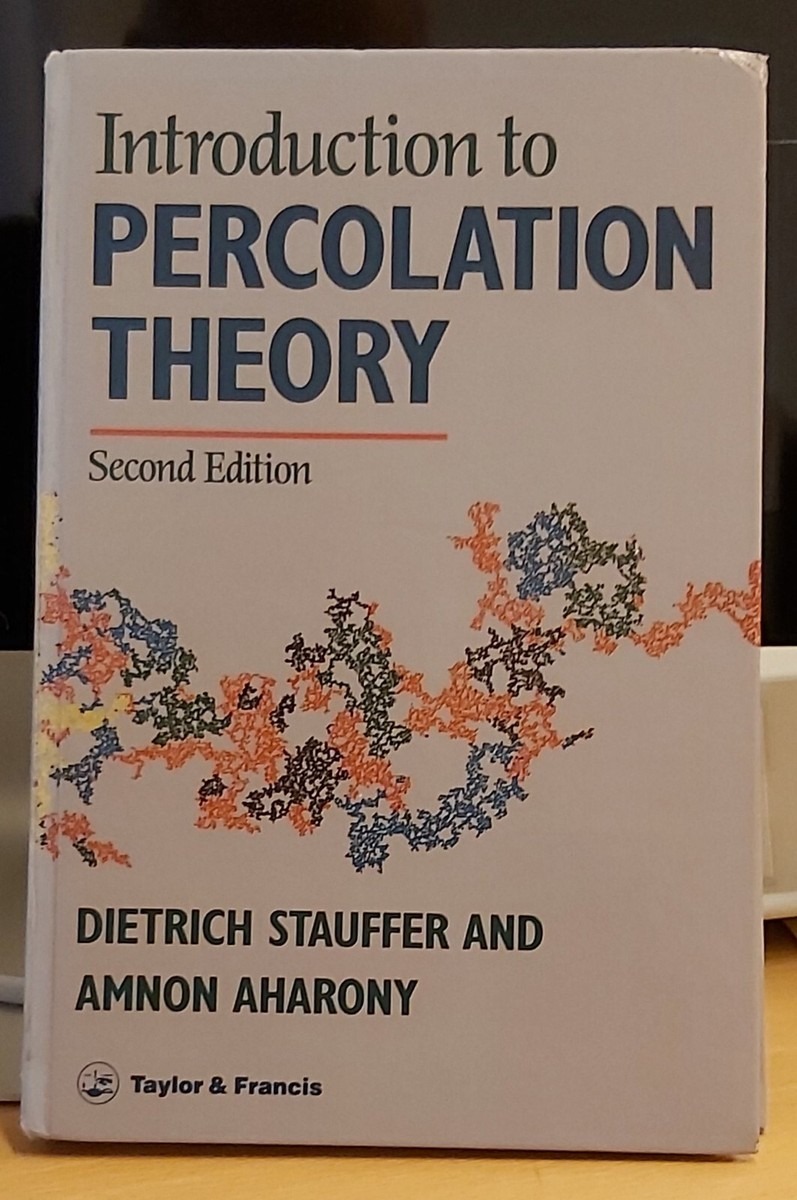
안녕하세요. 이 학습 노트는 물리학의 고전인 디트리히 슈타우퍼(Dietrich Stauffer)와 암논 아하로니(Amnon Aharony)의 명저 'Introduction to Percolation Theory'를 함께 읽기 위한 기록입니다. 우리는 늘 정보가 어떻게 퍼지고 유행이 어디서 시작되며 작은 연결이 어떻게 거대한 흐름으로 번져 가는지 궁금해합니다. 이 책은 그러한 질문에 ‘임계점(Threshold)’과 ‘군집(Cluster)’이라는 수학적 언어로 답하지만, 저는 그 건조한 수식들 사이에서 오히려 우리의 모습을 봅니다. 너와 내가 이어지고 그 연결이 모여 하나의 흐름이 되며, 그 거대한 네트워크 속에서 소외되지 않으려 애쓰는 인간의 몸짓까지도 함께 말입니다. 본문은 단순한 분석서가 아니라 복잡계 네트워크 속에서 우리가 어떻게 살아남고 어떻게 서로에게 닿을 수 있는지에 대한 작은 철학적 탐구에 가깝습니다. 정보가 흐르는 길(Path)을 찾고 불확실성의 숲을 건너며 각자의 좌표를 확인해 가는 이 여정이, 여러분의 마음에 잔잔한 지적 파동을 남기기를 바랍니다.
1. The Architecture of Connectivity: From Randomness to Order
Dietrich Stauffer and Amnon Aharony’s Introduction to Percolation Theory is not merely a textbook; it is a cartography of chaos. Published by Taylor & Francis in 1994, this work stands as a lighthouse in the foggy seas of statistical mechanics, illuminating the precise moment when a disconnected mess transforms into a connected system. At its heart lies a question that resonates deeply with our modern, hyper-connected existence: When does a fragmented scattering of individuals suddenly coalesce into a unified movement? This is the essence of percolation. It is the study of connectivity in random media, a discipline that finds order in the roll of the dice.
To understand information diffusion, we must first grapple with the fundamental models presented in the early chapters of this book. Stauffer and Aharony introduce us to the lattice, a grid that represents the substrate of our reality. In the context of physics, this might be a porous rock allowing oil to seep through, or a magnetic alloy finding its alignment. In the context of our digital lives, this lattice is the social network, the internet, the unseen web of human relationships. The authors distinguish between two primary types of percolation: site percolation and bond percolation.
Imagine a checkerboard. In site percolation, we randomly occupy squares with a probability p. If p is low, the board is a scattering of isolated islands. As p increases, these islands grow, merge, and reach out to one another. In bond percolation, the squares are always there, but the bridges between them are open or closed based on probability. This distinction is crucial for analyzing information spread. Site percolation models whether an individual is receptive to an idea. Are they active? Are they listening? Bond percolation models the relationship. Is the channel of communication open? Is the trust strong enough to carry the message?
The beauty of Stauffer’s exposition lies in his rigorous yet accessible approach to these models. He forces us to look at the lattice not as a static picture, but as a dynamic theater of probability. The book meticulously explores different lattice types—square, triangular, honeycomb in two dimensions; simple cubic, body-centered cubic in three dimensions. Each geometry dictates a different threshold for connectivity. This geometric determinism serves as a profound metaphor for social structures. A tightly knit community (a triangular lattice) requires a lower threshold of individual participation to achieve global consensus than a loosely connected, spread-out society (a simple cubic lattice). The geometry of our connections determines the destiny of our ideas.
The text moves seamlessly from discrete lattices to continuum percolation, where the rigid grid dissolves into a mess of overlapping circles or spheres. This shift mirrors the transition from structured organizations to the fluid, chaotic swarm of the modern internet. Here, connections are not dictated by grid lines but by proximity and interaction range. If we view information diffusion as a biological contagion, a perspective the authors touch upon in later chapters on epidemics, continuum percolation describes the reality of viral spread in a crowded room or a bustling digital plaza. The math tells us that we do not need everyone to be connected for a message to conquer the world; we only need to surpass a specific, mathematical limit.
We observe a profound humanity in these mathematical structures. The struggle of a cluster to grow, to bridge the gap, to find a path from one side of the system to the other, mirrors our own human struggle for connection. We are all sites on a lattice, oscillating between occupied and empty, trying to form a cluster that matters. Stauffer and Aharony provide the grammar to describe this struggle. They teach us that isolation and connectivity are not binary states of being, but phases determined by a control parameter. We are all subject to the laws of probability, yet within that randomness, a predictable, almost destined structure emerges. This is the first lesson of the book: structure is an emergent property of randomness, provided the density is high enough.
The authors distinguish between two fundamental types of percolation which map perfectly to social networks.
Site Percolation: Consider a grid where each intersection (site) is either occupied or empty. In information terms, this represents individuals. Is the person receptive to the idea? If a "site" is blocked (a person is uninterested or offline), the flow stops.
Bond Percolation: Here, the sites are all present, but the connections (bonds) between them are probabilistic. This mirrors the algorithmic feeds of social media. You and I might both be online (active sites), but if the algorithm (bond) does not show you my post, the information bridge is broken.
2. The Critical Threshold: Navigating the Phase Transition
If there is a protagonist in this book, it is p<sub>c</sub>, the critical threshold. This is the magic number, the tipping point, the boundary between the finite and the infinite. Chapters 3 and 4 of the book are dedicated to understanding the behavior of the system near this critical point. Below p<sub>c</sub>, clusters are small, finite, and isolated. The information you share dies out within your immediate circle. It is a subcritical state; the fire cannot catch. But the moment p crosses p<sub>c</sub>, a phase transition occurs. An infinite cluster appears. Suddenly, a path exists that spans the entire system. A local whisper becomes a global roar.
Stauffer and Aharony are masters at explaining the universality of this phenomenon. They draw parallels to thermal phase transitions, like water freezing into ice or iron becoming magnetic at the Curie temperature. The mathematics describing these disparate physical events are eerily similar. This concept of universality suggests that the details of the interaction—whether it is atoms aligning or teenagers sharing a meme—matter less than the dimensionality and the symmetries of the system. For information diffusion, this is a liberating realization. It means we do not need to model every nuance of human psychology to understand the broad strokes of viral trends. We only need to understand the topology of the network and the proximity to the critical threshold.
The authors discuss exact results for the critical threshold in various dimensions. In one dimension, a simple line, p<sub>c</sub> is 1. You need every single link to be intact for information to travel from end to end. If one person breaks the chain, the message stops. This explains why the game of Telephone always fails. But in two dimensions, on a square lattice, p<sub>c</sub> for site percolation is approximately 0.5927. You only need about 59% of the population to be active for a giant component to emerge. In higher dimensions, or on lattices with higher coordination numbers (more neighbors), p<sub>c</sub> drops even further. On a Bethe lattice, which simulates a branching tree structure often used to model viral spread, the threshold is simply 1/(z-1), where z is the number of neighbors. The more connected we are, the easier it is for information to percolate.
However, the book warns us of the "critical slowing down." As we approach p<sub>c</sub>, the correlation length—the distance over which sites "know" about each other—diverges. Fluctuations become massive. The system becomes incredibly sensitive. In terms of information flow, this is the state of a market before a crash or a society before a revolution. The tension is palpable. Small inputs can have macroscopic outputs. The authors explain this through scaling concepts and critical exponents (beta, gamma, nu). These Greek letters are not just variables; they are the DNA of the transition. Beta describes how the strength of the infinite network grows. Gamma tells us how the average cluster size explodes.
This section of the book invites us to look at the world with a sense of wonder. We realize that the difference between a failed product launch and a global phenomenon is often a microscopic shift in p. If the "stickiness" or transmission probability of your content is 0.2 and the network requires 0.25, you fail. Increase it to 0.26, and you own the world. The transition is sharp, non-linear, and unforgiving. Stauffer and Aharony provide the rigorous mathematical tools to calculate these thresholds, offering a way to quantify the seemingly unpredictable nature of popularity and influence. They show us that while we cannot predict the fate of a single site, we can predict the fate of the system with absolute certainty.
The discussion of the infinite cluster is particularly poignant. Above p<sub>c</sub>, not everyone belongs to the infinite cluster. There are still pockets of isolation, small finite clusters cut off from the mainstream. This is a perfect analog for echo chambers and digital islands. Even in a supercritical world where information flows freely, there are those who remain untouched, protected, or perhaps imprisoned by the geometry of their local connections. The book forces us to ask: Are we part of the infinite cluster, connected to the global consciousness, or are we floating in a finite bubble, unaware of the vast network just beyond our reach?
| State | Mathematical Definition | Social Implication |
|---|---|---|
| Subcritical | p < pc | Information dies out locally. Niche communities. |
| Critical | p ≈ pc | High volatility. The "Viral" moment. Infinite correlation length. |
| Supercritical | p > pc | Global consensus. Mass adoption. The "Giant Component" exists. |
The book discusses Exact Results for specific lattices like the Bethe Lattice and Cayley Tree, providing the mathematical proof that these thresholds are not random; they are fundamental constants of geometry. For information diffusion, this implies that we do not need to convince everyone to create a global movement. We only need to increase the connectivity just enough to surpass pc. Once that threshold is crossed, the physics of the network takes over, and the spread becomes inevitable. This is a message of hope for the marginalized voice: you do not need a megaphone; you need a critical density of connections.
3. Scaling Theory and Renormalization: The Fractal Geometry of Truth
As we delve deeper into Chapters 5 and 6, the book introduces us to the powerful tools of Scaling Theory and the Renormalization Group. These are the heavy hitters of modern theoretical physics. Scaling theory posits that near the critical point, the system looks the same at all scales. It is self-similar. This brings us to the concept of fractals. Stauffer and Aharony masterfully explain that the infinite cluster at the threshold is a fractal object. It has holes of all sizes. It is rugged, ragged, and infinitely complex.
For an expert in information diffusion, this is a crucial insight. It implies that social networks and the spread of ideas are not smooth waves but fractal frontiers. The "coastline" of an idea—the boundary between those who know and those who do not—is infinitely long and complex. The authors introduce the concept of the fractal dimension, D, which describes how the mass of the cluster scales with its radius. In standard Euclidean geometry, a disk has dimension 2. But a percolating cluster in 2D has a fractal dimension lower than 2 (specifically 91/48 or approx 1.89). It is less dense than a solid object but more substantial than a line.
The Renormalization Group (RG) is perhaps the most intellectually satisfying concept in the book. It involves "coarse-graining" the system—stepping back to blur the details and seeing if the large-scale behavior remains the same. Imagine taking blocks of 2x2 sites and replacing them with a single "super-site" based on a majority rule. If the system is scale-invariant, this transformation leads to a "fixed point." This mathematical technique justifies why we can apply theories derived from simple computer models to complex real-world phenomena. The microscopic details wash out; only the macroscopic symmetries remain.
This has profound implications for strategy. It suggests that when trying to influence a network, you do not need to micromanage every individual (the microscopic scale). You need to change the renormalization flow. You need to alter the rules of local interaction such that the system naturally flows toward a connected state (a fixed point of connectivity) rather than a disconnected one. The authors guide us through real-space renormalization and the Migdal-Kadanoff approximation, showing how to calculate critical probabilities analytically. It is a triumph of theoretical reductionism, turning an intractable problem of billions of variables into a solvable equation of flow.
The fractal nature of the percolation cluster also teaches us about the efficiency of information storage and retrieval. The "backbone" of the cluster is the subset of sites that actually carry the current (or information) from one end to the other. The "dangling ends" are dead ends—people who receive the information but pass it to no one. Stauffer shows that the backbone is significantly thinner than the cluster itself. Most of the mass is dead weight. In any organization or movement, the true influencers, the backbone, are a fractal minority. Identifying this backbone is the Holy Grail of network optimization. The book provides the geometrical definitions to distinguish the backbone from the red bonds—the single links whose failure would sever the entire connection.
We feel a sense of fragility reading about red bonds. These are the bottlenecks, the vulnerable points in the network. In a robust democracy or a resilient server architecture, we want to minimize red bonds. We want multiple redundant paths. But near the critical threshold, red bonds are abundant. The flow of history often passes through a single narrow gate. Stauffer and Aharony’s geometric analysis gives us the visual and mathematical language to identify these vulnerabilities. They turn the abstract notion of "network resilience" into a measurable quantity, defined by the critical exponent for the red bond density.
The book emphasizes Finite-Size Scaling. In infinite theoretical models, the transition is sharp. In real, finite systems (like a social group of 100 people), the transition is blurred. This explains why predicting the exact "moment" a trend goes viral is so difficult in smaller communities. The sharp distinction between success and failure blurs, creating a zone of uncertainty.
The chapters on Renormalization Group and Fractal Concepts are particularly enlightening. The authors explain that at the critical point, the cluster of connected sites is a Fractal. It is self-similar; it looks the same whether you zoom in or zoom out. This maps beautifully to information diffusion. The structure of a conversation within a small sub-reddit often mirrors the structure of the national discourse. The "holes" in the fractal—the unconnected areas—represent the pockets of society that remain untouched by the information, no matter how pervasive it seems. Understanding this fractal nature helps us realize that even in a hyper-connected world, there will always be voids, creating natural echo chambers defined not by malice, but by geometry.
4. Transport and Dynamics: The Diffusion of Innovation
Moving into Chapter 9 and 10, the text shifts from static geometry to dynamic processes. How does stuff move through these clusters? The authors discuss conductivity, random resistor networks, and diffusion. This is where the analogy to information diffusion becomes literal. If we treat the lattice as a network of resistors, the conductivity represents the ease with which a message permeates society. Below p<sub>c</sub>, conductivity is zero. Above p<sub>c</sub>, it rises, following a power law characterized by the exponent mu (or t).
The discussion of "ant in a labyrinth" is particularly delightful and witty. Imagine an ant parachuted onto a random occupied site in a percolating cluster. It wanders blindly. How far does it get over time? This is the problem of anomalous diffusion. On a regular Euclidean plane, the mean square displacement scales linearly with time. But on a fractal percolation cluster, the ant is slowed down by dead ends and tortuous paths. The diffusion is slower; it is sub-diffusive.
This explains why fake news or revolutionary ideas often linger in pockets before exploding. They are trapped in the fractal geometry of the early adopter network, bouncing around in local cul-de-sacs (dangling ends) before finding the backbone that leads to the wider world. The authors also introduce the concept of the "chemical distance" or the shortest path length. On a fractal, the shortest path between two points is not a straight line; it is a winding, convoluted road. This means that even if two people are spatially close, the "social distance" between them—the number of intermediaries required to pass a message—might be enormous if they are on opposite sides of a structural hole.
Chapter 10 extends these ideas to "Forest Fires" and "Epidemics." The forest fire model is a canonical example of self-organized criticality. Trees grow slowly and burn down fast. If the density of trees (fuel) is below a threshold, fires die out. If it is above, a single match can burn the whole forest. The parallel to viral content is undeniable. The "fuel" is the public’s readiness to react. The "match" is the content. Stauffer and Aharony analyze the duration and magnitude of these fires. They show that the distribution of fire sizes follows a power law. This implies that massive, world-changing events (fires that burn everything) are not outliers; they are a natural, expected part of the distribution near criticality.
The authors also touch upon "Bootstrap Percolation," a variant where a site remains active only if it has a minimum number, m, of active neighbors. This is a model for social reinforcement or peer pressure. I might not buy a product if only one friend has it, but if three friends have it, I convert. This leads to different critical thresholds and discontinuous transitions. It models the inertia of society. Unlike simple percolation where change is continuous, bootstrap percolation can lead to sudden, catastrophic shifts—a "first-order" transition. One moment the status quo is solid; the next, it has completely collapsed.
The inclusion of these dynamic models elevates the book from a treatise on geometry to a handbook on change. It reminds us that time is a variable as important as probability. The speed of diffusion, the relaxation time of the system, the life-span of the fire—these are the metrics that matter in the real world. Stauffer and Aharony treat these topics with rigorous indifference to the specific application, which paradoxically makes their work applicable to everything. Whether it is a neuron firing in the brain or a rumor spreading on Twitter, the underlying transport equations share the same universality class.
5. Insight and Application: The Beta-Model of Social Trust
Reflecting on the vast intellectual landscape of this book, I offer a synthesized insight: The integration of the Bethe Lattice solution with modern Trust Dynamics. Stauffer and Aharony present the Bethe Lattice (or Cayley Tree) as a simplified model where no closed loops exist. In the 90s, this was a mathematical convenience. Today, it is a warning.
Social media algorithms often prune our networks, removing the "loops" that connect diverse groups and creating tree-like structures of echo chambers. In a tree structure, the removal of a single node (a parent node) disconnects the entire branch below it. This makes the network incredibly fragile and prone to manipulation. Information flows down the branches efficiently, but it cannot circle back to self-correct. The "loops" in a lattice—the redundant connections between peers—are the structures that allow for consensus verification and truth-checking.
Therefore, an optimal strategy for robust information diffusion—one that resists disinformation—aims to artificially increase the coordination number (z) and induce loops. We must move from a Bethe Lattice architecture to a highly connected Triangular Lattice architecture. In the language of the objective function, if we want to maximize Alpha (value/truth), we must design the DAO (organization) to operate in a dimension where p<sub>c</sub> is low, but the redundancy is high.
We must also consider the "Ghost Field" analog. In physics, a symmetry-breaking field aligns the spins. In information, this is the external Zeitgeist or the media narrative. Stauffer discusses how an external field smoothes out the singularity at the phase transition. It blurs the sharp line between order and chaos. In our current era, the "Ghost Field" is stronger than ever, constantly pushing the system away from true criticality. To find the truth, we may need to subtract this field, to look for the spontaneous symmetry breaking that comes from the grassroots—the pure, unadulterated percolation of genuine human sentiment.
The book ultimately teaches us humility. We cannot control the path of the ant in the labyrinth. We cannot dictate the shape of the cluster. We can only adjust the parameters—the probability p, the connectivity z—and wait for the laws of large numbers to do their work. It is a dance between the stochastic nature of the individual and the deterministic destiny of the crowd.
Viral Potential Simulator
Based on Stauffer & Aharony's Lattice Thresholds
요약 및 제언
주요 요약
- 임계점의 과학: 정보 확산과 네트워크 연결은 서서히 진행되는 것이 아니라, 특정 확률(p<sub>c</sub>)을 넘어서는 순간 급격하게 폭발하는 상전이 현상입니다.
- 구조의 힘: 격자(Lattice)의 기하학적 구조가 임계값을 결정합니다. 연결성이 높은 사회 구조일수록 더 낮은 에너지로도 거대한 파급력을 만들어낼 수 있습니다.
- 프랙탈 차원: 확산되는 정보의 군집은 매끄러운 덩어리가 아닌 프랙탈 구조를 가집니다. 이는 정보 전달의 효율성과 저항성을 동시에 설명하는 핵심 키워드입니다.
- 동적 확산: '미로 속의 개미' 모델처럼, 정보는 최단 거리가 아닌 복잡하게 얽힌 백본(Backbone)을 따라 흐릅니다. 이를 이해하는 것이 최적화의 첫걸음입니다.
결론 및 제언
Stauffer와 Aharony의 'Introduction to Percolation Theory'는 세상이 어떻게 '단절'에서 '연결'로, '질서'에서 '혼돈'으로, 그리고 다시 그 안에서 '자기유사성(Fractal)'이라는 패턴을 찾아가는지에 대한 거대한 지도입니다.
우리가 살펴본 정보 확산의 관점에서 본다면, 가장 중요한 것은 임계점(Critical Threshold)입니다. 아무리 좋은 콘텐츠라도 네트워크의 연결 구조(Lattice Type)와 전달 확률(Bond Probability)이 임계치에 도달하지 못하면 소멸합니다. 반대로, 임계치를 아주 살짝만 넘겨도 그 파급력은 무한대(Infinite Cluster)로 발산합니다.
이 책이 주는 교훈은 '연결의 미학'에 있습니다. 우리는 고립된 점(Site)이 아니라, 누군가와 끊임없이 상호작용하는 선(Bond)입니다. 나의 작은 움직임이 거대한 클러스터의 일부가 되어, 전혀 알지 못하는 저 먼 곳의 누군가에게까지 닿을 수 있다는 사실. 이것이 바로 물리학이 우리에게 건네는 인간에 대한 연민이자 경이로움일 것입니다.
이제 여러분의 네트워크를 돌아보세요. 당신은 끊어진 링크인가요, 아니면 세상을 연결하는 붉은 본드(Red Bond)인가요?
Frequently Asked Questions ❓
Have you felt the "tipping point" in your own life? Share your story in the comments below!