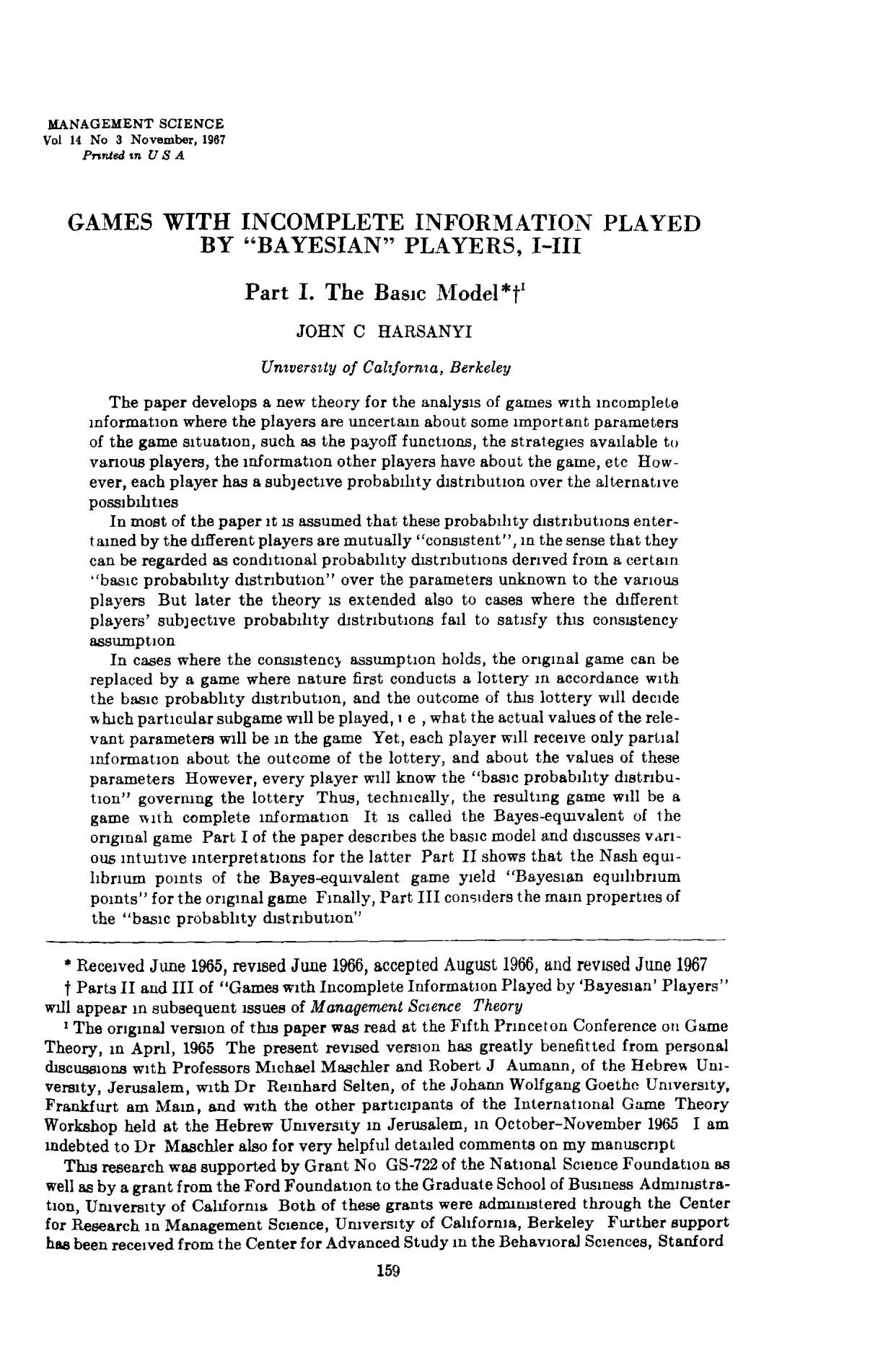
본 글은 존 하사니(John C. Harsanyi)의 불완전 정보 게임 이론을 바탕으로, 정보 비대칭 환경에서의 전략적 우위를 점하기 위한 베이지안 게임 모델링(Bayesian Game Modeling)을 분석합니다. 불확실성이라는 공포를 구조화된 질서로 치환하는 이 여정은 단순한 학문적 탐구를 넘어, 복잡한 현대 사회를 해석하는 강력하고 새로운 인지적 프레임워크를 제공합니다.
Bayesian Game Modeling Under Information Asymmetry 7 Proven Frameworks for Strategic Superiority
I once stood completely paralyzed by the sheer complexity of human interactions and market behaviors. Whenever I faced scenarios shrouded in hidden motives, undisclosed preferences, and structural opaqueness, a dense fog seemed to cloud my strategic judgment. The intricate dance of bluffs and asymmetrical knowledge felt like an unsolvable labyrinth where every step forward was a step into the unknown. I used to think that modeling such profound uncertainty was impossible, a realm reserved only for sheer intuition rather than rigorous analysis. However, immersing myself in John Charles Harsanyi's groundbreaking treatise, "Games with Incomplete Information Played by 'Bayesian' Players," profoundly shifted my paradigm. It was as if I had been handed a masterful blueprint to navigate the invisible architectures of strategic conflict. The ultimate goal derived from this analysis is to establish an autonomous, boundary-transcending control mechanism that extracts maximum strategic advantage through continuous probabilistic calibration. Let us dive deep into the very fabric of this transformative theory and explore how Bayesian Game Modeling can revolutionize our understanding of incomplete information landscapes.
Part I — Transmuting the Unknown into the Computable
To truly appreciate the magnitude of Harsanyi's contribution, we must first address the foundational Introduction of his work, which confronts the grand dilemma of traditional game theory. Before this paper, the strategic world was starkly divided. On one side, we had Games with Complete Information Defined, where every player knew the exact payoff functions, strategies, and constraints of every other player. It was a sterile, crystalline environment akin to chess, where all pieces are visible on the board. On the other side, we faced Games with Incomplete Information Defined. In these epistemic opaque environments, players are ignorant of critical parameters concerning their adversaries. They might not know the opponent's true costs, risk tolerance, or ultimate objectives. Harsanyi recognized that the real world operates almost exclusively within this latter domain. He eloquently dismantled the illusion that complete information is a necessary prerequisite for rational analysis, arguing instead that we must build robust conceptual bridges over the chasms of our ignorance.
The sheer brilliance of his solution lies in the construction of The Bayes-Equivalent Game. Whenever I reflect on this concept, it strikes me as one of the most elegant conceptual pivots in modern intellectual history. Harsanyi proposed that a game with incomplete information can be mathematically and logically transformed into a game with complete but imperfect information. Imagine a grand theater where the director, whom Harsanyi labels as "Nature," makes the very first, unseen move. Nature assigns a specific "type" to each player—a type encapsulating all the private information, secret capabilities, and hidden payoffs unique to that individual. When players enter the stage, they know their own type perfectly, but they only possess a probabilistic assessment of the other players' types. This theoretical transposition is nothing short of alchemy; it takes the unquantifiable void of "not knowing" and replaces it with a structured, probabilistic lottery that can be rigorously modeled and solved.
This mechanism introduces the concept of Bayesian Players. A Bayesian Player is not merely a rational actor in the traditional sense; they are continuous belief-updaters, dynamically calibrating their worldview as new information surfaces. They do not freeze in the face of uncertainty. Instead, they rely on subjective probability distributions to map out the likely configurations of their rivals. It is a profoundly proactive stance. You are no longer reacting blindly to a hidden adversary; you are interacting with a statistically weighted spectrum of possible adversaries. As these players observe moves and countermoves, they employ Bayes' rule to refine their probabilities, narrowing the spectrum of uncertainty and zeroing in on the absolute truth. It is a mathematical manifestation of learning through strategic interaction.
The Interpretation of the Basic Model extends far beyond mere mathematics. It requires us to view every interaction not as a clash of fixed entities, but as a collision of probabilistic envelopes. When you negotiate a contract, enter a new market, or formulate policy, you are engaging in a Bayes-Equivalent Game. Your counterpart's "type" is hidden, but their strategic footprint allows you to continually refine your subjective probability distribution regarding their true nature.
However, Harsanyi was meticulously aware of the potential pitfalls in this mental architecture, leading to his profound exploration of Inconsistent Subjective Probability Distributions. What happens if Player A's belief about the world fundamentally contradicts Player B's belief? If the foundational probabilities are inconsistent, the entire fabric of the Bayes-Equivalent Game threatens to unravel into logical paradoxes. Harsanyi tackled this by illustrating how inconsistent priors complicate the attainment of equilibrium, forcing analysts to confront the deeply subjective nature of strategic beliefs. He argued that while inconsistency presents a severe hurdle, it does not invalidate the model; rather, it highlights the necessity for rigorous alignment protocols or the acceptance of subjective divergence as a core feature of the conflict.
To ground these towering abstractions, the section on Applications and Examples provides indispensable utility. Harsanyi demonstrates how Bayesian Game Modeling applies to auction theory, oligopolistic competition, and arms races. In an auction, for instance, your valuation of a painting is your private "type." You must bid not only based on what you are willing to pay but also based on your subjective probability distribution of the other bidders' types. Through these examples, the theoretical framework descends from the ivory tower and embeds itself directly into the pulsating heart of real-world economics. The Concluding Remarks of Part I leave the reader with a sense of immense empowerment: the fog of war has not been dispelled, but we have been given a radar system capable of navigating it with unprecedented precision.
Part II — Synthesizing Rationality Amidst Shadows
As we transition into the Introduction of Part II, the narrative shifts from building the arena to analyzing the profound dynamics of the gladiators within it. Having established the Bayes-Equivalent Game, the pressing question becomes: How do rational entities actually behave when immersed in this probabilistic matrix? Harsanyi answers this by defining Bayesian Equilibrium Points. This concept is the beating heart of his entire theory. A Bayesian Equilibrium is achieved when every player, knowing their own private type and holding probabilistic beliefs about the types of others, chooses a strategy that maximizes their expected utility. It is a state of sublime strategic rest, where no player possesses an incentive to unilaterally deviate from their chosen path, given the vast web of uncertainties they are entangled within.
The Relation to Nash Equilibrium is crucial to grasp here. John Nash gave us the concept of equilibrium for complete information games—a monumental achievement in its own right. Harsanyi did not discard Nash; he transcendentally expanded him. A Bayesian Equilibrium is essentially a Nash Equilibrium played out in the expanded space of the Bayes-Equivalent Game. Instead of a strategy being a simple action (like "cooperate" or "defect"), a strategy in Harsanyi's world is a complete contingency plan. It is a complex mapping from every possible "type" a player could possess to an optimal action. This means a player is not just deciding what to do; they are deciding what they would do if they were a high-cost producer, what they would do if they were a low-cost producer, and so forth, balancing these decisions against the anticipated contingency plans of their rivals.
This leads us into a deep analysis of Strategic Behavior under Incomplete Information. In this realm, actions carry dual significance. They are not merely instrumental (designed to achieve a direct payoff); they are heavily communicative and informational. When you make a move, you are leaking information about your hidden type. Conversely, some players will engage in deliberate obfuscation or costly signaling to project a false type to their adversaries. The strategic behavior here is a delicate ballet of revealing and concealing. You must extract the maximum amount of utility while carefully managing the informational exhaust of your decisions. It is a continuous, high-stakes process of probabilistic calibration, where every action shifts the underlying belief structures of the entire ecosystem.
The interplay between Mixed Strategies and Bayesian Equilibria represents a fascinating evolution in game theory. Under complete information, players often use randomized (mixed) strategies to keep opponents guessing. However, Harsanyi illustrates that in the presence of incomplete information, what appears to be a randomized mixed strategy to an outside observer is often a strict, pure strategy determined by a player's private type. The uncertainty generated by incomplete information often completely absorbs the need for deliberate randomization.
Of course, constructing such an elaborate theoretical edifice invites rigorous mathematical scrutiny, which Harsanyi addresses in Existence Problems. Does a Bayesian Equilibrium always exist, or are there pathological scenarios where the probabilistic structures collapse into an unsolvable void? Drawing upon advanced fixed-point theorems, Harsanyi meticulously proves that under relatively standard assumptions (such as finite action spaces and well-defined probability distributions), at least one Bayesian Equilibrium is mathematically guaranteed to exist. This proof is not mere academic pedantry; it is the structural steel that ensures the entire framework is sound, proving that rational resolution is always possible, even in the densest fogs of information asymmetry.
The section concluding Part II re-emphasizes Applications, bringing the lofty calculus of equilibrium back to strategic reality. Whether it is regulatory bodies trying to govern monopolies without knowing the monopolies' true operational costs, or nations negotiating treaties while hiding their true military readiness, the Bayesian Equilibrium provides a precise diagnostic tool to predict outcomes. The Concluding Remarks of this section cement the idea that strategic superiority is not achieved by eliminating uncertainty, but by internalizing it. Mastery belongs to the player who can map the equilibrium points of the expanded Bayes-Equivalent Game faster and more accurately than their opponents.
Part III — Resolving the Infinite Regress
As we enter the Introduction to the final installment, Harsanyi addresses the deepest and most profound epistemological challenge of his theory. If my optimal decision depends on what I believe about you, and your optimal decision depends on what you believe about my beliefs about you, we are immediately trapped in a hall of mirrors. This is the dreaded Infinite Regress of Expectations. "I think that you think that I think that you think..." This infinite loop has the power to shatter analytical frameworks, paralyzing decision-makers in an endless cycle of recursive second-guessing. How does one model a system where the foundational beliefs are infinitely recursive?
Harsanyi's masterstroke is found in his concept of Consistent Games and the Uniqueness of the Basic Probability Distribution. To slice through the Gordian knot of infinite regress, he introduces the Common Prior Assumption (often referred to today as the Harsanyi Doctrine). He posits that we can mathematically trace all differing subjective beliefs back to a single, consistent, basic probability distribution. Imagine a primordial state before "Nature" assigned any types. In this state, all players share the exact same objective probability distribution regarding how types will be assigned. The information asymmetry only arises because, after the types are assigned, each player is privately informed of their own type. Their differing posterior beliefs are not born of fundamental irrationality, but simply from conditioning that common prior on their disparate private information.
This assumption is an absolute game-changer. By proving the Uniqueness of the Basic Probability Distribution in Consistent Games, Harsanyi collapses the infinite regress into a single, highly computable state matrix. We no longer need to model infinite layers of recursive beliefs; we only need to model the common prior and the specific conditioning mechanisms of each player. It is a triumph of mathematical elegance over cognitive chaos. It implies that at the deepest foundational level, rational actors can possess a shared grammar of probability, even if their vocabularies differ due to asymmetric information.
Naturally, Harsanyi recognizes that the real world is messy, addressing Inconsistent Games where the Common Prior Assumption fails to hold. What if players' fundamental worldviews are so alien to one another that they cannot be traced back to a common origin? Through a brilliant methodological maneuver, he details the Transformation into Consistent Games. He demonstrates how analysts can artificially expand the model, introducing "pseudo-types" or adjusting the parameters so that an inconsistent game can be mathematically massaged into a consistent framework for the sake of rigorous analysis. This transformation is a testament to the flexibility and enduring power of his modeling architecture.
In the penultimate section on Generalized Models, Harsanyi broadens the scope of his theory, showing how these probabilistic architectures can accommodate continuous variables, infinite type spaces, and highly complex, multi-stage dynamic environments. It is here that Bayesian Game Modeling truly proves itself as a universal language for strategic analysis. The Concluding Remarks of Part III synthesize the entire trilogy. Harsanyi leaves us with a finalized, airtight methodology. He has taken the most terrifying aspect of strategic interaction—the sheer, unadulterated ignorance of the other—and provided a systematic, mathematically rigorous pathway to equilibrium and resolution.
A Spoonful of Insight: The Synthesis of Equilibrium and Epistemology
Reflecting upon this monumental work, my personal insight revolves around the concept of "Strategic Parallax." In optics, parallax is the apparent displacement of an object when viewed along two different lines of sight. Harsanyi teaches us that information asymmetry is fundamentally a manifestation of Strategic Parallax. You and your opponent are looking at the exact same objective reality (the Bayes-Equivalent Game), but from vastly different epistemological vantage points defined by your private types.
The true power of Bayesian Game Modeling is that it provides the calculus required to reconcile these differing perspectives without demanding total transparency. It suggests that absolute knowledge is an unnecessary luxury. Strategic supremacy belongs to those who can accurately construct the probability distributions of the unseen. When we internalize the Harsanyi Doctrine, we shift our focus from trying to forcefully uncover our opponent's secrets to dynamically analyzing the probabilistic shadows those secrets cast upon the market. It fundamentally changes the role of the decision-maker from a blind gambler to an elite statistical architect, continuously optimizing their posture within the boundary conditions of asymmetrical landscapes.
결론적으로, 존 하사니의 베이지안 게임 모델링은 불확실성이라는 안개를 뚫고 나가는 강력한 전략적 나침반입니다. 우리는 타인의 숨겨진 의도나 자원을 완벽하게 알아낼 수는 없지만, 하사니가 제시한 확률적 구조와 공통 사전 확률(Common Prior)의 가정을 통해 그들의 행동을 예측하고 최적의 대응점을 찾아낼 수 있습니다. 이 글을 통해 정보의 비대칭성을 두려워해야 할 맹점이 아니라, 치밀한 확률적 계산을 통해 우위를 점할 수 있는 전술적 무대로 인식하시길 바랍니다. 끊임없이 상대의 '타입'을 추론하고 자신의 전략을 동적으로 보정하는 베이지안의 태도야말로, 고도로 복잡해진 현대의 전략적 환경에서 승리하기 위한 절대적인 열쇠입니다.