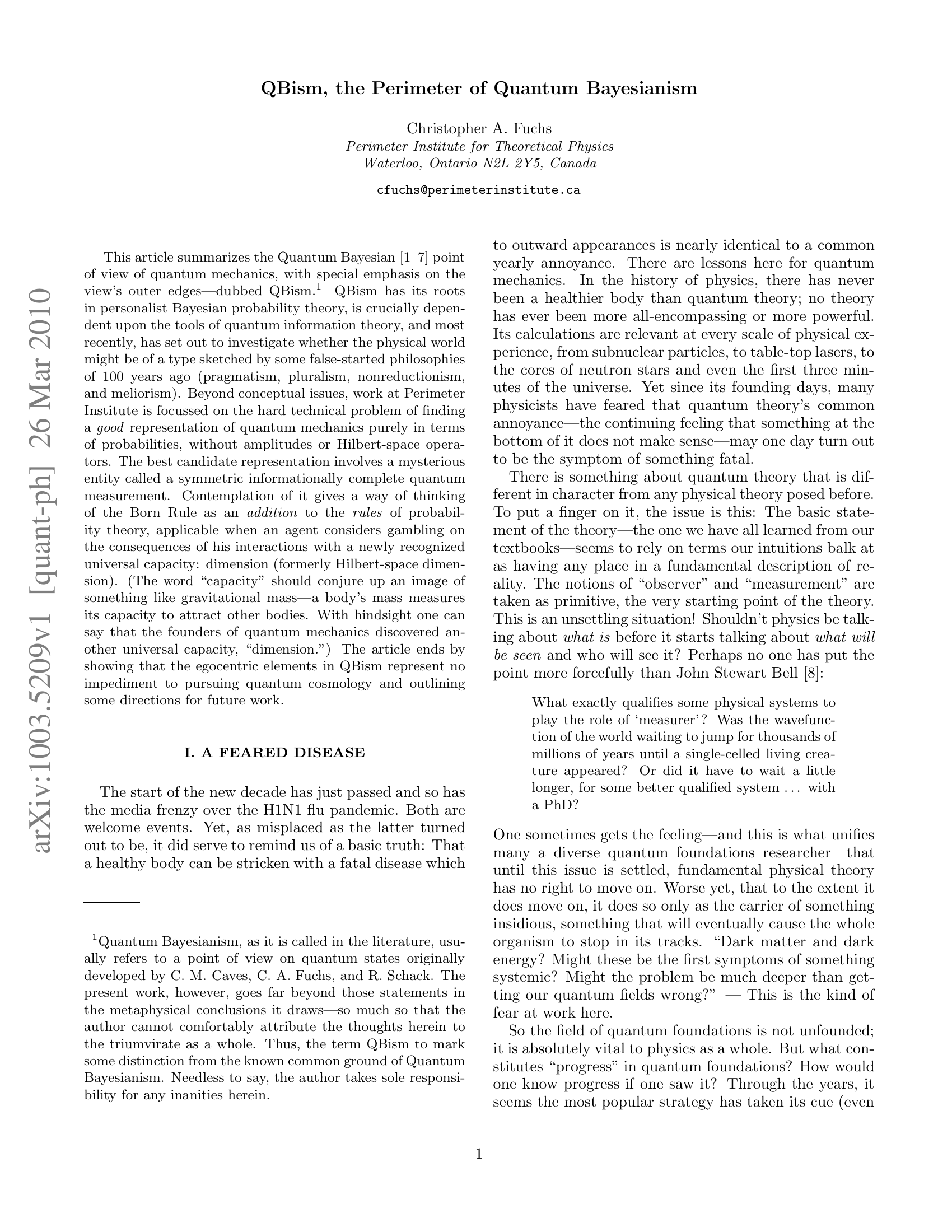
이 분석의 목표는 분산된 네트워크 동학, 경계를 넘나드는 데이터 구조, 그리고 확률론적 최적 제어 메커니즘을 종합하여 전례 없는 전략적 우위와 예측 불가능한 환경에서의 초과 성과를 도출하는 것입니다. 본 글는 크리스토퍼 푹스(Christopher A. Fuchs)의 연구를 바탕으로, 불확실성이 지배하는 복잡계 속에서 우리의 주관적 신념과 관측 행위가 어떻게 세계를 재구성하는지 탐구합니다.
Have you ever felt a profound sense of disorientation when confronted with the sheer unpredictability of modern complex systems? Whether we are analyzing the microscopic interactions of subatomic particles or observing the macroscopic chaos of global stochastic networks, the rapid pace of change often leaves us oscillating between anxiety and awe. Recently, I delved into Christopher A. Fuchs's profound work, "QBism, the Perimeter of Quantum Bayesianism." From the very title, it captured my intellectual curiosity, promising a radical paradigm shift. It is a work that fundamentally challenges our preconceived notions of reality, replacing cold, objective determinism with a vibrant, participatory framework.
Instead of treating physical theories as detached mirrors reflecting an absolute external world, Fuchs forces us to ask a deeply intimate question: What if the equations we use to describe reality are actually describing our own profound relationship with it? The concepts discussed transcend traditional physics, offering a philosophical compass for anyone engaged in rigorous risk assessment, decision theory, and the modeling of deeply uncertain futures. As we journey through the philosophical reconstructions of this theory, I will share my reflections on how understanding the perimeter of this framework reshapes not just theoretical physics, but our fundamental approach to any environment defined by deep uncertainty.
1. The Demise of Objective States: Embracing the Quantum Belief
For nearly a century, the standard interpretations of the microscopic world have struggled with profound paradoxes. The core problematic of standard frameworks lies in their insistence on treating the wave function—the mathematical description of an isolated system—as an objective, physical reality. This assumption leads to logical dead ends: cats that are simultaneously alive and dead, or the mystical "collapse" of reality upon observation. QBism radically departs from this legacy. By examining the fundamental problematics of quantum interpretations, Fuchs establishes a vital departure point: the mathematical state is not an element of physical reality.
In this paradigm, the "quantum state" is explicitly reframed. It is not an intrinsic property of the electron or the photon; rather, it is a quantification of the observer's subjective belief. The state is entirely within the agent's head.
This transition from an objective state to a subjective degree of belief resolves the historical paradoxes immediately. When an observer makes a measurement and the state "collapses," the physical universe itself is not instantly transforming. Instead, the observer is simply updating their epistemic horizon—their personal state of knowledge—based on a new experience. This framework transforms the observer from a passive spectator into an active participant. In environments characterized by massive data influxes and stochastic volatility, recognizing that our models are maps of our own convictions rather than perfect blueprints of reality is a profoundly liberating realization.
2. Measurement Redefined: Pragmatism and the Participatory Cosmos
If the state is merely a belief, what then is a measurement? Traditional frameworks treat measurement as the passive revelation of a pre-existing truth, akin to reading the pages of a book that has already been written. Fuchs completely dismantles this notion. Drawing heavily on the philosophical foundations of pragmatism, particularly the thoughts of William James, QBism reinterprets measurement as an active intervention—a genuine action taken by the agent that forces the universe to respond.
A measurement is not a discovery; it is an experience. It is a localized interaction between the decision-making agent and the rest of the world. When you choose to measure, you are initiating a dialogue with the unknown. The universe responds, and that response constitutes your new experience. This means the universe is constantly in a state of creation, and observers are deeply implicated in its unfolding.
Comparative Paradigm Framework
| Framework Paradigm | Nature of the Wave Function | Role of Measurement |
|---|---|---|
| Classical Interpretation | An objective physical reality or hidden mechanism. | Passive observation of a pre-existing outcome. |
| Quantum Bayesianism (QBism) | A highly personalized, subjective belief structure. | An active catalyst triggering a novel experience. |
It is a common error to conflate this view with extreme solipsism. QBism does not claim the external world does not exist; rather, it asserts that our mathematical formalisms only codify our expectations *about* our interactions with that very real, unyielding external world.
3. The Born Rule as a Normative Standard of Rationality
To truly appreciate the perimeter of QBism, we must examine its treatment of the Born Rule, the mathematical heart that generates probabilities from wave functions. Historically, the Born Rule has been viewed as a law of nature, an immutable decree governing the physical trajectory of matter. Fuchs radically redefines it as an extension of classical probability theory—specifically, a normative rule of decision making.
In classical Bayesian probability, rules like the law of total probability exist so that an agent's internal beliefs remain consistent. If an agent violates these rules, they are susceptible to a "Dutch book"—a scenario where they are guaranteed to lose resources regardless of the outcome. In QBism, the Born Rule functions precisely this way, but optimized for a reality that is fundamentally participatory and non-commutative. It is an empirical addition to the rules of logic, telling the agent how to optimally structure their subjective probabilities to avoid cognitive and strategic inconsistency in a deeply interconnected, stochastic environment.
By establishing the Born Rule as a normative addition rather than a physical mechanism, Fuchs highlights a profound truth: the mathematics we use to navigate uncertainty do not dictate what the world *is*, but rather how we ought to *reason* to survive its unpredictable nature. The theory ceases to be a description of the universe from a "God's eye" view and becomes a user's manual for rational action within the universe.
4. Dimensionality, Capacity, and the SIC-POVM Structure
The philosophical weight of QBism is anchored by rigorous mathematical restructuring. To prove that the theory can be entirely understood through subjective probabilities, Fuchs relies heavily on the concept of Symmetric Informationally Complete Positive Operator-Valued Measures (SIC-POVMs). While the terminology is dense, the underlying objective is conceptually beautiful: it is an attempt to rewrite the entire architecture of the theory without utilizing abstract Hilbert spaces, relying solely on an interdependent web of raw probabilities.
The Paradigm of Capacity
Through the lens of SIC-POVMs, the concept of "dimension" undergoes a profound transformation. Dimension is no longer an ontological property of a physical particle. Instead, dimension is interpreted as an informational capacity. It represents the ultimate volume of distinct propositions an agent can mutually hold about an interaction before logical saturation occurs. It is the bandwidth of subjective experience.
When we express states purely through the vector of probabilities (represented simply as pi) derived from a reference SIC-POVM, the Born Rule reveals its true form. It appears as standard classical probability, modified by a structural dimension-dependent term. This beautiful derivation emphasizes that the essence of the theory is not about unseen waves propagating through space, but about optimizing the allocation of an agent's informational capacity in the face of structural, universal noise.
5. Pluralism, Cosmology, and the Epistemic Horizons
As we push to the very perimeter of Quantum Bayesianism, we must confront its ultimate boundaries. Can a theory founded entirely on the subjective beliefs of a localized agent scale to the level of quantum cosmology? Critics often argue that treating states as personal belief structures fails when attempting to model the universe as a whole, because the universe predates any observer.
However, Fuchs elegantly defends the pluralistic nature of the cosmos. The universe is not a single, monolithic block of spacetime waiting to be comprehended. It is a vast, unfinished tapestry of interactions. There is no overarching, objective "state of the universe." There are only the localized, experiential updates of countless agents, each holding their own belief structures, each participating in the ongoing creation of reality. This nonreductionist view aligns seamlessly with the philosophical pragmatism introduced earlier.
Personal Insight: Reflecting deeply on this, I realize that in any highly stochastic environment—whether it is the subatomic realm or a globally interconnected financial market—the models we engineer do not describe the world itself. They describe our optimal strategy for surviving and thriving within it. They are epistemic tools. Acknowledging this subjective perimeter does not weaken our analytical power; rather, it makes our strategies infinitely more adaptable and resilient to systemic shocks.
Core Synthesis: The Epistemic Shift
Frequently Asked Questions
결국 크리스토퍼 푹스가 탐구한 큐비즘(QBism)의 철학적, 수학적 재구성은 우리에게 한 가지 분명한 메시지를 던집니다. 우리가 세상을 이해하기 위해 구축하는 모든 복잡한 모델과 확률 구조는 세상 그 자체의 본질을 밝혀내는 것이 아니라, 불확실성 속에서 살아남고 전략적으로 행동하기 위한 우리 자신의 합리적 신념 체계라는 것입니다. 측정은 단순히 결과를 읽어내는 것이 아니라 세계와 상호작용하며 새로운 경험을 창조하는 적극적인 행위입니다. 이러한 통찰은 물리학의 경계를 넘어, 고도로 불확실한 네트워크와 데이터를 다루는 모든 분석적 사고에 깊은 영감을 제공합니다. 더 깊은 토론이나 나누고 싶은 인사이트가 있다면 언제든 의견을 남겨주세요.