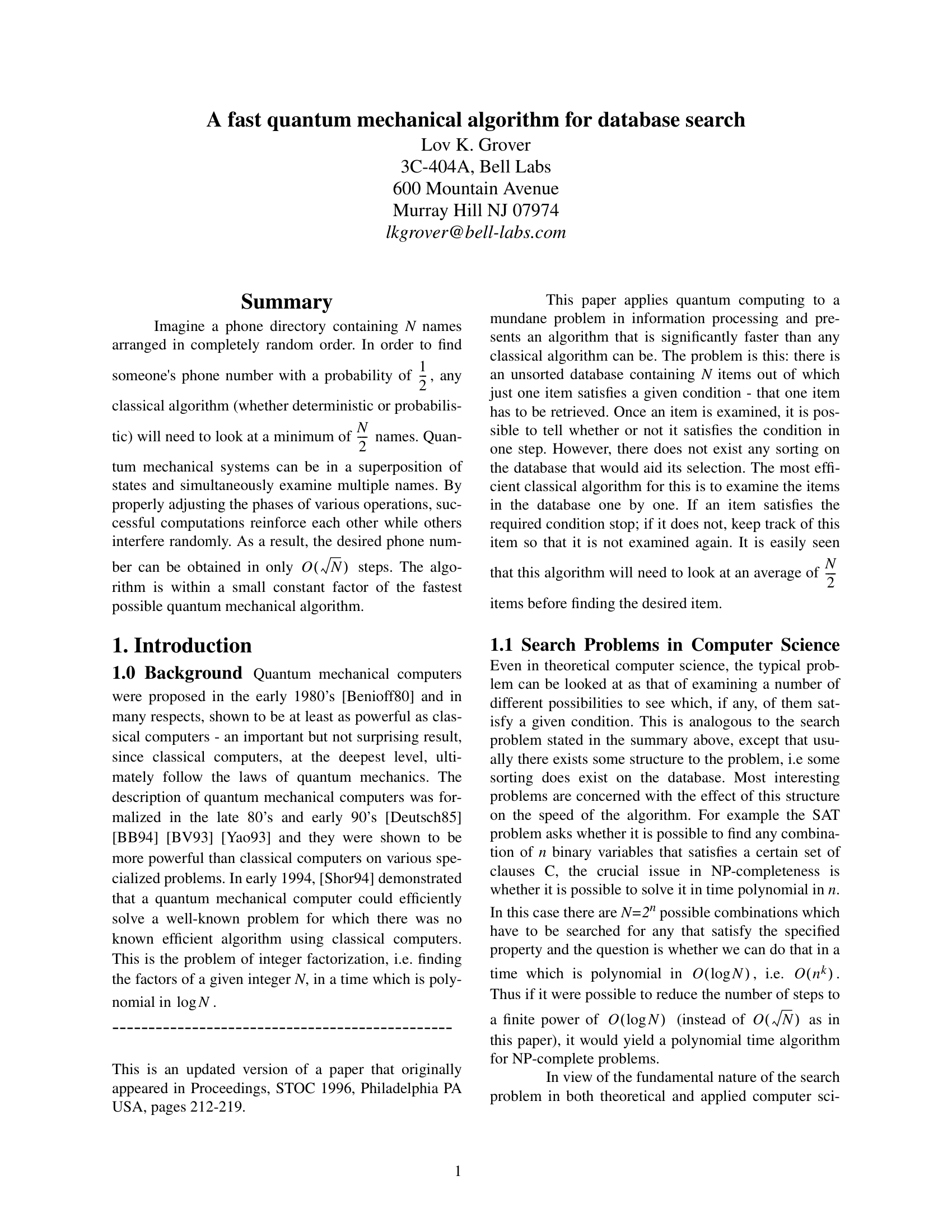
이 분석을 통해 도출해낸 목표는 비정형 데이터의 탐색 공간을 비선형적으로 압축하여 시장의 구조적 비효율성을 가장 먼저 선점하는 것입니다. 본 문서는 양자 역학의 기초 물리 법칙이 실전 거래의 정보 차익거래 시스템으로 치환되는 경이로운 과정을 조명하는 형식으로 전개됩니다.
Grover Algorithm Catalyzes 1 Monumental Shift in Unstructured Search Paradigms
Greetings to those who dwell at the fascinating intersection of theoretical physics and quantitative market modeling. When I first encountered the foundational texts of quantum computation during my early academic pursuits, Lov K. Grover's 1996 paper detailing a fast quantum mechanical algorithm for database search appeared to me as an elegant, albeit purely theoretical, mathematical puzzle. I read it with a fleeting sense of fascination, much like one admires a cleverly constructed paradox. However, as the years progressed and my immersion in the chaotic architecture of global financial markets deepened, I found myself returning to this exact manuscript. Upon revisiting these pages with a seasoned perspective on the severe latencies plaguing institutional data processing, the profound depth and sheer structural inevitability of Grover's propositions left me genuinely astounded. It is staggering to consider that an architectural blueprint drafted over two decades ago holds the precise topological keys to dismantling the sequential bottlenecks we face in modern quantitative research today. This manuscript does not merely answer how we might find a needle in a haystack; it fundamentally redefines the very fabric of the haystack, prompting us to rethink the genesis of algorithmic interaction and the latent potential hidden within unstructured domains. Through this exposition, you will acquire a newly calibrated lens, observing the chaotic universe of data not as a linear obstacle course, but through the highly orchestrated perspective of probability amplitudes and phase inversions.
Phase 1: The Tyranny of Linearity and the Unstructured Abyss
The contemporary landscape of systematic research is fundamentally incarcerated by a singular, inescapable physical constraint: the temporal degradation inherent in isolating a definitive signal within a purely chaotic, unstructured dataset. Let us observe the foundational problem definition. In classical computing paradigms, if one is tasked with locating a specific entry in an unsorted database comprising N elements, the system must undertake an exhaustive, sequential interrogation. The mathematical reality dictates that, statistically, this search requires N / 2 operations to achieve a probable success, and in the worst-case scenario, it demands exactly N operations. This O(N) complexity is not merely a benign mathematical abstraction; it is the fundamental gravitational friction that governs global processing latency. It establishes the absolute physical boundaries regarding how rapidly institutional capital can parse, internalize, and react to sprawling alternative data streams. When we confront the vast arrays of unstructured market data, ranging from sprawling global sentiment indices and fragmented order book imbalances to raw, unprocessed satellite imagery, we are essentially navigating a blind, unindexed labyrinth. The conventional logic insists that without a pre-existing index, one must sequentially knock on every computational door until the anomaly is unveiled. Yet, the architectural limits of silicon-based sequential processing are rapidly approaching their absolute physical asymptotes. The necessity for a profound structural deviation is no longer a theoretical luxury discussed in academic halls, but an empirical imperative for survival in the algorithmic ecosystem.
The Exhaustive Search Bottleneck
In the rigorous theater of systematic trading, identifying a mispriced derivative contract across a multidimensional, globally distributed options surface represents the ultimate unsorted search problem. When volatility surfaces warp instantaneously under macroeconomic stress, the classical pricing engines evaluate these nodes sequentially. The inescapable O(N) constraint forces a critical latency gap between the exact millisecond a pricing anomaly materializes and the moment a quantitative firm can execute a stabilizing arbitrage trade. The entity that successfully collapses this search time inherently dictates the market's liquidity premium. Relying on linear progression in a non-linear market is akin to mapping the ocean floor with a single sounding line; it is exhaustively slow and structurally inferior.
Phase 2: The Quantum Oracle and the Architecture of Superposition
The monumental breakthrough formalized by Grover bypasses the arduous sequential interrogation process entirely by exploiting the bizarre yet rigorously predictable mechanics of the quantum realm. Instead of examining computational elements one by one, the quantum system initializes a state of uniform superposition across all N possible states. In this remarkably delicate architecture, the system essentially occupies and observes every potential solution simultaneously. It is a state of total, omnipresent potential. However, maintaining superposition alone yields a uniform, random probability distribution. If one were to observe or measure the system immediately, the collapse of the wave function would result in a purely random output, rendering the massive parallelization entirely useless. The system requires a mechanism to distinguish the signal from the omnipresent noise without collapsing the state.
The architectural genius lies in the introduction of a specialized operator known as the Oracle. The Oracle functions as a quantum black-box operation, meticulously designed to recognize the target item based on a predefined condition, without needing to know the target's exact location. When the vast superposition of states passes through the Oracle, an extraordinary phenomenon occurs: the phase of the correct target state is inverted multiplied by negative one, while the phases of all other incorrect states remain completely untouched. Visually, if all probabilities are pointing upwards, the Oracle flips the single correct probability downwards. This phase inversion does not change the probability of measuring the state directly, but it marks the target cryptographically within the quantum system, setting the stage for the crucial next step. It is a silent, profound identification process occurring in the dark space of unmeasured variables.
The Phase Inversion of Signal Detection
Consider a highly complex statistical convergence framework monitoring tens of thousands of correlated global asset pairs. Most of these pairs exhibit random, un-tradable noise resembling the standard, uniform superposition of states. In this paradigm, the Oracle functions as our stringent, mathematical trigger condition perhaps a definitive threshold of mean-reversion deviation or a localized liquidity vacuum. By applying an analog of phase inversion to our algorithmic filters, we do not merely scan for deviations sequentially; we mark the structural anomalies instantly across the entire monitoring space. We effectively invert the mathematical sign of the single pair experiencing a critical dislocation, creating a systemic marker that separates the orthogonal excess return vector from the vast sea of systemic beta.
Phase 3: Amplitude Amplification as the Iterative Engine
Identifying the target through phase inversion is only half the battle; the system must now amplify that hidden signal so it becomes measurable. This is achieved through the process of amplitude amplification, which acts mathematically as an inversion about the mean. Because the target state's amplitude was rendered negative by the Oracle, the overall mean amplitude of the entire massive system drops slightly. When the diffusion operator inverts all amplitudes around this newly established, lower mean, an astonishing redistribution occurs. The amplitude of the target state, starting from a negative position, surges dramatically upwards past the mean, while the amplitudes of the billions of incorrect states shrink slightly towards zero. This orchestrated, symmetrical manipulation of probabilities sculpts the quantum landscape, elevating the distinct signal out of the overwhelming noise.
Crucially, amplitude amplification is not a singular, instantaneous event; it is an iterative, meticulously calibrated refinement. The profound realization of the Grover methodology is that the cycle applying the Oracle followed by the diffusion operator must be repeated a highly specific number of times. The diffusion operator continuously, rhythmically redistributes the probability mass from the vast ocean of incorrect states directly into the singular target state. If the iteration is halted prematurely, the probability of measuring the correct state remains vastly insufficient. Paradoxically, if the algorithmic iteration continues past the optimal mathematical point, the amplitude of the target state begins to diminish, oscillating back into the noisy background. The mathematics rigorously dictate that the peak probability of observing the correct state is achieved after approximately π / 4 × √N iterations. This optimal stopping boundary defines the absolute efficiency of the algorithm, transforming an endless linear journey into a precise, cyclical convergence.
Constructive Interference in Feature Extraction
In the rigorous realm of deep reinforcement learning applied to high-frequency market microstructure, the iterative diffusion process beautifully mirrors the optimization cycles of neural networks extracting definitive features from chaotic order book snapshots. Just as the quantum algorithm requires a precise stopping point to avoid losing the amplified target state, an advanced algorithmic trading model must employ sophisticated early stopping mechanisms to prevent catastrophic overfitting. The iteration is a deliberate, constructive interference of truth against noise. It requires quantitative researchers to calibrate the depth of their neural search space to the optimal √N boundary of their specific historical data universe, ensuring the execution signal is triggered precisely at its statistical zenith before the market paradigm shifts.
Phase 4: The Geometric Choreography of Vector Rotation
To truly appreciate the elegance of this mechanism, we must demystify the abstract linear algebra and visualize the algorithm as a rigid, rhythmic rotation within a two-dimensional geometric plane. Let us define a plane spanned by two completely orthogonal vectors: one vector representing the uniform superposition of all incorrect, irrelevant states, and the other vector representing the pure, isolated target state itself. The initial state of the quantum computer is a vector lying almost entirely flat along the massive axis of incorrect states, with only a microscopic, almost imperceptible angle separating it from that axis of failure.
Each application of the iterative cycle acts as a precise geometric rotation of this state vector within the plane. The Oracle operator reflects the vector across the axis of incorrect states, and the diffusion operator subsequently reflects the vector across the initial uniform superposition vector. The net mathematical result of these two consecutive reflections is a pure, unadulterated rotation directly toward the target state vector. With each cyclical iteration, the state vector steadily and relentlessly rotates, sweeping across the geometric plane. After the optimal number of iterations, the vector aligns almost perfectly with the target axis, ensuring that a final measurement will yield the desired database entry with near absolute certainty. It is a breathtaking mathematical choreography, turning a needle in a haystack into a beacon that naturally aligns with the observer's instrument.
Vector Space Portfolio Realignment
This geometric rotation profoundly parallels the continuous, dynamic realignment of a multi-asset portfolio vector towards the optimal trajectory. In a massive, multi-dimensional factor-investing model, the current portfolio allocation is merely a single vector in an N-dimensional space, heavily weighted and dragged down by market noise, transaction costs, and suboptimal factor exposures. The continuous ingestion of new, unstructured data acts as our rotational operator. Instead of randomly rebalancing which represents a classical, inefficient O(N) approach the sophisticated quantitative optimizer mathematically reflects and rotates the portfolio vector away from the dense hyperplane of systemic risk. It systematically aligns the capital distribution directly with the orthogonal axis of pure, idiosyncratic excess return, step by calculated step.
Phase 5: Asymptotic Dominance and the Collapse of Complexity
The true, world-altering magnitude of this theoretical architecture is revealed entirely in its asymptotic complexity analysis. While a classical computational system unequivocally mandates O(N) operations to guarantee success in locating a target in an unsorted database, the quantum mechanical framework achieves the exact same guarantee in O(√N) operations. This paradigm shift from a linear dependency to a sub-linear, square-root time complexity represents a massive quadratic speedup. In the realm of small numbers, this might seem like a mere optimization. However, in domains where N represents millions, billions, or trillions of unstructured data points, the divergence between N and √N transitions from a mere quantitative improvement to a qualitative redefinition of what is physically and computationally feasible.
This quadratic dominance breaks the historical tyranny of exponential data growth. It ensures that our capacity to interrogate and derive meaning from vast datasets scales far more gracefully than the expanding datasets themselves. The implications for cryptographic hashing vulnerabilities, exhaustive private key searches, and extraordinarily complex combinatorial optimization problems are absolute and unyielding. It suggests a future where the sheer volume of data is no longer the primary hurdle, but rather the ingenuity of the Oracles we design to parse it.
The Latency Asymptote and Structural Edge
In the relentless, hyper-competitive arms race of autonomous market making, the research firm operating with O(√N) search efficiency across real-time, fragmented data feeds processes the universe of market possibilities exponentially faster than competitors operating at classical O(N) constraints. If a decentralized liquidity network contains one million hidden transaction pockets, classical models require five hundred thousand sequential probes to accurately map the liquidity state. The quantum-inspired logic maps the exact same state space in roughly one thousand precise iterations. This staggering quadratic reduction in processing latency is the absolute definition of an insurmountable structural edge. It allows advanced algorithms to parse, compute, and execute upon deep-book imbalances while traditional algorithms are still initializing their basic search parameters.
Phase 6: Expansions into Generalized Frameworks
The breathtaking architecture of this search mechanism is by no means confined merely to looking up a distinct, static entry in a database. It serves as a infinitely generalized framework for amplitude amplification, which can be elegantly extended to tackle an expansive array of complex computational challenges. Whenever a problem relies on evaluating a heuristic, testing a hypothesis, or isolating a minority property within a vast, chaotic combinatorial space, the Oracle can be custom-reprogrammed to flag that specific, nuanced condition. The core engine remains identical; only the definition of the target changes.
This theoretical elasticity extends deeply into the territory of solving NP-complete problems, where the potential search space typically grows exponentially with the size of the input. While Grover's methodology does not miraculously provide polynomial-time solutions to these deeply entrenched problems, the quadratic speedup fundamentally alters the practical boundaries of computational tractability. Tasks that would take millennia on classical supercomputers could be reduced to fractions of that time. Furthermore, the algorithm can be dynamically modified to locate multiple target states simultaneously, automatically adjusting the geometric rotational angle and the iteration count on the fly based on the unknown, fluctuating number of valid solutions residing within the dataset.
Multivariate Stress Testing and Scenario Generation
The extension of this generalized framework maps flawlessly onto the acceleration of Monte Carlo simulations and multi-variate risk pricing engines. When evaluating the systemic tail-risk of a sprawling, heavily cross-collateralized derivatives portfolio, calculating the accurate Value at Risk (VaR) involves searching through millions of simulated, stochastic market trajectories for the distinct, highly specific scenarios that trigger catastrophic capital breaches. By treating these catastrophic economic paths as the target states of a generalized quantum search, quantitative risk models can amplify the probability of identifying hidden tail-risk events without enduring the computational drag of executing every single benign simulation path. This vastly accelerates the accurate pricing of complex structured products in intensely volatile regimes.
Phase 7: Historical Synthesis and The Shoulders of Giants
The conceptual foundation of this algorithm is deeply and respectfully anchored in the preceding, audacious explorations of quantum mechanical computation. It does not exist in a vacuum; rather, it builds meticulously upon the theoretical scaffolding constructed by visionary pioneers like Richard Feynman and David Deutsch, who first boldly theorized that quantum systems could execute specific mathematical operations fundamentally faster than classical deterministic Turing machines. The brilliant integration of unitary matrices, quantum interference patterns, and probability amplitude manipulation draws directly and heavily from the dense, foundational texts of early quantum information theory.
By examining the historical trajectory of these early, highly theoretical papers, one observes the breathtaking transition from abstract physics thought experiments to rigorous, deployable algorithmic logic. It stands as a powerful testament to the fact that profound technological leaps rarely emerge in sudden isolation; they are synthesized from the meticulous, progressive, and sometimes rebellious dismantling of classical assumptions over decades. Recognizing this lineage allows us to appreciate the algorithm not just as a tool, but as a pinnacle of human intellectual triumph over the limitations of classical physics.
The Evolution of Financial Paradigms
Just as these algorithms evolved from the dense theoretical physics literature of the late twentieth century, the next generation of financial modeling relies entirely on absorbing and adapting paradigms outside traditional, siloed econometrics. The historical evolution from the rigid assumptions of the Black-Scholes model to dynamic local volatility surfaces, and now to advanced machine learning-driven stochastic pricing grids, requires researchers to constantly reference, respect, and integrate adjacent scientific disciplines. The research firm that successfully maps quantum search topologies onto topological data analysis for financial time series will undoubtedly command the next decade of systemic edge generation.
Frequently Asked Questions
결론
궁극적으로 이 탐구를 통해 도출해낸 목표는 비정형 데이터의 거대한 탐색 공간을 비선형적으로 압축하여 시장에 내재된 구조적 비효율성을 그 누구보다 먼저 선점하는 것입니다. 물리학의 극미한 영역에서 증명된 우아한 수학적 진리가 거대한 금융 데이터의 폭력적인 홍수 속에서 새로운 수익 창출의 절대적인 나침반이 될 수 있음을 깊이 인지하는 순간, 우리는 기존 데이터 공학의 한계를 완전히 뛰어넘어선 새롭고 경이로운 차익거래의 지평을 마주하게 됩니다. 이 글을 끝까지 함께해주신 연구자 분들께 깊은 감사를 전합니다.