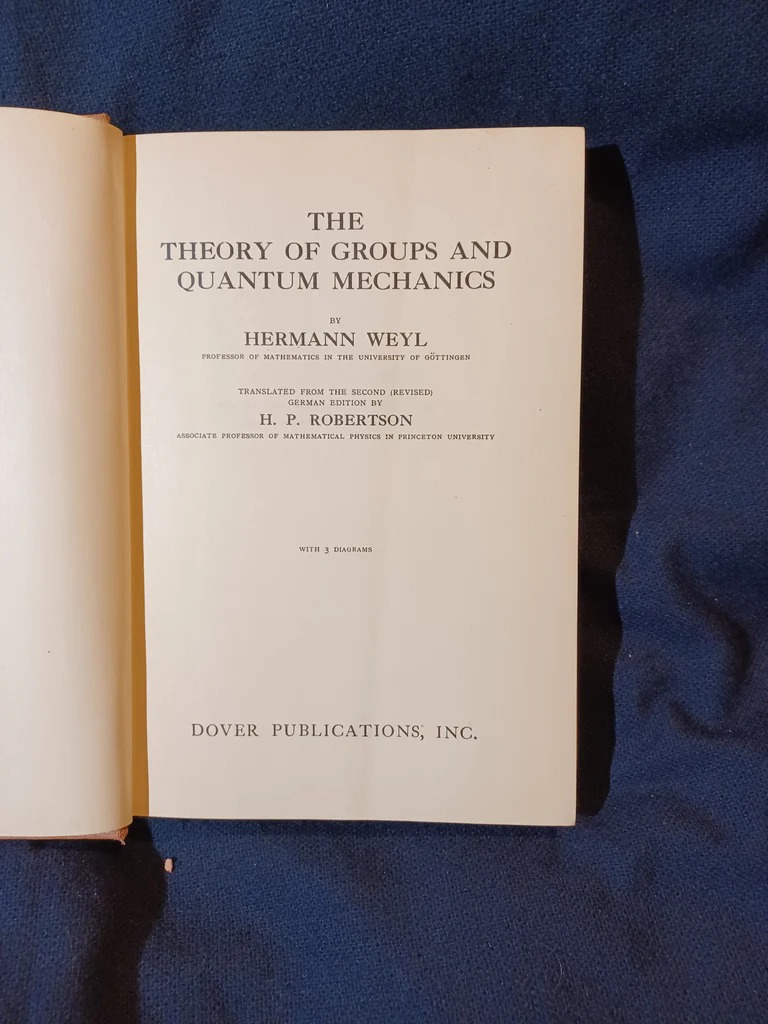
혼돈 속의 기하학: 양자 대칭성에서 시장 불변성을 추출하다
우리는 매일 고빈도 매매의 노이즈와 거시경제의 폭력적인 변동성 한가운데 서 있습니다. 이 압도적인 확률적 세계에서 살아남기 위한 해답을, 현대 물리학의 근간을 이룬 헤르만 바일(Hermann Weyl)의 '군론과 양자역학'(The Theory of Groups and Quantum Mechanics)에서 추출합니다.
이 글은 입자의 대칭성과 기하학적 불변성이라는 양자역학적 진리를 시장 불변성(Market Invariants)과 구조적 알파(Structural Alpha)를 발견하기 위한 실전적이고 철학적인 프리즘으로 치환하는 치열한 지적 탐험입니다. 비평형 상태의 시장에서 흔들리지 않는 '고요한 중심'을 찾고자 하는 분들을 이 여정에 초대합니다.
There are profound moments in our existence when the sheer unpredictability of our surrounding environment forces us to pause and deeply question the underlying fabric of reality. I used to stare at the flickering screens of global market tickers late into the night, watching the chaotic, almost violent dance of prices, and ask myself a fundamental question. Is there a hidden, elegant order beneath this relentless turbulence? What is the true, unvarnished nature of the complex systems we are desperately trying to navigate? For those who find themselves lost in the dizzying complexity of modern financial ecosystems or the profound mathematical mysteries of physical reality, Hermann Weyl's timeless masterpiece, The Theory of Groups and Quantum Mechanics, offers an unexpected and deeply illuminating sanctuary.
To categorize this monumental volume merely as a textbook on theoretical physics or pure mathematics would be a profound understatement of its true value. It is, in its purest essence, a sweeping philosophical revelation woven meticulously through the rigorous and unforgiving logic of mathematical symmetries. It effortlessly bridges the daunting gap between the abstract algebra of transformation groups and the deeply human, existential quest for universal invariants. Weyl possesses a rare, almost poetic pedagogical grace, mapping out the multi-layered landscape of quantum states in a manner that resonates profoundly with our macroscopic struggles to find meaning and order. We naturally, and perhaps naively, perceive our world as a linear, predictable sequence of deterministic events. However, Weyl, by uniting the elegant structures of group theory with the probabilistic nature of quantum mechanics, unveils a universe governed not by rigid certainties, but by transformative symmetries and hidden invariant truths that remain constant even as the system undergoes radical shifts.
This exhaustive discourse transcends the boundaries of a conventional book review. It is designed as a rigorous intellectual expedition. I intend to meticulously translate Weyl's formidable mathematical framework into a functional, highly operational prism through which we can decode not only the discrete atomic spectra of microscopic particles but the very nature of market invariants and structural alpha in global finance. We build towering mathematical edifices, employing stochastic calculus and differential geometry, yet we must always stand in quiet awe of the vast, breathing ecosystem of human lives and unpredictable endeavors that these equations merely attempt to sketch. For those who have hesitated before the formidable reputation of quantum theory, or for astute practitioners seeking a definitive, mathematically grounded compass to navigate stochastic environments, this extensive analysis will serve as your foundational guide.
1. Quantum Theory and the Concept of Groups: The Departure from Determinism
The genesis of modern understanding, both in the microscopic physical realm and the macroscopic theaters of human exchange, requires a definitive departure from classical mechanics. The classical paradigm, heavily reliant on Newtonian determinism, posited a universe where the precise knowledge of initial conditions guaranteed absolute predictability of all future states. In the context of economic theory, this mirrors the traditional models of perfect rationality and absolute equilibrium, where market participants act with flawless foresight. However, as Weyl systematically demonstrates, the advent of quantum theory shattered this illusion of perfect determinism. The physical reality at the atomic level is not governed by definitive trajectories, but rather by probability amplitudes and inherent uncertainties. This quantum leap in physics perfectly parallels the realization in modern quantitative finance that markets are fundamentally stochastic, driven by probability distributions rather than deterministic paths.
To navigate this new probabilistic reality, Weyl introduces the concept of transformations and symmetry as the new foundational pillars of truth. When absolute positions and momenta can no longer be simultaneously known, the focus shifts to how systems behave under various transformations. A symmetry exists when a system undergoes a transformation but its core observable properties remain completely unchanged. This brings us directly to the mathematical definition of a Group. A group is an elegant algebraic structure consisting of a set of elements equipped with an operation that seamlessly satisfies four fundamental properties: closure, associativity, the existence of an identity element, and the existence of inverse elements. By abstracting the specific details of a system and focusing solely on the structure of its permissible transformations, group theory provides a universal language for describing symmetries.
Before we impose our mathematical will upon the data, we must recognize the limits of our perception. Group theory teaches us that what we perceive as reality is merely one specific projection of a much larger, symmetrical truth. Our localized viewpoint is inherently incomplete.
In the chaotic environment of global markets, identifying a Group Theory Symmetry and Market Invariants becomes the ultimate quest for the quantitative practitioner. Consider a portfolio of assets undergoing continuous rebalancing. The operations of buying, selling, and hedging can be viewed mathematically as transformations acting upon a vector space of capital allocations. If we can identify a specific group of transformations under which the risk-adjusted return profile of the portfolio remains invariant, we have discovered a fundamental symmetry of the market. This is the essence of structural alpha. It is not merely about predicting the next price movement, which is clouded by quantum-like uncertainty, but about constructing a portfolio architecture that preserves its optimal state regardless of the noisy transformations occurring in the broader economic environment.
Weyl expands this framework by detailing the distinction between discrete groups, such as the permutations of finite elements, and continuous groups, particularly Lie groups. Continuous groups are of paramount importance because they describe symmetries that vary smoothly, much like the continuous flow of time or the seamless evolution of asset prices in a high-frequency trading environment. A Lie group allows us to study macroscopic transformations by analyzing their infinitesimal generators. This concept is revolutionary. It implies that if we understand the mechanics of the smallest possible transformation occurring in an infinitesimal time step dx/dt, we can integrate these generators to comprehend the entire macroscopic trajectory of the system.
Applying the concept of Lie groups to financial markets transforms our understanding of volatility and drift. The stochastic differential equations that govern asset pricing are fundamentally connected to the generators of specific continuous groups. The market's state space is constantly being deformed by external macroeconomic shocks and internal liquidity dynamics. However, beneath these continuous deformations, certain invariants remain intact. By utilizing the rigorous mathematics of continuous groups, we can isolate these invariants, separating the meaningful, persistent signals from the transient, chaotic noise. This is where the cold, abstract intellect of theoretical physics warms to the practical, deeply human endeavor of preserving and growing capital amidst relentless uncertainty.
Ultimately, the first profound lesson from Weyl is the elevation of relationships over entities. In the classical view, the object itself was paramount. In the group-theoretic view, the transformations that connect objects, and the invariants that survive those transformations, hold the true essence of reality. We must stop trying to pinpoint the exact deterministic future of a market price, and instead map out the comprehensive group of symmetries that govern the pricing mechanism itself. This shift in perspective, from static prediction to dynamic invariant mapping, is the quintessential first step in achieving true mastery over complex, stochastic systems.
2. Representation of Groups: The Linear Mapping of Complex Realities
Abstract algebra, in isolation, is a construct of pure thought, beautiful but detached from physical or economic reality. Hermann Weyl's true genius lay in his masterful exposition of representation theory, the mathematical bridge that connects abstract groups to concrete linear transformations of vector spaces. A representation of a group essentially maps its abstract elements to matrices, allowing the group operations to be expressed as simple matrix multiplication. This process is absolutely vital because it translates the profound but abstract symmetries of a system into quantifiable, computable matrices that can operate on the state vectors of physical particles or financial portfolios.
The concept of linear representations requires us to view the state of a system as a vector residing in a multidimensional Hilbert space. In quantum mechanics, this vector encompasses all the probability amplitudes of the particle's possible states. When a physical transformation occurs, such as a rotation in space or a translation in time, it is mathematically executed by multiplying the state vector by a specific matrix representing that transformation. If we transpose this profound concept to the realm of modern finance, the state vector represents our complex portfolio holdings across numerous asset classes, and the transformation matrices represent the macroeconomic shocks, interest rate shifts, and liquidity draining events that act upon the market.
However, dealing with massive matrices that represent every conceivable interaction within a system is computationally intractable and conceptually opaque. Here, Weyl introduces the vital concept of irreducible representations. Any complex, reducible representation can be systematically broken down, or decomposed, into a direct sum of irreducible representations. These irreducible representations are the fundamental building blocks of symmetry. They are the prime numbers of group theory. They represent the pure, indivisible modes of transformation that cannot be further simplified. Finding the irreducible representations of a system's symmetry group is akin to discovering its ultimate, irreducible truths.
The economic parallel to decomposing a representation into its irreducible components is immediately striking to any quantitative researcher. When analyzing a vast covariance matrix of thousands of global equities, the raw data is overwhelmingly noisy and deeply correlated. The matrix is highly reducible. By applying techniques analogous to representation decomposition, such as Principal Component Analysis or spectral decomposition, we break down the complex market movements into independent, orthogonal risk factors. These fundamental risk factors are the financial equivalents of irreducible representations. They are the pure, uncorrelated drivers of variance in the market, completely independent of one another.
Understanding these irreducible risk factors allows practitioners to construct portfolios that are structurally immune to certain types of market transformations. If a portfolio is constructed to have zero exposure to a specific irreducible representation of the market's transformation matrix, it achieves a state of symmetry with respect to that specific risk. It becomes an invariant. This is the sophisticated, mathematically rigorous foundation of true market neutrality. It is not merely balancing long and short dollar amounts, but meticulously balancing the exposures to the hidden, fundamental generators of market phase transitions, ensuring that the portfolio's core value remains invariant under the brutal actions of the market group.
Weyl's exposition on the decomposition of representations teaches us that complexity is often just an illusion created by the entanglement of simpler, more fundamental truths. By relentlessly pursuing the irreducible representations of the systems we engage with, whether they be the quantum states of an electron or the hidden risk premia in global equities, we strip away the chaotic facade and reveal the elegant, invariant structures beneath. This meticulous linear mapping of complex realities into their irreducible matrices is the essential methodology for transforming raw, unyielding data into actionable, invariant alpha.
When we map market data into a high-dimensional vector space, the eigenvalues extracted from the transformation matrices do not merely represent statistical variance; they represent the structural integrity of the market's current state. The dominant eigenvalues correspond to the macroeconomic forces currently tearing through the state space, while the eigenvectors provide the exact geometric coordinates of those forces. True mastery requires identifying the null space of these matrices, the precise coordinates where the market's transformative energy equates to zero, offering a sanctuary of invariant value.
3. Rotational Groups, Quantum Spin, and Market Momentum
One of the most profound and counter-intuitive discoveries of early quantum mechanics was the concept of intrinsic spin, a property that classical physics could neither predict nor adequately explain. Weyl tackles this mystery by deeply analyzing the three-dimensional rotation group, denoted mathematically as SO(3), and its profound relationship with angular momentum. In the classical macroscopic world, if you rotate an object 360 degrees, it returns exactly to its original state. This is the intuitive nature of SO(3). However, when physicists began analyzing the spectral lines of atoms in magnetic fields, they discovered anomalies that suggested particles possessed an internal, intrinsic form of angular momentum that did not correspond to physical rotation in spatial dimensions.
Weyl rigorously explains that to fully understand the quantum states of electrons, we must look beyond the simple rotation group SO(3) and delve into its double cover, the special unitary group SU(2). The mathematics of SU(2) reveal a startling truth: there exist mathematical entities, known as spinors, which must be rotated by a full 720 degrees, not 360 degrees, to return to their original, identical state. A 360-degree rotation actually flips the sign of the spinor's wavefunction. This concept of half-integer spin fundamentally rewrote the laws of physics, demonstrating that the microscopic reality possesses a more complex, interwoven geometric structure than our macroscopic intuitions allow us to perceive.
The conceptual framework of spinors and the SU(2) group offers an exceptionally powerful, albeit abstract, lens for analyzing complex financial market cycles and behavioral momentum. In financial markets, we frequently observe cyclical behavior, oscillating between phases of extreme greed and profound fear. A naive observer might assume that a complete market cycle, moving from peak to trough and back to peak, represents a 360-degree rotation back to the initial state. However, the market possesses an intrinsic "spin" driven by the cumulative psychological scarring and regulatory adaptations of its participants.
When a market completes a severe boom-and-bust cycle, the price index may return to its original high water mark (a 360-degree rotation in price space), but the underlying state of the system is fundamentally altered. The leverage dynamics have changed, institutional memory has been overwritten, and the regulatory environment has hardened. The market state vector has undergone a sign change, much like a spinor after a 360-degree rotation. To return to the true, identical initial state of risk appetite and structural vulnerability, the market must often undergo a secondary, confirming cycle. It requires a 720-degree rotation in the abstract psychological state space to truly reset. Recognizing this intrinsic spin of human collective behavior prevents the catastrophic error of assuming that equal prices equate to equal risks.
Do not assume that an asset returning to its previous price level is in the same structural state. Just as a Fermion requires a 4π rotation to return to its initial quantum state, an asset recovering from a crash carries a different volatility 'spin' than it did before the crash. The price is the same, but the internal geometry has profoundly shifted.
Furthermore, the mathematics of angular momentum and the commutation relations of its generators define the strict limits of what can be simultaneously known about a spinning system. The Heisenberg uncertainty principle is deeply encoded within the non-commutative algebraic structure of these rotational groups. In the context of Group Theory Symmetry and Market Invariants, this teaches us a crucial lesson about the velocity and momentum of asset prices. We cannot simultaneously measure the absolute instantaneous trend of an asset and its precise localized volatility with infinite precision. The very act of measuring over shorter time frames introduces severe structural noise, a phenomenon thoroughly understood through the non-commutative properties of market operators.
By internalizing Weyl's masterclass on rotational groups, we graduate from linear, Euclidean thinking to a more sophisticated, manifold-based understanding of dynamic systems. We learn to anticipate the sign flips in market sentiment that occur even when nominal prices recover. We recognize that the momentum of human endeavor is not merely a vector pointing forward, but a complex, spinning entity defined by the rigorous boundaries of SU(2) topology. This profound geometric perspective is essential for designing strategies that can survive the complex, multi-layered rotations of global macroeconomic cycles.
4. Symmetries, Conservation Laws, and Market Invariants
Perhaps the most beautiful and far-reaching conceptual bridge built in theoretical physics is the connection between the abstract mathematical concept of symmetry and the physical reality of conservation laws. This profound linkage, formalized by Emmy Noether and extensively utilized by Weyl throughout his treatise, states unequivocally that every continuous mathematical symmetry of a physical system leads directly to a corresponding conserved quantity, an invariant. If the laws governing a system are invariant under translations in time, the system conserves energy. If they are invariant under spatial translations, the system conserves linear momentum. Symmetries dictate the unbreakable rules of the universe.
Weyl applies this rigorous logic to construct the mathematical structure of quantum states. The state space of a quantum system is vast and complex, evolving continuously under the influence of various energetic operators. However, amidst this constant, unceasing evolution, the symmetries of the Hamiltonian operator define the quantities that will absolutely not change over time. These invariants serve as the bedrock of physical reality, the reliable anchors in a sea of probability and uncertainty. Without these symmetry-induced invariants, the universe would descend into an unintelligible, structureless chaos.
The pursuit of Group Theory Symmetry and Market Invariants is the direct application of Noether's theorem to the chaotic ecosystem of financial markets. In a complex, adaptive market, prices, volumes, and volatilities are in a state of continuous, violent flux. However, if we can identify the deep structural symmetries of the economic mechanism, we can deduce the corresponding market invariants. What is conserved in a closed financial ecosystem? While money can be created or destroyed by central banks, relative pricing relationships, structural risk premiums, and specific arbitrage boundaries often exhibit powerful conservation properties driven by the continuous symmetries of institutional capital flows.
Consider the symmetry of information within a highly efficient market subsystem. If the pricing mechanism is invariant to the specific identity of the market maker executing the trade (a form of permutation symmetry), it implies a conservation of the bid-ask spread relative to the asset's intrinsic volatility. If we discover a continuous symmetry in how a yield curve deforms under macroeconomic stress, we have identified an invariant relationship between different maturity tenors that can be exploited relentlessly. These invariants are the holy grail of quantitative finance; they are the true structural alpha that persists regardless of the overarching market direction.
Weyl's exploration of state spaces and transformations also emphasizes that the observation of a system inherently involves interacting with these symmetries. When we project a complex quantum state onto a specific basis vector to measure an observable, we are fundamentally asking the system to reveal its state relative to a specific symmetry axis. In finance, when we construct a portfolio, we are projecting our capital onto the complex state space of the global economy. If our portfolio is perfectly aligned with the invariant axes dictated by the market's fundamental symmetries, our capital becomes conserved and insulated from orthogonal shocks.
This profound understanding forces us to operate with a sense of macroscopic humility. We realize that we cannot force the market to adhere to our arbitrary, linear predictions. Instead, we must humbly observe the complex transformations, employ the rigorous algebra of continuous groups to uncover the hidden symmetries, and align our strategies with the resulting conservation laws. The market's state space is far too vast to be conquered by brute force prediction; it must be navigated by anchoring oneself to the unbreakable invariants forged by the system's own inherent symmetries.
5. Eigenvalue Problems, Spectral Theory, and the Architecture of States
To extract measurable, concrete reality from the abstract realm of Hilbert spaces and linear operators, Weyl relies heavily on the profound mathematics of eigenvalue problems and spectral theory. In the quantum framework, every physical observable, such as momentum, position, or energy, is represented by a specific mathematical operator. The possible values that we can actually measure in an experiment are precisely the eigenvalues of that specific operator. The corresponding eigenvectors represent the pure, definitive states in which the system possesses that exact value. The entire structure of reality is thus broken down into a discrete or continuous spectrum of eigenvalues.
Spectral analysis is the mathematical art of resolving a highly complex, entangled operator into its fundamental, orthogonal components. It allows physicists to understand the exact, distinct energy levels an electron can occupy within an atom, explaining the precise spectral lines we observe in the light emitted by stars. The spectrum reveals the hidden, quantized architecture of the physical system, demonstrating that nature is not merely a continuous blur, but a meticulously organized hierarchy of allowed states and transitions.
This mathematical architecture has a direct, incredibly powerful mapping to the analysis of complex financial systems. The yield curve of a sovereign nation, for instance, is not merely a collection of distinct interest rates; it is the observable spectrum of a deeply complex macroeconomic operator acting upon the state space of the global economy. By applying spectral decomposition to the historical covariance matrix of these interest rates, we extract the eigenvalues and eigenvectors that define the fundamental architecture of the yield curve. We discover that the vast complexity of the curve can be almost entirely explained by three primary, orthogonal eigenvalues: parallel shift, slope change, and curvature deformation.
The pursuit of Group Theory Symmetry and Market Invariants relies crucially on this eigenvalue decomposition. When we design a complex statistical arbitrage portfolio, we are attempting to construct a state vector that is entirely orthogonal to the dominant eigenvalues of the market matrix. If the primary eigenvalue represents the massive, chaotic fluctuations of the general market index, a truly invariant alpha strategy must have a dot product of zero with that corresponding eigenvector. We seek to occupy the quiet, hidden eigenvalues of the market spectrum, the subtle structural inefficiencies that the macroscopic forces overlook.
Furthermore, spectral theory provides a rigorous methodology for understanding phase transitions in complex systems. Just as the spectrum of a quantum Hamiltonian shifts dramatically under immense external pressure, altering the very nature of the material, the eigenvalue spectrum of the global financial matrix undergoes violent structural shifts during liquidity crises. The correlation matrices condense, and previously distinct, orthogonal eigenvectors collapse into a single, dominant singularity of panic selling. Understanding the spectral dynamics of the market allows practitioners to mathematically anticipate and measure these phase transitions, adjusting their state vectors before the structural collapse propagates through the entire system.
Weyl's exposition on the eigenvalue problem teaches us that we must never accept complex, entangled data at face value. We must relentlessly apply the tools of spectral analysis to break down the operators of our environment, isolating the pure eigenvalues and mapping the orthogonal eigenvectors. It is only by understanding this hidden spectral architecture that we can hope to construct strategies that possess true mathematical resilience, maintaining their integrity even as the dominant eigenvalues of the global macroeconomic spectrum fluctuate wildly.
6. Permutation Groups and the Statistics of Indistinguishable Entities
As quantum mechanics expanded its purview from single particles to multi-particle systems, a profoundly philosophical mathematical challenge emerged: the problem of identical particles. In classical mechanics, even if two billiard balls are perfectly identical in mass and volume, we can theoretically track their distinct trajectories over time; they retain an individual identity. Weyl demonstrates that in the quantum realm, this fundamental intuition breaks down entirely. Two electrons are absolutely indistinguishable. If their positions are swapped, the physical reality of the system must remain completely invariant. This introduces the profound application of the Permutation Group to the heart of physical reality.
The mathematical requirement that the probability density of the system must be invariant under the permutation of identical particles leads to a fascinating bifurcation in nature. The wavefunctions describing the system must be either entirely symmetric or entirely antisymmetric under particle exchange. Symmetric wavefunctions describe Bosons, particles like photons, which inherently prefer to occupy the exact same quantum state, leading to phenomena like lasers and Bose-Einstein condensates. Antisymmetric wavefunctions describe Fermions, particles like electrons, which are strictly forbidden from occupying the same state by the Pauli exclusion principle, a mathematical constraint that literally gives matter its solid structure and prevents stars from collapsing immediately.
This mathematical dichotomy between symmetric and antisymmetric states offers an incredibly elegant framework for analyzing the collective statistical behavior of agents in complex economic systems. While human participants are obviously not identical elementary particles, their behavioral manifestations in hyper-connected, high-speed markets often exhibit striking similarities to the statistical mechanics of indistinguishable entities. In the context of Group Theory Symmetry and Market Invariants, we can categorize market participants based on the permutation symmetry of their trading algorithms and behavioral heuristics.
Trend followers, momentum algorithms, and retail crowds driven by social media consensus operate in a mathematically symmetric fashion. They are the Bosons of the financial markets. They actively seek to occupy the exact same directional state, bunching together in massive herds. This symmetric behavior leads to the economic equivalent of Bose-Einstein condensates: massive, unsustainable asset bubbles and localized hyper-inflation of valuations. Their collective action defines the macroscopic momentum, but it inherently destabilizes the microscopic pricing efficiency, creating profound structural imbalances.
Conversely, sophisticated arbitrageurs, mean-reversion algorithms, and fundamental value investors operate in an antisymmetric framework. They are the Fermions of the ecosystem. By their very nature, they seek to exploit differences and discrepancies; they inherently refuse to crowd into the exact same saturated trade. They fill the distinct, unoccupied energy levels of the pricing spectrum, enforcing the Pauli exclusion principle of the market, ensuring that distinct assets maintain rational price differentials. They are the structural backbone that provides solidity and efficiency to the market, resisting the collapsing pressure of irrational exuberance.
Weyl's exploration of permutation groups teaches us that the macroscopic behavior of a complex system is fundamentally dictated by the permutation symmetries of its microscopic constituents. To engineer robust, invariant alpha generation systems, one must deeply understand whether the target ecosystem is currently dominated by the symmetric herding of financial bosons or the antisymmetric structuring of financial fermions. An optimal strategy must mathematically counterbalance the dominant statistical mechanics of the crowd, maintaining its invariant structure amidst the shifting sands of collective behavioral states.
7. The Lorentz Group and Relativistic Geometric Structures
The culminating triumph of theoretical physics in the early 20th century was the integration of quantum mechanics with Einstein's special relativity, an integration heavily reliant on the geometric structures illuminated by Weyl. The Galilean transformations that governed classical physics were proven inadequate at immense velocities. They were replaced by the Lorentz group, a complex mathematical structure that defines the symmetries of four-dimensional spacetime, preserving the invariant speed of light across all frames of reference. This shift forced physicists to abandon the concept of absolute, universal time and embrace a deeply interconnected geometric reality where space and time are fluid, yet bound by rigid symmetry.
Weyl masterfully explicates how the mathematical demands of the Lorentz group, specifically its representations through spinors, led Paul Dirac to formulate his relativistic wave equation. This equation not only unified relativity and quantum mechanics for the electron but mathematically demanded the existence of antimatter, a profound prediction derived entirely from the necessity of preserving group symmetry. The structure of the continuous Lorentz group, explored via the intricate mathematics of Lie algebras and infinitesimal generators, demonstrates that the fundamental laws of nature are ultimately expressions of pure differential geometry acting upon complex manifolds.
This transition from static algebraic representations to continuous differential geometric structures provides the ultimate framework for advanced quantitative finance. Just as physicists use the Lorentz group to model the invariant propagation of light across distorted spacetime, quantitative practitioners utilize the continuous time mathematics of stochastic differential equations and dynamic control theory to model the propagation of information and capital across distorted market environments. The mathematical techniques used to study the infinitesimal generators of Lie groups are directly analogous to the methods used in formulating the optimal continuous-time hedging strategies in modern derivatives pricing.
When we search for Group Theory Symmetry and Market Invariants in this continuous geometric landscape, we are effectively utilizing the framework of Hamilton-Jacobi-Bellman (HJB) equations. We treat the evolution of wealth and risk as a continuous trajectory moving through a highly curved, stochastic state space. The goal is to find the optimal control policy, a continuous transformation protocol, that maximizes an objective function regardless of the turbulent path dictated by market Brownian motion. The mathematical elegance of Lie algebras provides the rigorous tools necessary to analyze how infinitesimal local trades integrate over time to form robust, macroscopic geometric invariants.
Moreover, the concept of relativistic invariance has a compelling parallel in high-frequency trading and market microstructure. Just as the speed of light is the ultimate, invariant boundary in the Lorentz group, the speed of information propagation and the minimum latency of execution represent the absolute boundaries of arbitrage in global markets. The geometric structure of market liquidity and order flow can be modeled as a complex manifold where distance is measured not in miles, but in milliseconds and bandwidth. Understanding the continuous symmetries of this execution manifold is crucial for surviving in the relativistic environment of modern algorithmic trading.
Through the rigorous lens of Hermann Weyl, we realize that the abstract theories of groups and quantum mechanics are not merely esoteric tools for physicists mapping the atom. They are the universal language of complex, dynamic systems. They teach us that beneath the terrifying chaos of probability and continuous transformation, there exist elegant, hidden invariants dictated by strict mathematical symmetries. By embracing this profound geometric perspective, we elevate our interaction with the unpredictable rhythm of human endeavor, transforming from reactive participants tossed by the turbulent waves of stochasticity, into deliberate architects capable of extracting pure, invariant truth from the noise.
The Architecture of Invariance
(Where invariant space V remains unchanged under the action of Group g)
기하학적 통제권의 회복과 공공재적 알파
헤르만 바일의 렌즈를 통해 확인한 바와 같이, 거시적인 시장의 붕괴나 폭발은 결코 우발적인 난수가 아닙니다. 그것은 미시적 행위자들이 만들어내는 무수한 대칭성 연산과 HJB방정식의 지배를 받는 연속적인 기하학적 궤적의 결과물입니다. 우리는 시장을 억지로 예측하려는 고전적이고 결정론적인 오만에서 벗어나야 합니다. 대신, 이 거대한 매니폴드(Manifold) 위에서 어떤 변환에도 파괴되지 않는 절대적인 구조, 즉 시장 불변성을 찾아내야 합니다.
데이터의 표면적인 분산에 휘둘리지 않고, 그 이면에 숨겨진 기하학적 진리를 포착하는 것. 이것이 바로 단순한 개인의 탐욕을 넘어, 시장의 구조적 비효율을 바로잡고 시스템에 건강한 유동성을 공급하는 공공재적 알파를 향한 첫걸음입니다. 끊임없이 요동치는 장세 속에서도, 여러분만의 견고하고 고요한 중심을 구축하시길 바랍니다.