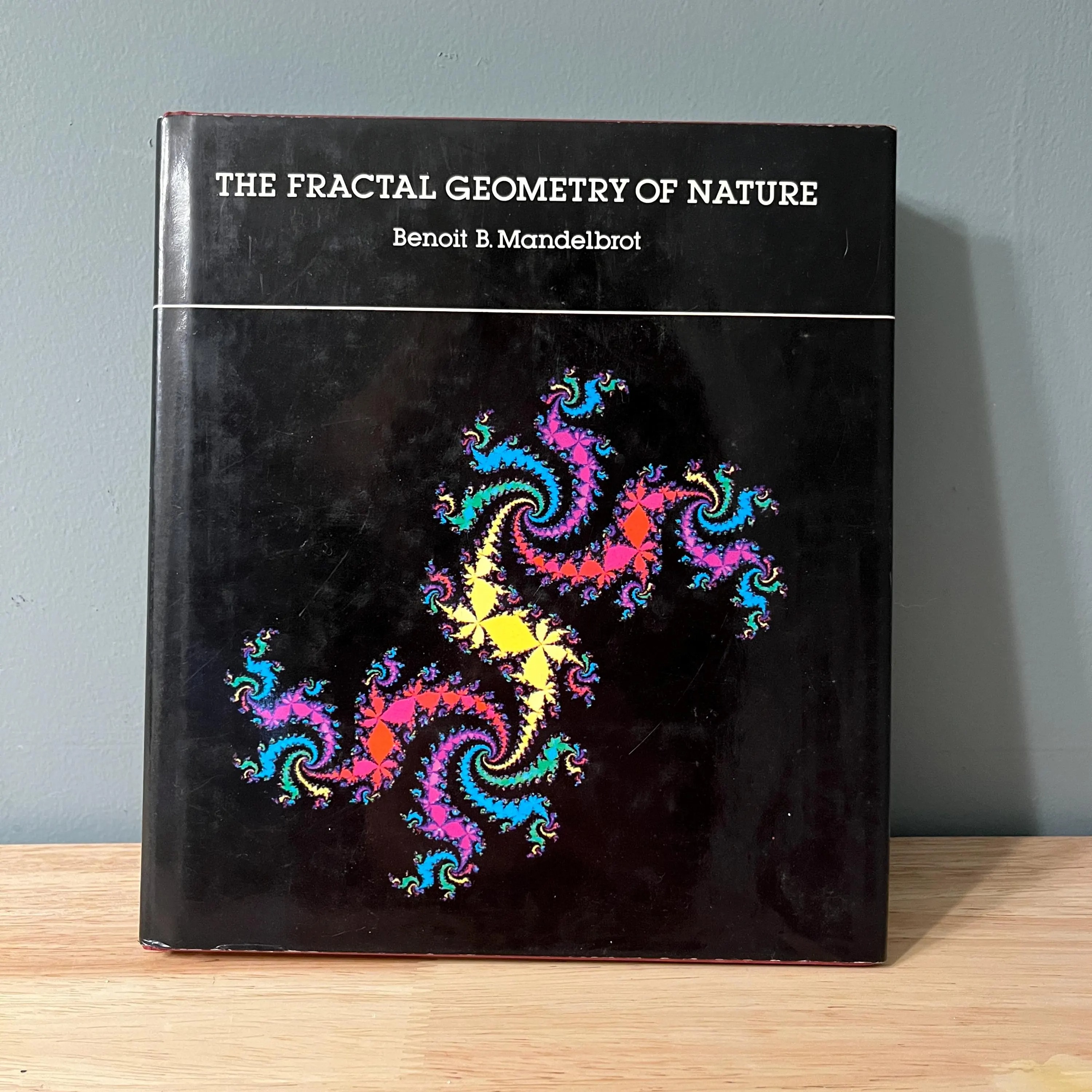
The text we encounter today goes beyond a mere enumeration of mathematical theories; it is an intellectual revolution in itself—one that dismantles the fundamental cognitive framework through which we perceive the shape of the world, reconstructing it into a far grander order. Benoit Mandelbrot's immortal masterpiece, The Fractal Geometry of Nature, stands as a chilling manifesto that shatters the smooth illusions of classical geometry, forcing us to confront the true, unvarnished face of a fragmented and rugged reality.
This record is a fierce process of intellectual inquiry. It dissects the profound depths of how the radical search algorithm known as the Lévy Flight dictates both the survival of biological life and the extreme volatility of capital markets, all within the colossal abyss of irregularity explored in this magnificent academic text. Through this journey, we will trace the bold trajectories of a flight that cuts across the shattered fragments of our world, transcending the limits of finite perception to advance toward a horizon of infinite scales.
Now, let us step together into this rough, yet utterly dazzling forest of geometry.
1. Introduction to the Fractal Paradigm and the Limits of Euclidean Orthodoxy
The epistemological foundations of our spatial comprehension have long been imprisoned by the sterile, idealized architectures of Euclidean geometry. For centuries, the human intellect, striving desperately for a semblance of manageable order amidst the chaotic and overwhelming tapestry of reality, superimposed the rigid constructs of straight lines, perfect circles, and unblemished spheres upon a universe that fundamentally and violently rejects such simplistic homogenization. Benoit B. Mandelbrot, in the monumental exposition The Fractal Geometry of Nature, dismantles this deeply entrenched orthodox paradigm. He initiates this intellectual rebellion with a profound observation that serves as the genesis of an entirely new mathematical philosophy. He posits a physical truth so visually evident yet historically neglected that its articulation forces an immediate and complete recalibration of how we perceive our environment. Mandelbrot famously declares that clouds are not spheres, mountains are not cones, coastlines are not circles, and bark is not smooth, nor does lightning travel in a straight line. This declarative statement is not merely a poetic or aesthetic observation regarding the irregularity of the natural world; it is a rigorous, undeniable indictment of the limitations inherent in classical geometric measurement and conceptualization.
When we begin to analyze the spatial strategies employed by autonomous entities—whether biological organisms seeking sustenance or computational algorithms mining for data—this Euclidean limitation becomes glaringly problematic. Consider the fundamental concept of a search path (stochastic navigation). In a world imagined solely through the lens of traditional geometry, an entity seeking resources might be mathematically modeled as moving in predictable linear vectors or sweeping in perfect, uninterrupted concentric arcs. However, the true terrain of existence is fiercely and uncompromisingly irregular. A pelagic predator navigating the boundless, seemingly empty ocean does not encounter resources distributed in neat, predictable grids. The introduction of the fractal concept provides the precise mathematical lexicon required to articulate the rough, the broken, and the fragmented aspects of morphological reality. A fractal is elegantly yet rigorously defined as a geometric set that exhibits a repeating statistical pattern displayed at every scale, essentially quantifying the very concept of roughness itself. It builds a crucial intellectual bridge across the cognitive chasm separating the microscopic from the macroscopic, revealing that the irregularity we observe with our naked eyes is not a lack of order, but rather a profoundly different, infinitely more complex manifestation of structural organization.
To comprehend the Lévy Flight, one must first entirely discard the Euclidean comfort of the predictable straight line. The trajectory of a foraging animal in the wild is an intricate, unpredictable dance of short, dense, exploratory micro-steps abruptly punctuated by sudden, massive macro-relocations. This is not anomalous or aberrant behavior; it is a meticulously calibrated, evolutionary response to a fractal universe.
By understanding the fractal definition of nature, we are compelled to acknowledge that our human-centric, artificially smoothed-out perception of the world is merely a comfortable illusion draped over a breathtakingly complex and unforgivingly rough reality. We must elevate our analytical framework from simple geometric approximations to the sophisticated topography of scale-free dynamics. The failure of Euclidean geometry is not a failure of mathematics itself, but a failure of application; it is the erroneous mapping of a smooth theory onto a radically textured reality. Mandelbrot's introduction sets the stage for a universe where anomaly is the rule, and smoothness is the rare exception.
2. Fractional Dimension and the Measurement of Irregularity
The concept of dimensionality is arguably one of the most intellectually jarring and profoundly transformative elements introduced in Mandelbrot's exposition. Our cognitive conditioning and early education heavily bias us toward a universe strictly composed of integers. We are taught that a line possesses precisely one dimension, a flat plane possesses two dimensions, and a tangible solid object claims three. This integer-based framework is so deeply ingrained in our spatial logic that deviating from it feels almost counterintuitive. Mandelbrot, however, shatters this numerical rigidity by introducing the undeniable reality of fractional dimensions—a concept that fundamentally alters how we quantify, measure, and ultimately understand complex systems, particularly when analyzing the intricacies of a stochastic search path traversing an unpredictable landscape.
To vividly illustrate this revolutionary concept, Mandelbrot invokes the famous coastline paradox, a problem of measurement originally pondered by the polymath Lewis Fry Richardson. If an observer attempts to measure the absolute length of a rugged, natural coastline, the final numerical measurement is inextricably and fatally linked to the length of the measuring stick employed. A kilometer-long measuring apparatus will simply bridge across the smaller bays and peninsulas, providing a relatively short total length. However, as the measuring stick becomes progressively shorter—measuring in meters, then centimeters, then millimeters—it begins to capture the microscopic, infinite zigzags of the rocks, the sand grains, and the molecular boundaries, causing the measured length to increase exponentially towards infinity. Therefore, a coastline utterly defies the strict definition of a one-dimensional line. It occupies space much more densely than a simple, smooth curve, yet it does not possess the capacity to completely fill a two-dimensional plane. Its true mathematical dimension is a non-integer, a fraction that sits somewhere in the liminal space between one and two. This fractional dimension is not a mere theoretical artifact; it is a highly specific, quantifiable measure of the coastline's inherent roughness and infinite complexity.
When we rigorously apply this profound mathematical revelation to the analysis of a Lévy Flight and its associated search trajectory, the ecological and algorithmic implications are staggering. A trajectory generated by an organism employing a Lévy Flight strategy is never a simple, easily measured one-dimensional line drawn across a cartographic map. It is an infinitely complex, tangled web of movement. When an albatross glides over the turbulent ocean seeking its prey, its path consists of dense, highly localized clusters of intense searching activity (representing a high local dimension), connected by extraordinarily long, seemingly straight transit flights (representing a lower local dimension). If we attempt to calculate the total absolute length of this path, we immediately encounter the exact same scaling laws that plague the coastline paradox. The trajectory itself possesses a definitive fractal dimension.
The tuning of this dimension dictates survival.This dimension dictates the spatial efficiency with which the organism explores its given environment. If the fractional dimension of the search path is too low (approaching 1.0), the trajectory approximates a straight line; the organism traverses vast distances rapidly but tragically misses critical, localized resources hidden just off its linear path. Conversely, if the dimension is too high (approaching 2.0 or standard Brownian motion), the trajectory becomes a dense, tangled knot; this results in the exhaustive over-exploration of a depleted local area and a catastrophic failure to discover new, fertile patches across the broader landscape. The scaling law is the mathematical heartbeat of this entire phenomenon. Biological entities, operating under the relentless, unforgiving pressure of natural selection over millions of years, have unconsciously but masterfully calibrated the fractional dimension of their search paths. They navigate the razor-thin equilibrium between the exhaustive exploitation of known local resources and the bold, energy-intensive exploration of the vast unknown.
3. Self-Similarity Across Infinite Scales of Existence
The defining hallmark, the very architectural signature of any legitimate fractal construct, is the unyielding principle of self-similarity. This concept mathematically dictates that as one magnifies or reduces the physical structure of an object—zooming infinitely inward or panning infinitely outward—the inherent geometric pattern replicates itself flawlessly, completely independent of the scale of observation. Mandelbrot provides extensive visual galleries and rigorous mathematical proofs of this mind-bending phenomenon through classic theoretical examples, most notably the Koch curve and the Cantor set.
The Koch curve, generated through an infinite, recursive algorithmic process of adding triangular protrusions to the middle third of existing line segments, results in a geometric monstrosity: a perimeter of theoretically infinite length that paradoxically encloses a strictly finite area. No matter how deeply an observer zooms into the jagged, microscopic boundary of the Koch snowflake with a theoretical electron microscope, the triadic, spiky structure remains visually and mathematically indistinguishable from the macro-structure seen by the naked eye. This recursive nature is not a mere geometric parlor trick designed to confuse; it is a profound philosophical and mathematical commentary on how staggering, seemingly insurmountable complexity can be generated through the relentless, iterative repetition of devastatingly simple rules across varying magnitudes.
When we meticulously map the concept of self-similarity onto dynamic movement models like the biological search path, the implications fundamentally rewrite behavioral ecology and stochastic modeling. A genuine Lévy Flight search path exhibits robust self-similarity in both temporal and spatial domains. Imagine a marine biologist meticulously mapping the foraging path of a pelagic shark over the course of an entire calendar year. The macro-map will reveal distinct clusters of intense hunting activity concentrated within specific oceanic regions, linked by massive, trans-oceanic migrations. If the researcher then isolates and magnifies just one single month of telemetry data within one of those active clusters, the exact same structural pattern miraculously emerges: smaller sub-clusters of localized hunting linked by relatively long, regional transits. If the temporal focus is narrowed even further down to a single day, or down to a single hour, the overarching pattern stubbornly persists. The search behavior is definitively scale-free. The mathematical distribution of movement lengths looks identical regardless of the temporal or spatial zoom level applied by the observer.
This manifestation of self-similarity in search paths solves one of the most profound ecological challenges an organism faces: environmental nescience. An organism operating in the wild generally possesses zero prior knowledge regarding the optimal mathematical scale of its resource distribution. Food might be clustered in microscopic patches separated by mere centimeters, or it might be located in massive biological blooms separated by hundreds of kilometers.
By employing a self-similar search strategy driven by Lévy Flight mechanics, the organism is functionally and mathematically prepared to encounter and exploit resources at literally any possible scale. The pattern of its movement becomes a structural reflection, a behavioral mirror, of the fractal distribution of resources in the natural world. It is a breathtaking example of how organic life has internalized the complex, non-linear geometry of inorganic nature to ensure survival against insurmountable odds. The geometry of the seeker seamlessly, almost poetically, mirrors the geometry of the sought.
4. Canonical Architectures of Chaos: Representative Structures
Mandelbrot meticulously catalogues representative fractal structures that serve as the foundational alphabet for decoding complex, chaotic systems. To truly understand the sophisticated mechanics of an optimized search path, we must mercilessly dissect these canonical architectures, specifically contrasting space-filling curves with fragmented sets, and standard classical diffusion with anomalous diffusion. The Peano curve and the Cantor set hold special, almost sacred significance in this analytical framework. The Peano curve represents the terrifying extreme of fractal density. It is a continuous, seemingly one-dimensional line that twists, turns, and folds upon itself so intricately and relentlessly that it eventually passes through every single infinitesimal coordinate point within a two-dimensional square. It challenges our intuitive understanding of dimensions by demonstrating how a line can functionally and mathematically become a solid plane.
| Structural Archetype | Geometric Property | Search Path Implication |
|---|---|---|
| Peano Curve | Space-filling, dense. Dimension approaches 2.0. | Ultimate local exploitation. Fatal if the local area is barren due to lack of mobility. |
| Cantor Set (Dust) | Infinite fragmentation. Dimension between 0 and 1. | Represents clustered resource nodes separated by vast, uncrossable voids. |
| Brownian Motion | Gaussian steps. Tangled cluster. | Inefficient in fractal terrains. Trapped by its own finite variance. |
Conversely, the Cantor set represents the extreme, desolate frontier of fractal fragmentation. Created by taking a simple line segment and recursively, brutally removing the middle third ad infinitum, it leaves behind a ghostly mathematical space filled with an infinite number of discrete points separated by an infinite number of gaping voids, often poetically referred to as Cantor dust. Its dimension is a fragile fraction between zero and one. When analyzing a Lévy Flight, the Cantor set provides the absolute perfect morphological analogue. The remaining, isolated points of the Cantor dust represent the tight, dense clusters of localized searching activity where an organism intensively hunts a freshly detected resource patch. The empty gaps, the vast dark voids created by the recursively removed middle thirds, represent the long, unbroken, desperate leaps across barren, hostile territory.
When directly contrasting a standard Brownian motion with a Lévy Flight, the structural distinction becomes unignorable. Brownian motion, the mathematical formalization of the random, unpredictable jittering of microscopic particles suspended in a fluid, generates a physical path that is fundamentally a dense, tangled ball of highly localized movement. Step lengths are safely drawn from a normal, predictable Gaussian distribution. The variance is strictly finite, and extreme, long-distance movements are statistically deemed impossible. A searcher employing Brownian motion is effectively a prisoner of its own variance, doomed to over-explore its immediate, familiar surroundings and entirely incapable of traversing vast distances efficiently to find new oases. A Lévy Flight, however, shatters this mathematical confinement. It utilizes the architectural principles of the Cantor dust to dictate its movement algorithm. It is a canonical architecture of chaos that expertly, flawlessly balances the dense, greedy exploitation seen in Peano-like behaviors with the vast, risky exploration necessitated by Cantor-like environmental fragmentation.
5. Natural Manifestations of the Geometrical and Biological Synchronization
The unparalleled genius of Benoit Mandelbrot lay not merely in defining these esoteric, abstract mathematical structures within the sterile, academic confines of pure theory, but in possessing the profound, almost prophetic vision to recognize their undeniable manifestation absolutely everywhere in the physical universe. The Fractal Geometry of Nature is effectively a vast, irrefutable empirical catalog demonstrating how the physical world vehemently eschews the straight line and the smooth curve in favor of chaotic turbulence, aggressive bifurcation, and infinite recursive scaling laws. The sprawling, branching networks of ancient river systems carving relentlessly through continental crust, the jagged, unyielding profiles of tectonic mountain ranges, the convoluted, ever-shifting surfaces of storm clouds, and even the incomprehensibly vast, uneven distribution of glittering galaxies across the cosmic void—all of these phenomenological realities conform rigidly and beautifully to the dictates of fractal geometry. Nature communicates its physical reality not through the polite language of Euclidean perfection, but through the rough, chaotic, infinite dialect of fractals.
This inherent natural roughness directly and inescapably influences the behavioral algorithms of the organisms embedded within it. The biological search path is never an isolated, independent phenomenon; it is a direct, hardwired evolutionary response to the fractal topography of the specific habitat. Consider the high-stakes foraging patterns of apex predators in the pelagic ocean. The open ocean is arguably the ultimate fractal environment—vast, desolate, terrifying deserts of water punctuated highly irregularly by swirling, ephemeral oceanic eddies where phytoplankton suddenly bloom, attracting incredibly dense, complex food webs. If a predator, such as a great white shark or a wandering albatross, utilizes a simple, mathematically naive Brownian random walk to search for these exceedingly rare, highly clustered resources, it is mathematically guaranteed to expend far more caloric energy than it consumes, leading to its inevitable, quiet starvation in the deep blue.
Empirical telemetry data, meticulously gathered through decades of tracking marine and terrestrial animals with satellite tags, consistently reveals a breathtaking truth: these animals naturally, instinctively execute Lévy Flights. When an animal detects faint chemical cues or brief visual evidence of prey, it immediately drops into highly localized, dense, Brownian-like searches. It ruthlessly exploits the patch. However, once the local resource is thoroughly depleted and the chemical cues fade into nothingness, the animal does not continue to wander aimlessly in the now-dead local vicinity. Instead, driven by an ancient, mathematical instinct, it executes an incredibly long, seemingly blind straight-line flight to a completely different, unknown sector of the ocean or landscape, actively and rapidly bypassing vast tracts of empty, useless space. This is the living, breathing biological manifestation of the heavy tail in the mathematical probability distribution. The animal, of course, does not possess a conscious, cognitive understanding of fractional calculus or inverse square laws. Yet, millions of years of ruthless, bloody evolutionary pressure have sculpted its neurobiology to generate search algorithms that are perfectly, mathematically optimized for fractal environments. Mandelbrot's work provides the vital Rosetta Stone required to translate the static morphological structure of the habitat into the dynamic behavioral patterns of the life it sustains.
6. Probability, Heavy Tails, and the True Architecture of Randomness
To truly grasp the hidden mechanics and the profound efficiency of the Lévy Flight, we must descend past the visual geometry and delve deep into the rigorous, often intimidating probabilistic foundations laid out by Mandelbrot. The classical view of randomness, which has comfortably dominated scientific and statistical thought for centuries, is heavily reliant on the Central Limit Theorem and Gaussian distributions, colloquially known to the layman as the bell curve. In a strictly Gaussian world, extreme events—massive deviations from the norm—are vanishingly rare, so statistically rare they can be safely, comfortably ignored in most practical models. The variance of the system is finite, meaning that an average value perfectly and adequately describes the expected behavior of the system over time. Standard Brownian motion is the direct spatial and temporal translation of this polite Gaussian probability. However, as Mandelbrot painstakingly and ruthlessly points out, nature frequently and violently violates these orthodox assumptions. Mandelbrot introduces the paradigm-shifting concept of fractional Brownian motion and stochastic fractals, revealing a universe governed not by the polite, predictable averages of the bell curve, but by the chaotic, highly disruptive dominance of heavy-tailed distributions.
In a true Lévy Flight, the step lengths are categorically not drawn from a normal distribution. Instead, they are drawn from a Pareto-like probability distribution where the tails of the mathematical curve decay much, much slower than a standard exponential curve. Specifically, the probability of taking a step length greater than a specific distance value follows a strict power law. We can express this conceptually without complex formatting: the probability is proportional to the inverse of the step distance raised to a specific scaling exponent (alpha), where this exponent strictly resides between the values of zero and two. Because of this agonizingly slow decay in probability, the likelihood of an extremely large step—a massive, discontinuous jump across the landscape—remains statistically significant at all times.
The Nightmare of Infinite Variance
The mathematical consequence of this heavy tail is profound and deeply counterintuitive to classically trained statisticians: for a scaling exponent less than two, the variance of the step lengths becomes literally infinite. In this chaotic realm, there is no such thing as a typical step size. The very concept of an average step length becomes entirely meaningless, as the mean itself can be skewed infinitely by the sudden occurrence of a single, massive outlier.
This specific architecture of randomness—this heavy-tailed extreme outlier probability—is precisely what gives the Lévy Flight its unique, life-saving visual characteristic of dense clusters connected by extraordinarily long transit lines. The infinite variance mathematically ensures that the searcher is never permanently trapped in a local minimum or a depleted, barren resource patch. Even if the searcher spends days executing tiny, dense movements, eventually, the heavy-tailed probability distribution will inevitably generate a step length large enough to catapult the searcher into a completely unexplored, distant domain. By abandoning the safety and predictability of the Gaussian bell curve, the organism embraces a much riskier, highly volatile movement strategy. Yet, paradoxically, it is this exact embrace of extreme volatility that guarantees long-term survival in completely unstructured, unpredictable environments. Extreme events, the massive jumps in the dark, are not anomalies to be smoothed over; they are the fundamental, structural drivers of the entire system.
7. Pragmatic Transpositions: From Biological Foraging to Financial Volatility
The ultimate, crowning triumph of Mandelbrot's thesis lies in its boundless, astonishing applicability across seemingly disparate academic and practical disciplines. The fractal geometry he elucidated, and the Lévy Flight dynamics derived directly from it, effortlessly transcend the abstract, isolated boundaries of theoretical mathematics to fundamentally reshape our understanding of modern physics, evolutionary biology, and profoundly, the chaotic, often destructive mechanics of global financial markets. In the realm of advanced physics, the anomalous diffusion of microscopic particles moving through highly heterogeneous media—such as chaotic superheated plasmas, turbulent fluids, or complex porous geological materials—cannot be accurately modeled by standard, Gaussian diffusion equations. The particles experience sticky periods of local entrapment within the material's complex structure, followed by sudden, violent flights of rapid, unimpeded transport. This behavior is perfectly captured and modeled by fractional calculus and Lévy distributions, proving that the physical universe operates on fractal principles down to the atomic level.
Yet, perhaps the most startling and widely debated application of Mandelbrot's work is in the notoriously unpredictable realm of financial economics. Mandelbrot observed early in his career, while studying historical cotton prices, that the fluctuations of prices in stock markets and commodity exchanges absolutely do not follow a mild, Gaussian random walk, despite decades of mainstream economic theory stubbornly assuming exactly that. If financial markets truly followed a Gaussian distribution, massive market crashes—events situated five, six, or seven standard deviations from the historical mean—would be practically impossible, mathematically predicted to occur perhaps once in the entire lifespan of the universe. Human history and empirical economic data vehemently, tragically contradict this classical model. Market prices execute distinct Lévy Flights. The daily, minute-by-minute minor fluctuations in stock prices represent the localized, dense clustering of Brownian motion. However, the market is periodically and inevitably disrupted by massive, discontinuous jumps—sudden, catastrophic crashes or explosive, unprecedented rallies that wipe out portfolios in minutes.
These long leaps in the price trajectory are the physical, undeniable manifestation of the heavy tails of the probability distribution operating in harsh economic reality. Understanding market dynamics through the unforgiving lens of Lévy Flights and fractal geometry provides a sobering, yet deeply insightful framework. It completely dismantles the dangerous illusion of predictable, manageable risk fostered by traditional, Gaussian-based financial models. It asserts, with cold mathematical rigor, that extreme volatility is an inherent, structural property of complex interacting human systems, not merely an external, unpredictable shock to be blamed on unforeseen events. Whether it is a microscopic immune cell frantically searching for a novel pathogen in human tissue, an autonomous algorithm mapping a devastated disaster zone, or a trader navigating the chaotic fluctuations of global currency exchanges, the optimum path—and the realistic expectation of movement—is dictated by the rough geometry of nature. Mandelbrot has given humanity the conceptual apparatus to see this invisible architecture. He has transformed our view of randomness from a terrifying, impenetrable abyss into a structured, navigable landscape governed by the elegant, albeit merciless, laws of fractal probability.
Frequently Asked Questions
우주의 거대한 불규칙성과 무자비한 변동성 앞에서 유한한 인식을 가진 우리가 취할 수 있는 가장 위대한 지적 태도는, 그 척도 없는 심연을 두려워하지 않고 고요히 관측하는 겸손함을 갖추는 것입니다. 척도 불변의 도약 분포를 통해 통제 불가능한 혼돈을 지도화하는 결정론적 프레임워크를 수립함으로써, 우리는 파편화된 세계 속에서 생존의 궤적을 묵묵히 그려나가는 모든 존재들의 치열함에 가닿을 수 있습니다. 이 글이 여러분의 고정된 인식의 틀을 부수고 더 넓은 지평을 사유하는 작은 단초가 되었기를 바랍니다.