양자 랜덤 워크와 초단기 변동성: 시장의 잡음 속에서 신호를 읽다
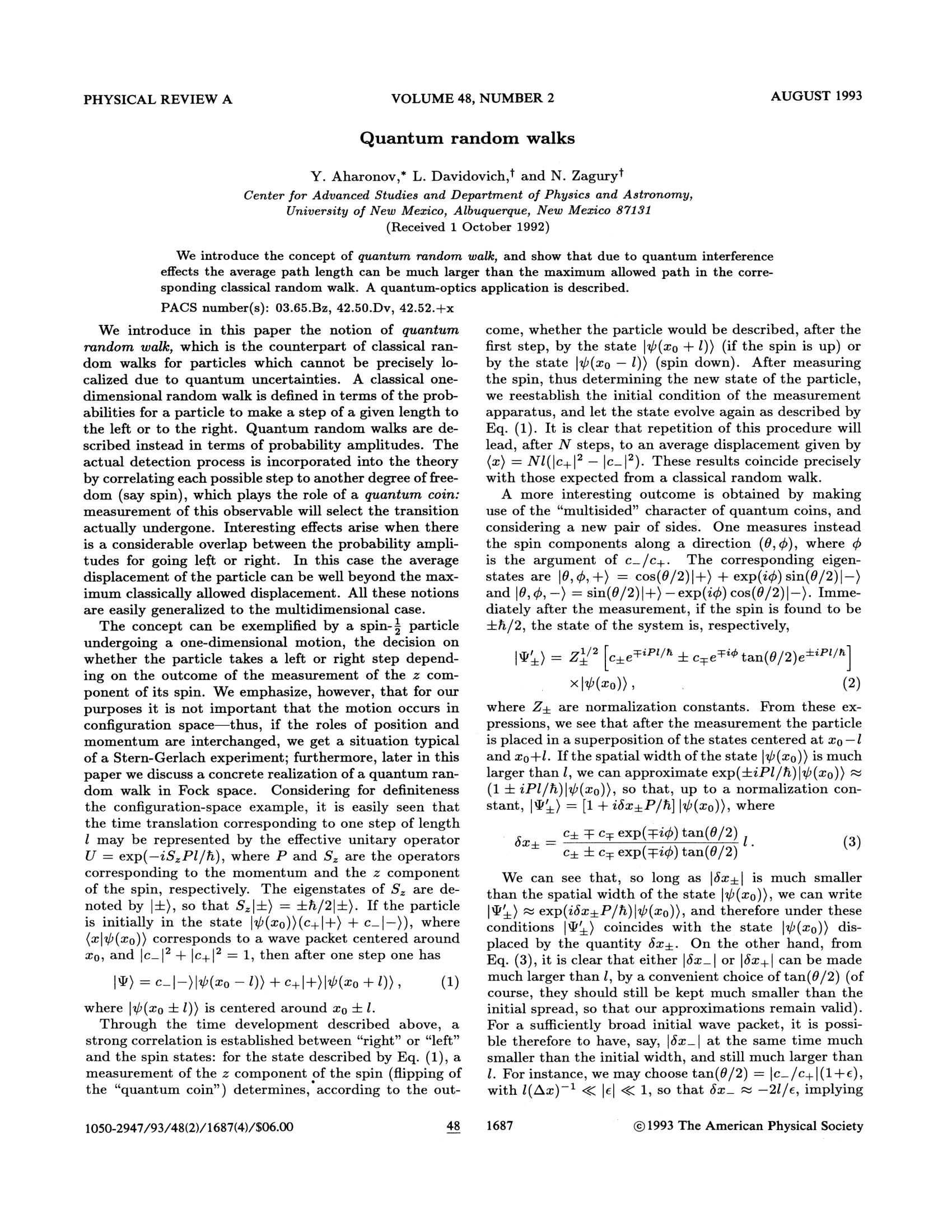
우리는 눈 깜짝할 사이에 발생하는 거칠고 폭력적인 초단기 변동성의 한가운데서 끊임없이 쏟아지는 잡음과 마주합니다. 이 통제 불가능해 보이는 확률적 혼돈 속에서 질서를 찾기 위한 실마리를, 1993년 발표된 야키르 아하로노프(Yakir Aharonov) 연구진의 논문 양자 랜덤 워크(Quantum Random Walk)에서 탐구합니다.
이 글은 다중첩과 간섭, 그리고 탄도학적 확산(Ballistic spreading)이라는 양자역학적 메커니즘을 시장의 미세 진동을 해석하는 실전적이고 철학적인 프리즘으로 확장합니다. 고전적 확률의 한계를 넘어, 예측 불가능한 시장 데이터 속에서 흔들리지 않는 최적의 궤적과 순수한 신호를 식별하고자 하는 분들을 이 여정에 초대합니다.
Greetings to all who navigate the labyrinthine corridors of relentless numerical tides. For someone entirely captivated by the intricate dance of variables, there is an unparalleled satisfaction in deciphering the raw language of motion. Have you ever stared at the ceaseless ebb and flow of momentary metrics, wondering if the erratic leaps and sudden plunges conceal a deeper, almost symphonic order? That quiet realization, where the cacophony of the world suddenly aligns into a pristine, readable signal, is an experience I hold incredibly dear. I vividly recall the moment I first encountered the theoretical framework that elegantly maps this very phenomenon. Seeking refuge from the overwhelming deluge of unstructured data, I found solace in a realm where uncertainty is not a flaw, but a fundamental characteristic to be understood and harnessed.
This transformative perspective stems from a magnificent piece of literature: the 1993 publication by Yakir Aharonov, Luiz Davidovich, and Nicim Zagury, which fundamentally altered our comprehension of probabilistic movement. When we observe ultra-short-term fluctuations, those violent, transient market oscillations that occur in the blink of an eye, it is easy to feel entirely adrift. Yet, observing these microscopic movements through the specific lens provided by this paper fundamentally shifts the paradigm. The chaotic shivering of a one-minute chart ceases to be random noise; instead, it becomes a canvas where myriad possibilities overlap, interact, and eventually collapse into a singular trajectory.
Today, I am absolutely thrilled to share a comprehensive, deeply analytical exploration of this masterpiece. We will meticulously unpack the core mechanics introduced in this paper, mapping the ethereal concepts of quantum mechanics directly onto the visceral reality of volatile fluctuations. From the foundational divergence between classical predictability and quantum multiplicity to the astonishing realization of these theories in optical systems, this journey promises a radical recalibration of how we perceive probability. Are you prepared to plunge into the depths of probability amplitude dispersion and emerge with a refined framework for interpreting the world? Let us embark on this intricate intellectual voyage.
The Conceptual Dawn of the Quantum Random Walk
To truly appreciate the magnitude of the theoretical leap presented by Aharonov, Davidovich, and Zagury, we must first ground ourselves in the familiar territory of classical mechanics. The classical random walk, often illustrated by the meandering path of a profoundly disoriented pedestrian or the erratic drift of a pollen grain suspended in water, operates on the principle of mutually exclusive probabilities. At each discrete moment in time, a choice is made: a step to the left or a step to the right. The pedestrian flips a coin, and the outcome definitively dictates the subsequent location. This process is inherently Markovian, meaning the system possesses no memory; the probability of the next step relies exclusively on the current position, entirely divorced from the historical path taken to arrive there.
However, the introduction of the quantum random walk shatters this deterministic exclusivity. In the microscopic realm described by this 1993 paper, the pedestrian is replaced by a quantum entity, and the classical coin is substituted with a quantum state, such as the spin of a particle. The pivotal difference between the classical random walk and the quantum random walk lies in the foundational nature of the coin toss. When the quantum coin is flipped, it does not land definitively on heads or tails. Instead, it enters a state of quantum superposition, existing simultaneously in a combination of both states. Consequently, the walker does not move simply left or right; the walker's probability amplitude splits, and the walker fundamentally propagates in both directions at once.
This concept of exploring multiple trajectories concurrently provides an incredibly powerful metaphorical and mathematical engine for understanding ultra-short-term fluctuations. In the chaotic environments where rapid variables are constantly digested, the path of a metric over a micro-interval does not behave like a singular, classical pedestrian. Instead, it behaves precisely like a quantum walker. A multitude of latent forces, opposing sentiments, and algorithmic executions exist in a state of superposition prior to the ultimate realization of the price or data point. The observed metric at any given microsecond is the complex summation of these overlapping, unresolved probabilities.
The impact of quantum superposition and interference on the walking process is the crucial mechanism that diverges from classical intuition. As the quantum walker takes multiple steps, the various branches of its reality begin to intersect. Because these branches are governed by probability amplitudes, which can be positive, negative, or complex numbers, they possess the unique capacity to interfere with one another. When branches with opposing phases cross, they cancel each other out, a phenomenon known as destructive interference. Conversely, when branches with aligned phases merge, they amplify each other, resulting in constructive interference.
This continuous cycle of constructive and destructive interference completely redefines the landscape of the walk. It reveals why certain barriers in a volatile environment hold steadfast against immense pressure, while at other times, a seemingly minor catalyst triggers a massive, instantaneous directional surge. The interference patterns dictate the flow.
Through this lens, the violent whipsaws and sudden directional bursts observed in high-frequency data environments are entirely demystified. They are not merely the products of random chaos, but rather the visible manifestations of underlying probability amplitudes undergoing massive constructive interference. By shifting our cognitive framework from the classical tracking of definitive steps to the quantum tracking of amplitude evolution, we gain a superior vantage point. We stop trying to predict the unpredictable single coin toss and begin, instead, to map the structural probabilities of the entire wave front.
The Architecture of Probability Amplitudes
As we delve deeper into the core of the paper, the authors meticulously establish the mathematical formalism required to govern this phenomenon. The foundation of the quantum random walk relies entirely on the precise definition of the time evolution of the quantum state. Unlike classical systems where we update a simple probability vector, the quantum system requires a unitary transformation operating within a Hilbert space. This Hilbert space is constructed as the tensor product of two distinct spaces: the coin space, which dictates the internal state or directionality, and the position space, which represents the discrete locations on the lattice the walker can occupy.
The execution of a single step in this quantum framework involves a two-part operator. First, a coin operator, often the Hadamard operator, is applied. This operator acts exclusively on the coin space, taking a definitive state and transforming it into a perfect superposition of moving left and moving right. Subsequently, the conditional shift operator, directly tied to the position operator and the quantum mechanical walk, is applied. This shift operator reads the internal state of the coin. If the coin amplitude dictates a forward movement, the corresponding position amplitude is shifted to the right. If it dictates a backward movement, the amplitude is shifted to the left.
The crucial realization is that this shift happens simultaneously to all components of the superposed state. At time step t = 1, the walker is simultaneously at position +1 and -1. At time step t = 2, the branches further bifurcate and shift, causing the wave function to overlap at position 0. It is precisely at this intersection that the structure of quantum probability amplitudes, which drastically differs from classical probability distributions, reveals its profound nature. Because the amplitudes are complex vectors rather than scalar probabilities, the overlap at the origin involves the addition of these vectors.
Comparative Topology of Distributions
| Metric of Analysis | Classical Walk Dynamics | Quantum Walk Dynamics |
|---|---|---|
| Mathematical Base | Real, non-negative probabilities [0, 1]. | Complex probability amplitudes. |
| Interaction Mechanism | Simple scalar addition; paths are independent. | Vectorial addition; permits interference. |
| Resulting Distribution | Gaussian (Normal) distribution, centrally peaked. | Bimodal, highly asymmetric, heavy-tailed distribution. |
In a classical system, after many steps, the probability of finding the walker forms a smooth, bell-shaped Gaussian curve perfectly centered around the origin. The highest likelihood is that the walker, despite all the erratic movement, has barely progressed from the starting point. The quantum reality, however, is starkly inverted. Due to the asymmetric nature of the coin operator, destructive interference effectively hollows out the probability of remaining near the origin. The distribution is pushed aggressively outward, creating towering probability peaks at the far edges of the allowable space.
Translating this back to the theater of ultra-short-term fluctuations, we find a compelling explanation for the phenomenon of volatility clustering and momentum ignition. Traditional models, heavily reliant on Gaussian assumptions, constantly underestimate the probability of extreme, rapid deviations from the mean. They expect the metric to revert to the center. However, by applying the quantum probability amplitude structure, we understand that within highly dense, high-frequency environments, the overlapping actions of market participants actively suppress mean-reversion (destructive interference at the center) and violently amplify directional breakouts (constructive interference at the edges).
This mathematical framework provides a robust lexicon for the dual code of modern analysis. What the uninitiated view as a terrifying, unpredictable anomaly, the sophisticated observer recognizes as the natural, inevitable evolution of a complex unitary operator resolving its probability amplitudes. By mapping the position operator to specific price levels or data thresholds, one can begin to theoretically model where these extreme probability peaks are likely to materialize, completely bypassing the limitations of classical stochastic assumptions.
The Drastic Alteration of Distances
The theoretical beauty of the amplitude structure inevitably leads to the most visually striking and physically consequential aspect of the paper: the Quantum Interference Effects. Aharonov and his colleagues demonstrated with elegant mathematical precision how quantum interference dictates that the mean path length can differ significantly from the classical random walk. This is not a marginal difference; it is a fundamental alteration of the scaling laws that govern diffusion and dispersion in physical systems.
To contextualize this, we examine the variance of the position, denoted as the expectation value of the squared distance, ⟨x2⟩. In the classical paradigm, the variance grows strictly linearly with time, expressed as proportional to t. This implies that the standard deviation, the actual distance the walker is expected to have traversed, grows only as the square root of time, √t. It is a sluggish, highly constrained form of diffusion. If you want a classical walker to go ten times further, they must take a hundred times as many steps.
The core physical result of this paper establishes that for a quantum random walk, the variance grows quadratically with time, ⟨x2⟩ proportional to t2. Consequently, the standard deviation grows linearly with time, directly proportional to t. This is known as ballistic spreading.
This ballistic spreading means the quantum walker travels exponentially faster than their classical counterpart. It behaves less like a particle diffusing randomly through a dense fluid and more like a wave propagating unobstructed through a vacuum. The constructive interference at the leading edges of the wave function constantly pushes the boundary of probability forward, resulting in a linear, rapid expansion of the occupied space. This exponential divergence in mean path length is the defining signature of the quantum walk mechanism.
When we map this ballistic spreading onto ultra-short-term fluctuations, the insights are breathtaking. It explains the mechanics behind instantaneous liquidity vacuums and flash movements. During periods of relative calm, a metric might exhibit classical, square-root-of-time diffusion, oscillating gently within established bands. However, when specific threshold conditions are met—when the underlying network of participants aligns in a way that mimics the phase coherence of a quantum state—the system transitions from classical diffusion to quantum ballistic spreading.
In these critical microseconds, the metric does not slowly drift to a new level; it teleports. The distance covered in time t is suddenly vastly larger than classical models permit. Recognizing this transition from linear variance to quadratic variance allows an observer to stop fighting the momentum and instead ride the wave of constructive interference. By understanding that the core physical results of this paper mandate such extreme movements under coherent conditions, one ceases to be surprised by market shocks, viewing them instead as the majestic execution of a ballistic physical law.
Bringing the Ethereal into Reality
A theory, no matter how mathematically elegant, remains confined to the realm of philosophy until it can be tested against the uncompromising rigors of physical reality. The absolute brilliance of Aharonov, Davidovich, and Zagury in this 1993 paper is that they did not conclude with the derivation of the walk; they proposed a concrete, actionable Quantum-Optics Application. They detailed how to apply the proposed quantum random walk to a quantum-optical system, translating abstract Hilbert spaces into tangible mirrors, lasers, and cavities.
The authors suggested utilizing the incredibly precise and delicate environment of cavity quantum electrodynamics. In this proposed setup, the possibility of implementation using photons and quantum-optical states is presented with meticulous care. The quantum coin, the driver of the superposition, could be instantiated by the internal state of a two-level atom, or alternatively, the polarization state of a single photon. A beam splitter would serve as the physical embodiment of the Hadamard coin operator, taking a definitively polarized photon and splitting it into a coherent superposition of transmitting and reflecting paths.
The position space, the lattice upon which the walker moves, would be mapped to the phase shifts or the specific cavity modes the photon inhabits. As the photon bounces between highly reflective mirrors, passing through phase modulators contingent on its polarization, the entire abstract mathematics of the unitary shift operator is perfectly executed by the geometry of the optical table. The detection of the photon at the end of the apparatus would yield the physical measurement of the bimodal, edge-heavy probability distribution, serving as undeniable proof of the ballistic spreading and interference effects.
This transition from theory to optical reality holds profound implications for contemporary analytical frameworks. Just as the authors translated theoretical operators into optical beam splitters and phase delays, we can translate these same operators into algorithmic filters and data structures. The continuous influx of ultra-short-term fluctuations acts as the photon beam. Our analytical models, meticulously constructed to isolate signal from noise, function as the beam splitters and phase shifters.
By establishing a sophisticated architecture that processes data not as independent, classical events, but as a continuous, coherent wave of information subject to interference, we create a conceptual quantum-optical system on our screens. We monitor the constructive interference of cumulative volume deltas and the destructive cancellation of transient noise. The capacity to implement this mindset, to view a volatile data feed as a highly structured optical experiment yielding probabilistic outcomes, elevates the observer from a passive recipient of chaos to an active conductor of information. It represents the ultimate synthesis of theoretical physics and practical data engagement.
Discussions on Fundamental Dynamical Distinctions
As we draw this extensive exploration to a close, we arrive at the pivotal Conclusion and Discussions presented by the authors. The central, enduring thesis of their work is the definitive summary that the quantum random walk exhibits fundamentally different dynamics from the classical random walk. This is not a matter of degree, but a matter of category. The transition from a system governed by the addition of real probabilities to one governed by the interference of complex amplitudes rewrites the rules of engagement for any system that can sustain superposition and coherence over time.
We have traced the journey from the conceptual introduction of the walk, dissecting the precise nature of the time evolution and position operators. We have visually and mathematically contrasted the Gaussian sluggishness of classical diffusion with the breathtaking ballistic expansion of quantum interference. Furthermore, we have grounded these ethereal concepts in the physical reality of proposed quantum-optical experiments, proving that these mechanics are not mere mathematical curiosities, but robust descriptions of the physical universe.
The application of this theoretical construct to the relentless reality of ultra-short-term fluctuations provides a paradigm-shifting advantage. It demands that we abandon outdated models that assume memoryless, independent movements in highly integrated, high-frequency environments.
Instead, it requires us to view the volatile tapestry of data as a dynamic, interfering wave function. When the chaotic noise of the market feels overwhelming, remember the elegant architecture detailed in this 1993 paper. The sudden spikes and violent reversals are not breakdowns of order; they are the flawless execution of constructive and destructive interference among millions of superposed intentions. By internalizing the fundamental dynamical distinctions of the quantum walk, we equip ourselves with a profound serenity. We learn to read the amplitude, anticipate the ballistic breakout, and navigate the most turbulent numerical storms with the quiet confidence of one who understands the deepest physics of the flow.
지금까지 1993년 발표된 양자 랜덤 워크 논문의 이론적 배경부터 광학적 구현 가능성, 그리고 이를 통한 초단기 변동성 시장의 해석 프레임까지 이어진 긴 사유의 여정을 함께해 주셔서 감사합니다. 고전적 확률의 한계를 벗어나 다중첩과 간섭이라는 새로운 렌즈로 세상을 바라볼 때, 우리는 비로소 통제 불가능해 보이던 무질서 속에서 가장 아름답고 최적화된 가치의 경로를 발견할 수 있습니다. 이 글이 여러분의 치열한 분석과 통찰에 작게나마 영감을 주는 단단한 디딤돌이 되었기를 바랍니다.