자기 지도 학습과 특징 추출을 중심으로 얀 르쿤의 세계 모델을 분석
기계가 파편화된 데이터의 바다에서 무작위적인 노이즈를 소거하고, 스스로 구조적 인과율을 구성하여 불확실한 미래를 통제하는 강건한 자율 지능 체계를 구축함을 목표로 합니다.
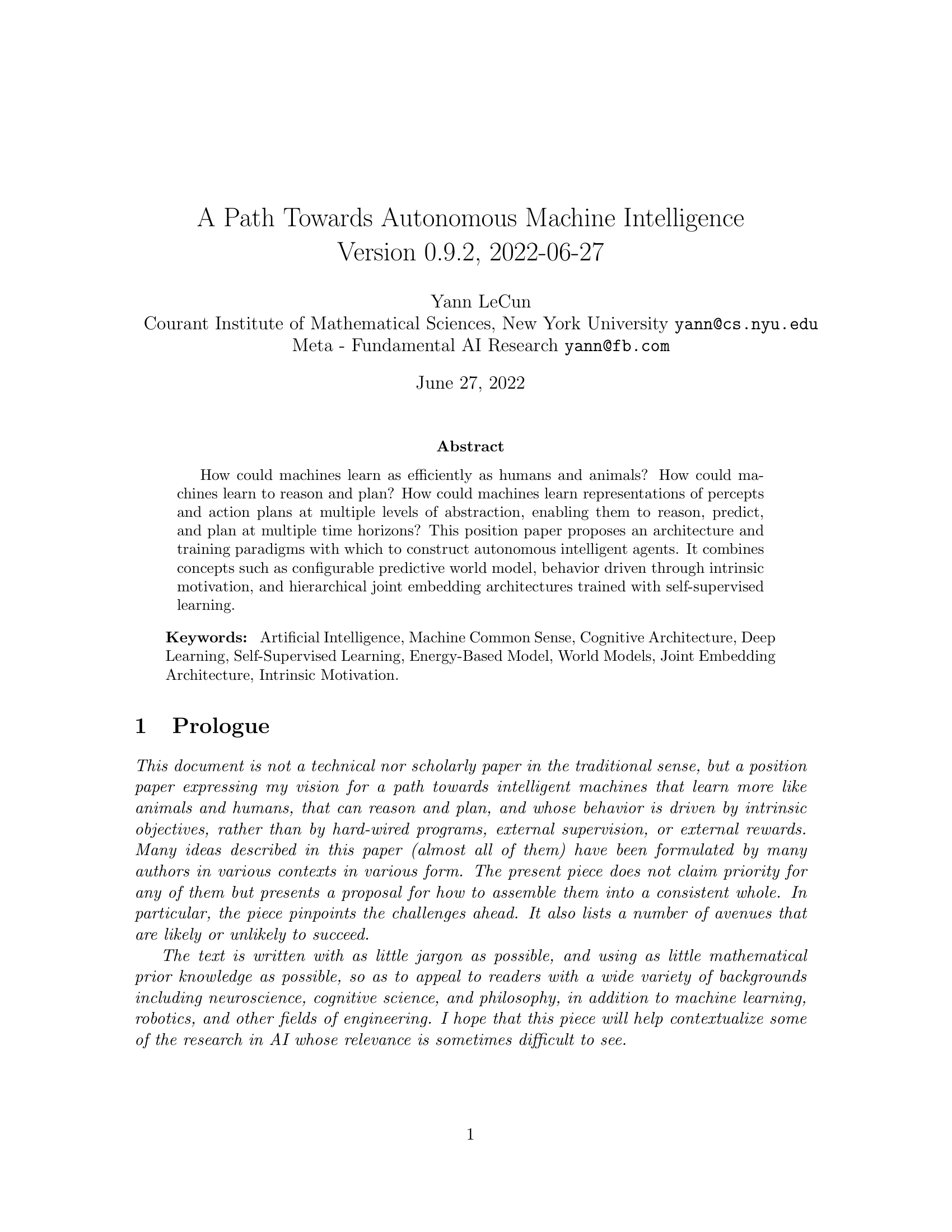
Greetings to all who relentlessly pursue the fragile signals hidden beneath the roaring noise of our complex reality. Today, I invite you on a profoundly captivating journey into the most breathtaking landscape of modern artificial intelligence research: Yann LeCun's visionary blueprint for autonomous machine intelligence. When I first embarked on my own intellectual endeavor to design robust analytical models capable of extracting structural truths from the chaotic fluctuations of global markets, I found myself entirely mesmerized by a singular, elegant proposition embedded deep within this paper. The sheer intellectual beauty of a machine learning to navigate the vast, unlabelled oceans of data, autonomously comprehending the physical architecture of reality without human intervention, was an irresistible call to venture into this dense forest of theoretical computer science.
As I waded deeper into the structural logic of this masterpiece, the scenery that unfolded was infinitely more sophisticated and meticulously crafted than any external summary could ever convey. Throughout the process of tracing the mathematical flow, silent exclamations of awe echoed continuously in my mind. The underlying skeletal framework governing how a machine abstracts reality and engages in autonomous reasoning is nothing short of a mathematical symphony. It transcended the mere observation of a novel algorithmic structure; it felt akin to communing with a grand tapestry that translates the very essence of how sentient beings perceive, adapt, and survive into a rigorous lexicon of energy optimizations. Through this extensive discourse, I will dissect every module of LeCun's architecture, sharing the profound insights and analytical methodologies I have cultivated over countless hours of rigorous text deconstruction. Are you prepared to immerse yourself entirely in this mesmerizing realm of self supervised learning and feature extraction? Let us hoist the anchor of curiosity and set sail into the unknown.
1. The Genesis of Cognitive Architectures: Learning World Models and Hierarchical Representations
The monumental paradigm shift we are about to explore begins with a fundamental interrogation: how can machine intelligence transcend the limitations of reactive function approximators to become an entity that proactively interacts with the world? The conventional approaches have long treated artificial neural networks as passive conduits, mapping inputs to outputs with brute force. However, LeCun postulates a radical departure through the concept of Learning World Models. This implies an architecture that does not merely memorize statistical correlations but actively constructs an internal, dynamic simulation of the external environment. By possessing a world model, the machine acquires the profound ability to predict the consequences of its own hypothetical actions before executing them in physical reality.
Learning to Reason and Plan within this framework is entirely redefined. Reasoning is no longer a superficial traversal of a pre-programmed decision tree. Instead, it is mathematically framed as an intense optimization process occurring during inference time. When confronted with a novel situation, the machine leverages its world model to project multiple future trajectories. It simulates a sequence of latent states and evaluates the energy or cost associated with each potential path. By minimizing this objective function, the machine deduces the most optimal sequence of actions. This deliberate, contemplative mechanism perfectly mirrors the deliberate human cognitive processes, elevating the machine from a realm of mere reflex to the elevated domain of strategic foresight.
To achieve this level of predictive mastery, the system must master Learning Hierarchical Representations. The physical world operates simultaneously across multiple scales of time and space. Attempting to model the universe at a single, granular resolution is computationally catastrophic and intellectually futile. Therefore, the architecture is designed to construct representations in a hierarchical manner. At the lowest echelons, the machine extracts features that capture immediate, high-frequency dynamics, such as the subtle displacement of an object over milliseconds. As information flows upward through the hierarchy, these representations undergo aggressive abstraction.
This hierarchical abstraction is the absolute crux of feature extraction. The higher-level modules deliberately collapse the dimensions of irrelevant stochastic noise. They discard the unpredictable fluttering of a leaf in the wind to preserve solely the macroscopic trajectory of an approaching vehicle. By learning hierarchical representations, the machine ensures that long-term planning is conducted in a highly compressed, symbolic latent space where only the invariant, structural truths of the environment remain. This multi-resolution perception allows the machine to traverse the uncertainty of the future without being paralyzed by the computational weight of irrelevant details.
Through this lens, feature extraction is not merely a data compression technique; it is a profound act of cognitive filtration. The machine learns to discern what matters and what does not. The latent vectors generated by the network become a distilled essence of reality, purged of chaos. This elegant separation of signal from noise is what enables the world model to function with astonishing accuracy. When the machine plans, it plans not with the chaotic pixels of raw observation, but with the refined, stable concepts embedded deep within its hierarchical architecture.
Ultimately, the synthesis of learning world models, reasoning, and hierarchical representations forms a cognitive trifecta. It liberates artificial intelligence from the shackles of autoregressive mimicry. Instead of blindly predicting the next token in a sequence, the system contemplates the ultimate objective, calculates the latent trajectory required to reach it, and executes actions with a profound understanding of causality. This is the dawn of true autonomy, achieved not through endless human supervision, but through the rigorous, self-guided mastery of the world's underlying physics.
2. Deconstructing the Modular Architecture for Autonomous Intelligence
To actualize the ambitious vision of an autonomous entity, LeCun proposes a highly interdependent, macro-scale cognitive engine known as the Modular Architecture for Autonomous Intelligence. This is not a monolithic black box, but a symphony of specialized components. At the helm sits the Configurator. This module acts as the executive control center, analogous to the prefrontal cortex in biological brains. It is responsible for interpreting the overarching objective and dynamically reallocating computational resources, modulating the attention of all other sub-modules to align with the current task. It ensures the system remains highly adaptable, preventing the catastrophic phenomenon of rigid over-specialization.
The raw influx of sensory phenomena is first intercepted by the Perception module. This component performs the most vital stage of feature extraction. It ingests an infinite-dimensional observation vector, denoted as x, and systematically crushes the irrelevant stochasticity to yield a purified, low-dimensional state representation, s. This state representation is the sole vocabulary the rest of the system understands. The Perception module does not seek to recreate the world; it seeks to understand it, filtering out the blinding noise of reality to isolate the crucial, actionable signals necessary for survival and goal achievement.
Once the present state is perceived, it is anchored within the Short-Term Memory. This module acts as the temporal glue of the architecture, maintaining a contextual ledger of recent states, actions, and observations. It provides the necessary historical continuity for the machine to understand its trajectory. Without short-term memory, the machine would exist in a perpetual, disconnected present, utterly incapable of grasping sequences or executing multi-step logical deductions. It holds the immediate variables required for the subsequent inferential leaps.
The crown jewel of this architecture is the World Model. Utilizing the current state s from perception and memory, alongside a proposed action variable a, the world model simulates the transition to a future state. It is a differentiable engine of imagination. Because it is differentiable, it allows gradients to flow backward during the planning phase. Furthermore, to handle the inherent non-determinism of the physical universe, the Configurable World Model incorporates latent variables. These variables absorb the uncertainty that cannot be predicted from the observation alone, allowing the model to generate a diverse ensemble of plausible futures rather than collapsing into a single, blurry average.
To navigate this landscape of imagined futures, the system relies on the Cost module, which is fundamentally divided into two segments. The Intrinsic Cost represents the hardwired, immutable drives of the machine. It quantifies the fundamental penalties for systemic instability, energy depletion, or excessive uncertainty. It is the primal instinct of self-preservation. Conversely, the task-specific cost measures the distance to the objective mandated by the Configurator. The Critic module dynamically evaluates these costs, acting as an internal evaluator that scores the viability and danger of the trajectories hallucinated by the world model, long before any physical action is taken.
Finally, the culmination of this immense internal computation is realized through the Actor. Driven by the evaluations of the Critic, the Actor traverses the continuous Data Streams of the environment, finalizing the optimal action sequence that minimizes the total energy of the cost functions. It translates the abstract, optimized latent trajectory into concrete interventions in reality. Together, these modules form an elegant, closed-loop control system, continuously reading the environment, imagining the future, optimizing the path, and acting with precision.
3. The Engineering of Reality: Learning to Build World Models via Self Supervised Learning
The most formidable obstacle in realizing autonomous intelligence is figuring out how to construct the world model itself. The definitive answer provided by LeCun is Self Supervised Learning. We must abandon the archaic reliance on exhaustive human annotations. The physical world contains an infinite reservoir of supervisory signals within its own structure. By training the network to predict obscured portions of a video or the subsequent states of a dynamic system, the machine is forced to internalize the grammatical laws of physics. Self supervised learning is not merely a training technique; it is an epistemological framework where the machine derives truth directly from the consistency of its continuous observations.
To mathematically formalize this learning process, the paper champions Energy-Based Models. Probabilistic models suffer from an intractable flaw: they require computing normalized probabilities across an infinite continuum of possible futures, demanding exorbitant computational resources to force the integral to one. Energy-based models bypass this fatal bottleneck entirely. They simply assign a low scalar energy value to compatible pairs of observations and predictions, and a high energy value to incompatible ones. By merely pushing down the energy of the observed reality and pulling up the energy of incorrect states, the machine effortlessly carves out a stable data manifold—a valley of truth—within the high-dimensional latent space.
However, predicting the future is an inherently ill-posed problem due to the universe's stochastic nature. A single initial condition can bifurcate into multitudes of valid outcomes. To conquer this one-to-many mapping, Latent Variable Energy-Based Models are introduced. By injecting an unobserved latent variable z into the predictive equation alongside the input x, the model gains the flexibility to represent uncertainty. During inference, the system searches for the specific configuration of z that minimizes the energy between the prediction and the actual outcome y. This elegant mathematical construct allows the machine to precisely target one specific outcome out of a distribution of possibilities, effectively domesticating the chaos of random variables.
When processing hyper-dimensional Data Streams like raw video, generative prediction in pixel space becomes an exercise in futility, leading to catastrophic overfitting on irrelevant high-frequency noise. The monumental breakthrough here is the Joint Embedding Architecture. Instead of reconstructing pixels, both the current observation x and the target y are passed through encoders to project them into an abstract, high-dimensional representation space. The system then learns to predict the abstract embedding of y from the abstract embedding of x. This deliberate architectural choice to abandon generation in favor of latent prediction is the ultimate manifestation of feature extraction. It allows the machine to become gloriously blind to the meaningless textures of reality, focusing solely on the structural semantic shifts.
To prevent the Joint Embedding Architectures from experiencing informational collapse—where the network trivially outputs a constant vector for all inputs to achieve zero energy—Non-Contrastive Learning methodologies are strictly applied. Traditional contrastive methods rely on pushing apart negative samples, which incurs an exponential computational penalty in high dimensions. Non-contrastive techniques, such as variance-covariance regularization or asymmetric exponential moving averages for the encoders, brilliantly preserve the informational volume of the embedding space without the need for exhaustive negative sampling. They maintain the tension and geometry of the latent representations flawlessly.
Building upon this foundation, the Hierarchical Joint Embedding Predictive Architecture takes feature extraction to its absolute zenith. As data ascends the hierarchy, Learning Abstractions occurs iteratively. Lower levels predict immediate, granular changes, while higher levels execute Learning to Predict over vastly extended temporal horizons. The Memory module synchronizes with this hierarchy, storing highly compressed episodic summaries at the top and detailed sensory buffers at the bottom. This multi-layered, abstractive prediction engine forms a robust, noise-immune world model capable of supporting the most complex, long-horizon logical deductions imaginable.
4. The Crucible of Autonomy: Intrinsic Motivation and Planning and Reasoning
The transition from a passive observer to an active agent is ignited by Intrinsic Motivation. In environments utterly devoid of external human rewards or explicit programmatic goals, the machine requires a foundational drive to explore, learn, and survive. Intrinsic motivation serves as this primordial engine. It is mathematically embedded as intrinsic cost functions that severely penalize states of high unpredictability or systemic failure. Like a biological organism avoiding pain and seeking stability, the machine inherently navigates its latent space to maintain energetic equilibrium. It forces the system to avoid chaotic regions of the state space where its world model breaks down.
Fascinatingly, this intrinsic cost is dual-natured. While it penalizes catastrophic uncertainty to ensure survival, it simultaneously incentivizes epistemological curiosity. When the machine encounters data that its world model fails to predict accurately, but which it deems learnable, an intrinsic reward for curiosity is triggered. This compels the autonomous agent to deliberately seek out novel situations, actively curating its own data streams to refine its internal representations. It is a perpetual cycle of self-improvement, where the machine pushes the boundaries of its comprehension, continuously chiseling away at the unknown through targeted exploration.
Once the world model is sufficiently calibrated by this intrinsic drive, the system executes Planning and Reasoning. This is where the magic of differentiable architectures truly shines. Planning is not a discrete search through a predefined grid; it is a fluid, continuous optimization process over a sequence of action variables and latent state variables. When presented with a task, the machine sets the initial state, fixes the desired low-cost target state, and allows the gradients of the cost function to flow backward through the world model, iteratively updating the proposed actions until the optimal trajectory is forged.
This inference-time optimization is the computational equivalent of deep, deliberate contemplation. By conducting this search entirely within the abstracted, noise-free dimensions of the Joint Embedding Predictive Architecture, the machine circumvents the exponential branching factor that paralyzes traditional search algorithms operating in pixel or token space. The machine evaluates thousands of potential futures, feeling the topological contours of the energy landscape, avoiding the peaks of high cost and steering gracefully into the valleys of task completion.
Ultimately, Planning and Reasoning in this framework demonstrate how machine intelligence can transcend reactive pattern matching. By utilizing a model that understands the constraints and dynamics of the physical world, the machine can synthesize entirely novel solutions to unprecedented problems. It does not merely interpolate between training examples; it extrapolates logic. The integration of self supervised feature extraction with gradient-based planning creates an entity that can confidently navigate the sheer complexity of reality, anticipating the consequences of its actions with mathematical precision and unwavering structural integrity.
The culmination of these modules represents a definitive roadmap toward artificial general intelligence. It shatters the illusion that scaling up autoregressive text predictors will magically yield logical reasoning. LeCun fundamentally proves that reasoning requires a playground—a latent, simulated world model—where hypotheses can be tested and destroyed safely before they manifest in reality. It is a triumph of architectural design, ensuring that the machine remains grounded in the physical laws of cause and effect, forever driven by the unyielding optimization of its intrinsic and task-oriented energy landscapes.
5. A Spoonful of My Own Reflection: The Resonance of Alpha
Now, let us venture beyond the academic boundaries of the text and apply a profound, solitary perspective to this architecture. When we transpose LeCun's Joint Embedding Predictive Architecture into the hyper-competitive, merciless arena of global quantitative trading, the structural parallels are nothing short of breathtaking. The relentless pursuit of self supervised learning and feature extraction is, in its purest essence, the identical crusade that a quantitative strategist undertakes when attempting to distill a pure, actionable signal from the deafening, high-frequency noise of market microstructure data. The flickering numbers on a Bloomberg terminal are the raw pixels of financial reality—chaotic, deceptive, and largely meaningless when viewed without a stabilizing abstraction.
Attempting to predict every single tick of an asset's price is the equivalent of a generative model foolishly trying to reconstruct the exact ripples of a pond in a storm. It inevitably leads to catastrophic overfitting, a fatal surrender to the random walk. However, if we adopt the philosophy of the hierarchical world model, we stop predicting the noise. We encode the raw order book data into a high-dimensional latent manifold, aggressively collapsing the dimensions of irrational market panic and algorithmic high-frequency spoofing. What remains in that purified embedding space is the true structural state of the asset—the underlying momentum, the mean-reverting tensions, and the macroeconomic regime shifts.
Furthermore, the inference-time optimization utilized in Planning and Reasoning perfectly mirrors the continuous-time stochastic control problems governed by the Hamilton-Jacobi-Bellman (HJB) equations. When an autonomous machine minimizes its intrinsic and task costs across a sequence of actions, it is mathematically identical to a trading algorithm dynamically adjusting its portfolio weights to maximize terminal wealth while strictly penalizing volatility and execution costs. The machine traverses the energy landscape just as the optimal control policy navigates the value function surface. The latent variable z acts as the stochastic volatility component, absorbing the unpredictable market shocks while the core model steers the portfolio toward the optimal alpha generation trajectory.
We must abandon the arrogance of attempting to map perfect probabilistic distributions over systems that are fundamentally characterized by extreme tail risks and non-stationary dynamics. LeCun's advocacy for Energy-Based Models over probabilistic ones validates this necessity. In both physical reality and financial markets, computing the absolute probability of every anomalous event is an intractable trap. Instead, we must define the energy fields of our structural signals. We must build robust internal representations that only allow execution when the market's trajectory aligns deeply within the stable, low-energy valleys of our validated analytical manifolds.
As I close my analysis of this magnificent paper, I am left with a profound realization. This modular architecture is not merely an engineering schematic for a better algorithm; it is a breathtaking mathematical projection of the cognitive resilience required to survive in a universe dominated by entropy and uncertainty. By absorbing the brutal randomness of the external world through the soft, intelligent cushion of hierarchical abstraction, and by suffering the consequences of failure internally through simulation rather than in the unforgiving realm of reality, the machine mimics the most elegant survival strategies of sentient life. We are witnessing the evolution of artificial systems from brute calculators into sophisticated entities capable of profound, structural contemplation.
The future of autonomous intelligence lies not in the mere accumulation of parameters, but in the structural elegance of its representations. As machines learn to independently distill the chaos of data streams into the immaculate geometry of cause and effect, they will increasingly become our peers in deciphering the complex truths of the world. This journey through self supervised learning and feature extraction proves that the ultimate alpha is found not by predicting everything, but by possessing the wisdom to abstract, compress, and deeply understand the few structural invariants that truly matter.
파편화된 데이터의 바다에서 기계가 스스로 세상의 물리적 법칙과 인과율을 학습해 나가는 이 거대하고도 치열한 지적 여정이 여러분의 분석적 시야에 깊은 통찰의 균열을 내었기를 바랍니다. 얀 르쿤이 제시한 세계 모델의 비전처럼, 무작위성의 노이즈를 걷어내고 구조적인 시그널을 통제하는 자율 지능의 시대가 도래할 그 경이로운 미래를 기대하며 이 긴 사유의 기록을 맺습니다.
'Tech & Science[기술과 과학] > AI & CompSci' 카테고리의 다른 글
| Innovation in Data Error Detection: Training Data Contribution Analysis Using Influence Functions (0) | 2026.06.16 |
|---|---|
| 컴파일러 원리 기법 도구 : 가비지 컬렉션과 코드 최적화의 근본을 파헤치다 (0) | 2026.04.16 |
| 컴퓨터는 왜 마음을 가질 수 없는가 로저 펜로즈 '황제의 새 마음' 속 강인공지능 불가능성 (0) | 2026.03.27 |
| '시스템 에러' 롭 라이히 : 실리콘밸리가 잃어버린 3가지 인간 가치 (0) | 2026.03.05 |
| 과학의 제4 패러다임: 벤지오 논문으로 보는 AI와 과학의 결합 (2) | 2026.01.26 |


