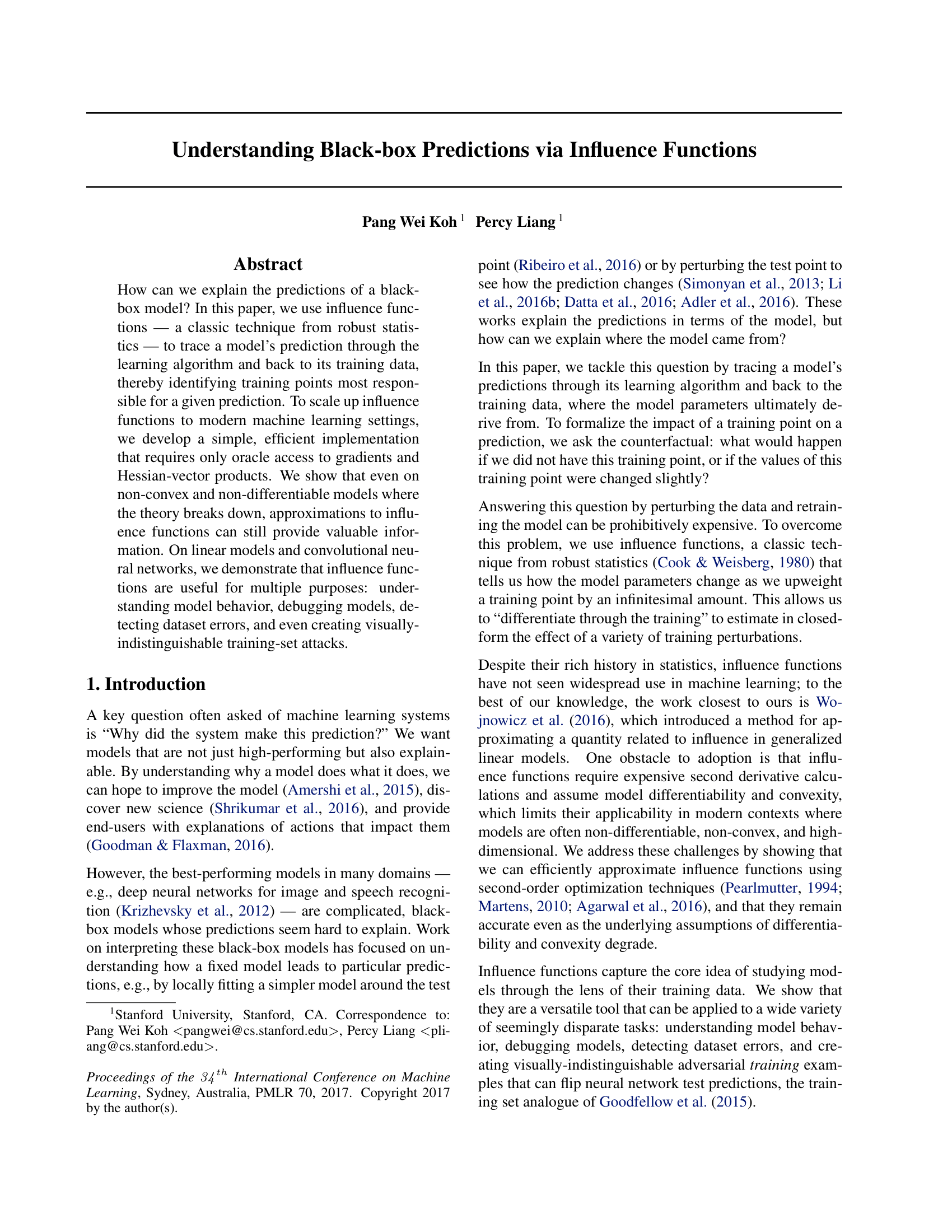
Innovation in Data Error Detection: Training Data Contribution Analysis Using Influence Functions
Influence Functions Training Data Contribution Analysis 1 Revelatory Journey Into Black Box Predictions
The optimization objective of this profound analysis is to decode the silent dialogues between raw data and algorithmic decisions, ultimately forging a transparent alpha of cognitive trust. There was a time when the opaque nature of complex machine learning architectures filled me with a profound sense of apprehension. Whenever I attempted to unravel the inner workings of deep neural networks, the sheer volume of interconnected parameters and the impenetrable fortress of high-dimensional matrix multiplications felt entirely overwhelming. The network was a silent oracle, dispensing judgments without revealing the underlying rationale. However, engaging deeply with the seminal research presented by Pang Wei Koh and Percy Liang completely rewired my intellectual perspective. It was an absolute revelation. Rather than interrogating the network to ask which specific node or layer is responsible for a localized output, this profound framework asks a far more fundamental question: which specific past experience, which exact piece of historical evidence, taught the network to formulate this specific decision? It provides a magnificent magnifying glass, illuminating the intricate ancestral lineage of artificial thought. Influence functions training data contribution analysis is not merely a mathematical diagnostic tool; it is a profound philosophical shift in how we perceive and interact with artificial intelligence. Let us embark on this exhaustive journey to uncover the hidden architectures of logic.
1. The Epistemological Awakening in Machine Learning
To truly appreciate the magnitude of influence functions training data contribution analysis, we must first contextualize the historical landscape of model interpretability. For years, the artificial intelligence community wrestled with the defining paradox of our era: as models became exponentially more accurate, they simultaneously became exponentially less interpretable. We built cognitive engines of unprecedented power, yet we stood before them as observers, unable to trace the genesis of their conclusions. The traditional methodologies of Explainable Artificial Intelligence, often abbreviated as XAI, predominantly focused on local feature attribution. Techniques such as Saliency Maps, Local Interpretable Model-agnostic Explanations, and Shapley Additive Explanations operate by perturbing the immediate input space. They illuminate which pixels in an image or which words in a sentence heavily dictated the final classification. While undeniably valuable, these methods only explain the 'how' of a prediction based on the present stimulus. They completely ignore the 'why' anchored in the model's developmental history.
This is where the paradigm entirely shifts. The authors brilliantly identify that a model is nothing more than a distillation of its training corpus. Therefore, a genuine explanation must inevitably point back to the data. Influence functions training data contribution analysis introduces a rigorously formulated mechanism to execute this precise traceback. Imagine a seasoned physician diagnosing a complex ailment. If asked to explain their reasoning, they might point to the current symptoms, analogous to feature attribution. But a far more profound explanation would involve the physician recalling the specific pivotal patient cases from their past that taught them to recognize this rare pattern. Influence functions grant our models this exact capability of historical recall. They allow us to explicitly measure the dependency of a specific prediction on a specific training point, bridging the seemingly insurmountable chasm between the static training archive and the dynamic inference engine. This introduction serves as a clarion call, signaling the transition from merely observing algorithmic behavior to deeply understanding its experiential roots.
The transition from feature-based attribution to data-based attribution represents a monumental leap. We are no longer just examining the lens through which the model views the world; we are examining the very experiences that ground the glass of that lens.
2. The Mathematics of Experiential Memory
The theoretical elegance of influence functions training data contribution analysis is deeply anchored in the venerable field of robust statistics, revitalized here for the modern computational era. Let us delve into the exquisite mathematical choreography that makes this possible. Suppose we have a machine learning model parameterized by a vector θ. After training on a massive dataset, the model converges to an optimal set of parameters, which we shall denote as θhat. The fundamental question we seek to answer is counterfactual in nature: what would happen to θhat if we had not included a specific training point, z, in our original dataset? Alternatively, what if we infinitesimally increased the weight of z during the optimization process?
Naively, to answer this, one would literally have to remove the point z and retrain the entire model from scratch to find the new optimal parameters, θ-z. In the realm of contemporary deep learning, where training consumes vast amounts of temporal and computational resources, performing this leave-one-out retraining for every single data point is a mathematical and practical impossibility. Herein lies the magnificent contribution of the authors. They employ a brilliant mathematical approximation using a first-order Taylor expansion around the optimal parameters θhat. By analyzing the analytical gradient of the loss function, they derive a closed-form estimation of the parameter change without requiring any actual retraining.
The core equation defines the influence of upweighting a training point z on the parameters: Iup,params(z) = -Hθhat-1 ∇θL(z, θhat). Let us carefully dissect this beautiful formulation. The term ∇θL(z, θhat) represents the gradient of the loss with respect to the parameters for that specific training point. Physically, this gradient tells us the direction in the parameter space that would most rapidly decrease the error for the point z. However, merely following the gradient is insufficient because it ignores the surrounding landscape sculpted by the rest of the training data. This is why the inverse Hessian matrix, Hθhat-1, is absolutely critical. The Hessian matrix encapsulates the second-order derivatives, effectively representing the curvature of the loss surface. Multiplying by the inverse Hessian corrects the gradient direction, ensuring that the estimated parameter shift respects the global geometry of the optimization landscape. It is a profound harmonization of local desire, represented by the gradient, and global constraint, represented by the curvature.
Furthermore, we do not merely want to know how the parameters shift; we want to know how a specific prediction changes. By applying the chain rule, we can project this parameter influence onto the loss of a new test point, ztest. The influence of upweighting training point z on the loss of test point ztest is defined as: Iup,loss(z, ztest) = - ∇θL(ztest, θhat)T Hθhat-1 ∇θL(z, θhat). This elegant dot product reveals the hidden alignment between the training point and the test point through the medium of the model's curvature. Influence functions training data contribution analysis thus provides a direct, mathematically rigorous conduit connecting past experiences to current inferences.
| Mathematical Component | Conceptual Meaning | Role in Influence Functions |
|---|---|---|
| ∇θL(z, θhat) | First-order Gradient | Indicates the immediate direction of error reduction for a specific data point. |
| Hθhat-1 | Inverse Hessian Matrix | Represents the structural curvature of the loss landscape, providing global context. |
| Iup,loss(z, ztest) | Test Loss Influence | Quantifies exactly how much a single training sample alters the prediction on a new test sample. |
3. Overcoming the Computational Leviathan
While the theoretical derivation of influence functions training data contribution analysis is a masterpiece of mathematical formulation, an immediate and seemingly insurmountable barrier arises when applying it to contemporary machine learning. The nemesis is the Hessian matrix. For a modern deep neural network possessing millions, or even billions, of parameters, the Hessian is an absolutely colossal matrix. Merely storing this matrix in memory is physically impossible for most hardware configurations, and calculating its inverse, an operation that scales cubicly with the number of parameters, is an astronomical computational impossibility. If the research had stopped at the theoretical equation, it would have remained a beautiful but entirely impractical curiosity.
However, the authors orchestrate a brilliant algorithmic rescue mission by heavily leveraging implicit Hessian-vector products. The crucial realization is that we never actually need the explicit formulation of the inverse Hessian matrix itself. If we look closely at the influence equation for the test loss, Iup,loss(z, ztest) = - ∇θL(ztest, θhat)T Hθhat-1 ∇θL(z, θhat), we observe that the inverse Hessian is multiplied by the gradient of the test point. Let us define a new vector, stest = Hθhat-1 ∇θL(ztest, θhat). The entire influence calculation then dramatically simplifies to a simple dot product: -stestT ∇θL(z, θhat). The monumental challenge is now entirely isolated to efficiently calculating this specific stest vector.
To compute stest, the authors creatively adapt stochastic estimation techniques and Pearlmutter's trick for exact Hessian-vector products. They frame the computation of stest as an optimization problem itself, striving to minimize a specific quadratic objective. By utilizing stochastic gradient descent or conjugate gradient methods, they can iteratively approximate stest without ever materializing the dense Hessian matrix in memory. This technique, often referred to as Lissa, transforms an O(p3) catastrophe into an operation that requires time linearly proportional to the number of parameters. This algorithmic scale-up is a phenomenal engineering achievement. It breathes practical life into influence functions training data contribution analysis, ensuring that this profound diagnostic capability can be actively deployed on realistic, large-scale architectures rather than being confined to trivial toy models.
The genius of scaling up lies in understanding that intermediate structures do not always need to be fully realized. By evaluating the effect of the Hessian directly on a vector, the computationally impossible becomes practically executable.
4. Illuminating the Corridors of Algorithmic Judgment
The theoretical profundity and the computational scalability of influence functions training data contribution analysis converge to unlock a treasure trove of practical applications. This methodology effectively transforms the black box into a meticulously indexed library of experiential references. Let us explore the diverse landscapes where this technique deploys its illumination. The most immediate and visceral application is identifying the most influential training samples for a given prediction. When a sophisticated image recognition model classifies an image as a specific breed of dog, we can now mathematically interrogate the model to present the top five training images that overwhelmingly convinced it to make that specific classification. This fundamentally changes the debugging experience. It moves the discourse from abstract feature spaces down to tangible, inspectable data artifacts.
Building upon this, influence functions become an unparalleled instrument for deep model debugging and uncovering insidious systemic biases. Imagine deploying a healthcare diagnostic model that exhibits a suspiciously high error rate on a specific demographic subpopulation. Traditional debugging would involve painstakingly analyzing the network layers or blindly collecting more data. With influence functions, we can isolate the misclassified test cases and trace their influence backward. Often, this reveals that the model is heavily relying on severely biased, noisy, or anomalous training samples within that demographic. The methodology exposes the toxic roots feeding the erroneous branches of logic.
Furthermore, the authors demonstrate the immense power of this approach in detecting dataset errors, specifically mislabeled data. In an era where datasets encompass millions of instances, manual verification is an impossibility. How do we find a microscopic mislabeled needle in a colossal haystack? The authors propose an extraordinarily elegant solution: calculate the self-influence of every training point. A point's self-influence measures how much the point helps its own prediction. Highly anomalous or mislabeled points often exhibit unusually high self-influence because they sit awkwardly in the feature space, forcing the model to contort its decision boundaries to accommodate them. By simply sorting the training dataset by self-influence in descending order, the authors show that a massive proportion of mislabeled data bubbles up directly to the very top. It is a mesmerizing demonstration of using the model's internal geometry to sanitize its own foundational experiences. Influence functions training data contribution analysis thus acts as a potent algorithmic immune system, identifying and isolating pathogenic data points.
5. Rigorous Validation Across Architectural Divides
A theory, no matter how mathematically beautiful, must withstand the harsh crucible of empirical reality. The authors of this seminal paper construct a meticulous suite of experiments to validate the efficacy and accuracy of influence functions training data contribution analysis. The primary challenge in validation is establishing a ground truth. To achieve this, they begin their empirical journey with strictly convex linear models, such as logistic regression and Support Vector Machines equipped with Radial Basis Functions. In these mathematically well-behaved environments, finding the absolute global minimum is guaranteed. Consequently, they can perform the excruciatingly slow, exact leave-one-out retraining for thousands of data points. When they plot the actual parameter shifts from exact retraining against the estimations generated by the influence function's Taylor approximation, the correlation is breathtakingly near perfect. The points align elegantly along the diagonal axis, proving definitively that the first-order approximation captures the true dynamic behavior of the optimization landscape with exceptional fidelity.
However, the true frontier of modern artificial intelligence lies far beyond the safe harbor of convexity. Deep neural networks are notoriously non-convex, characterized by chaotic optimization landscapes riddled with local minima, saddle points, and vast plateaus. Applying a first-order approximation derived assuming a strict global minimum to such a chaotic terrain seems inherently risky. The authors boldly venture into this territory by applying influence functions to complex Convolutional Neural Networks, specifically utilizing an Inception architecture applied to image classification tasks.
The empirical results in the non-convex domain are genuinely astonishing. Even though the foundational theoretical guarantees of strict convexity are violated, the influence estimations remain remarkably highly correlated with the actual leave-one-out retraining effects. Why does this approximation still hold such predictive power? The authors hypothesize that while the entire loss surface is non-convex, the immediate vicinity surrounding the converged parameters behaves locally convexly enough for the approximation to remain valid and useful. This empirical triumph is crucial; it demonstrates that influence functions training data contribution analysis is not just a theoretical artifact for toy models but a rugged, deployable diagnostic engine fully capable of interrogating the complex architectures dominating contemporary machine learning. The experiments section serves as a robust bridge between abstract mathematical theory and chaotic, real-world algorithmic practice.
6. Bridging Classical Statistics and Deep Learning
No scientific breakthrough emerges entirely in isolation. The genius of influence functions training data contribution analysis lies in its ability to synthesize classical statistical theory with the immense computational demands of modern deep learning. The authors meticulously map their intellectual lineage, drawing profound connections to the field of robust statistics developed extensively in the 1970s and 1980s. A pivotal concept in this lineage is Cook's distance, a metric traditionally used in linear regression analysis to estimate the influence of a data point by performing a mathematically equivalent operation of deletion. The authors effectively take this classical statistical concept, which was largely confined to low-dimensional, linear problems, and inject it with the computational steroids necessary to survive in the hyper-dimensional arena of deep neural networks.
It is also essential to contrast this methodology with the predominant interpretability paradigms that run parallel to it. The landscape of Explainable AI is heavily populated by feature attribution methods. Techniques like Saliency Maps generate heatmaps overlaying an image, LIME creates local surrogate models to explain immediate decision boundaries, and SHAP leverages cooperative game theory to assign contribution values to input features. These methods are undeniably powerful for understanding exactly what the model is looking at during the moment of inference. They answer the proximal question.
However, influence functions operate on an entirely different, perhaps deeper, epistemological axis. While feature attribution explains the spatial or structural 'how' of a prediction, influence functions elucidate the historical and experiential 'why'. If a model falsely identifies a husky as a wolf, feature attribution might reveal that the model is disproportionately looking at the snowy background rather than the animal's physical features. This is a crucial observation. But influence functions training data contribution analysis goes a profound step further: it reaches back into the training data to show us the exact images of wolves entirely surrounded by snow that inadvertently taught the model this erroneous correlation. By juxtaposing their work against these contemporary methods, the authors do not merely offer an alternative; they offer an entirely complementary, deeply historical dimension of interpretability that completes the holistic understanding of algorithmic behavior.
Interpretability Axes Comparison
- Feature Attribution (e.g., LIME, SHAP): Focuses on the present. Which parts of the current input are driving the decision?
- Data Attribution (Influence Functions): Focuses on the past. Which historical training examples cemented the logic for this decision?
7. Confronting Boundaries and Charting the Future
The integrity of any profound scientific work is demonstrated not only by its successes but by its candid confrontation with its own limitations. The authors engage in a transparent and deeply analytical discussion regarding the boundaries of influence functions training data contribution analysis. The most formidable theoretical boundary remains the non-convex nature of deep learning architectures. The entire foundational derivation assumes that the model parameters, θhat, reside at a strict, highly stable global minimum where the gradient is exactly zero. In the chaotic reality of training deep neural networks using stochastic gradient descent alongside techniques like early stopping, dropout, and batch normalization, the final parameters almost never rest at a perfect global minimum. They often inhabit complex saddles or expansive, relatively flat valleys.
When the gradient is not perfectly zero, the Taylor approximation inherently accumulates mathematical error. Furthermore, if the local curvature defined by the Hessian matrix is not positive definite—meaning there are directions in the parameter space where the loss actually curves downwards—the inverse Hessian computation becomes highly unstable, and the resulting influence estimations can become wildly inaccurate or conceptually meaningless. The authors openly acknowledge that while empirical approximations work astonishingly well in practice, the theoretical disconnect in highly non-convex spaces remains a fertile ground for intense future mathematical research.
Looking towards the expansive horizon, the implications of this research are staggering. Beyond mere debugging, influence functions lay the critical foundational groundwork for entirely new subfields. In the emerging domain of data valuation, where organizations seek to fairly compensate contributors in federated learning environments, influence functions provide a rigorous, mathematically sound metric to quantify the exact economic and predictive value of a single user's dataset. Moreover, in the critical area of machine unlearning, driven by privacy regulations requiring the deletion of user data from trained models, influence functions offer a pathway to mathematically estimate how to adjust model parameters without triggering catastrophic, computationally expensive retraining. The discussion profoundly emphasizes that we are merely at the genesis of understanding how to manipulate and audit the intricate, invisible threads connecting data to artificial cognition.
8. The Architecture of Rigor
The concluding sections of the paper, encompassing the Acknowledgements and the expansive Appendix, are far from mere formalities; they represent the rigorous bedrock upon which the entire intellectual edifice is constructed. The Acknowledgements reveal the collaborative, interwoven nature of modern scientific inquiry, highlighting discussions with leading minds that undoubtedly refined the complex computational strategies, particularly the stochastic estimation of the inverse Hessian matrix. It is a testament to the fact that profound breakthroughs are rarely isolated events but rather the culmination of vibrant intellectual ecosystems.
The Appendix serves as the uncompromising mathematical soul of the paper. While the main text gracefully glides over the intricate algebraic manipulations to maintain a compelling narrative flow, the Appendix presents the raw, unyielding derivations. Here, one finds the meticulous step-by-step calculus required to formulate the exact Taylor expansion, the rigorous proofs establishing the convergence guarantees of the stochastic Hessian-vector product estimators under specific conditions, and the exhaustive granular details of the hyperparameters utilized across the myriad of experiments. For the dedicated researcher attempting to replicate or extend this profound work, the Appendix is not supplementary reading; it is the essential cryptographic key required to unlock the full potential of influence functions training data contribution analysis. It exemplifies a commitment to absolute scientific transparency and mathematical reproducibility.