How Maxwells Demon and Information Asymmetry Solve the Riddle of Alpha Decay in 2026
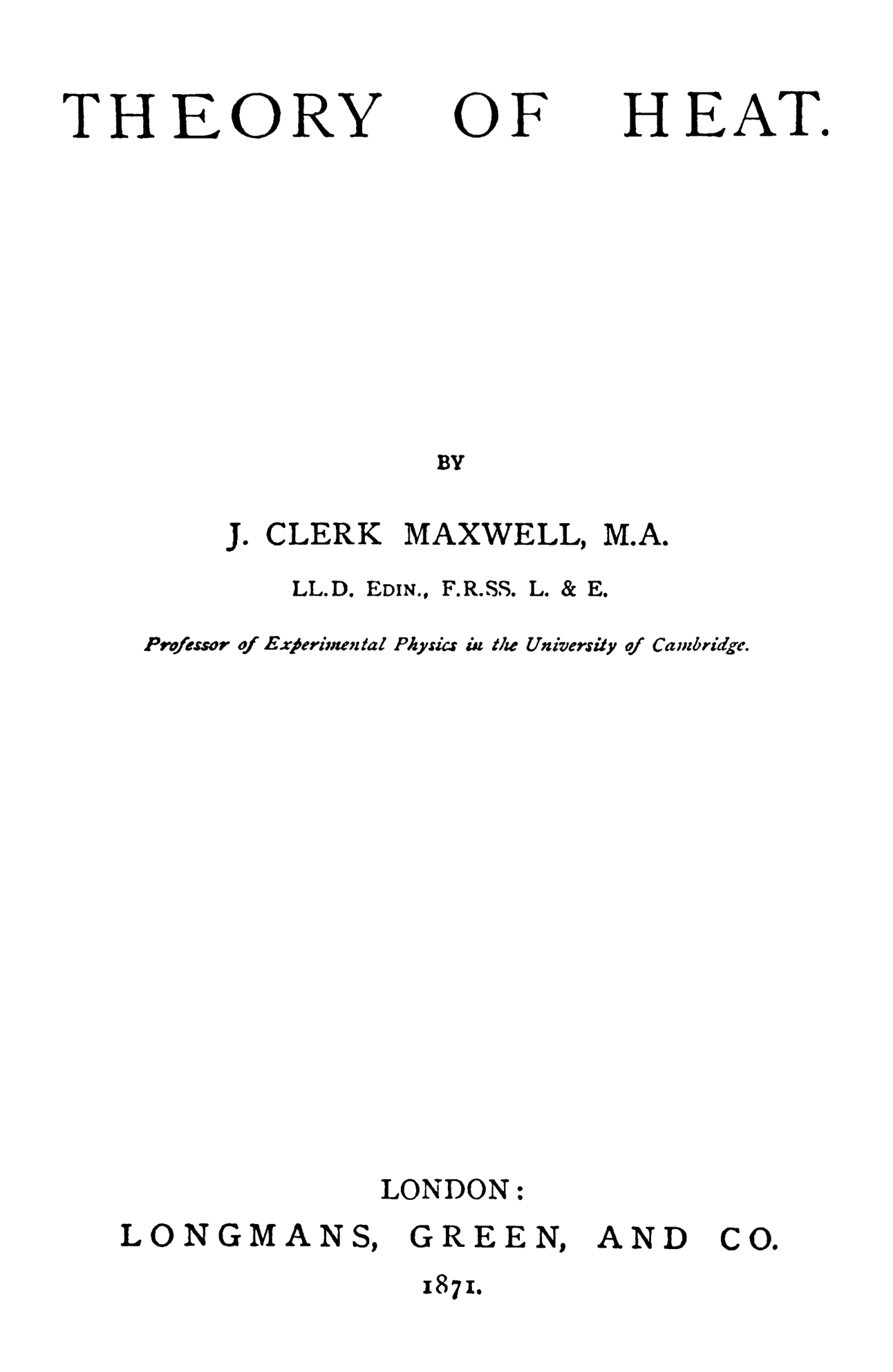
Every day, we scroll through our monitors, consuming an endless stream of quotes and news flows. Yet, the experience of truly peering into the fundamental nature of the colossal system breathing beneath them is becoming increasingly rare. Like a fleeting frame within rapidly streaming tick data, we often bypass the trajectories of capital and other participants with only a fragmented understanding. However, deeply examining the ideological foundations of an era is not merely about acquiring knowledge; it is an intellectual struggle that poses fundamental questions about the very existence of the market. The main text we are serving today—James Clerk Maxwell’s 1871 classic, Theory of Heat—is no simple physics textbook. It is an architecture of order built within chaos by a 19th-century genius. We are pulling Maxwell out of the taxidermied relics of the past and inviting him to the living, breathing frontlines of modern financial engineering. Through the body heat of countless market participants hidden behind cold formulas and the pulse of the system they generate, we embark on a journey of practical reasoning to unearth the sharpest edge from within the disorder.
The pursuit of asymmetric advantage within complex, heavily interconnected networks requires a philosophical foundation far deeper than mere statistical observation. It demands an epistemological framework capable of deciphering the macroscopic illusion of stability born from microscopic chaos. At the absolute core of this inquiry lies the concept of Maxwell Demon Information Asymmetry. When James Clerk Maxwell published his magnum opus in 1871, he did not merely redefine the physical laws governing steam engines and expanding gases; he inadvertently authored the foundational text for modern quantitative microstructure. He recognized the warmth of movement in what others saw as cold emptiness. He understood that the pressure exerted upon a system was not a uniform force, but the aggregated culmination of billions of unpredictable, violent, and highly erratic individual collisions. Today, we stand on the trading floors of a digital era, watching these exact same molecular collisions manifest as limit orders, high-frequency cancellations, and retail capitulations. To master this environment, we must adopt the lens of the physicist. We must learn to navigate the thermodynamic reality of our markets, where every actionable signal is relentlessly pursued, consumed, and ultimately dissipated into the ether of perfect efficiency.
I. The Baseline of Valuation and Thermal Capacity
Temperature, Expansion, and the Measurement of Equilibrium
Maxwell begins his meticulous architecture of reality by completely dismantling the archaic notion of caloric—an invisible fluid previously believed to carry heat. Instead, he redefines thermal dynamics fundamentally as energy in transit. In his early chapters addressing Temperature and the Expansion of Bodies, he establishes that temperature is merely the macroscopic indication of a body's internal, kinetic potential. When two entities of varying temperatures are brought into physical contact, an inexorable law dictates that energy will flow from the highly agitated system to the sedate one until absolute thermal equilibrium is achieved. At this point of equilibrium, the net exchange of energy drops to zero. Furthermore, Maxwell quantifies the exact mechanics of expansion and the Quantity of Heat, introducing specific heat capacity: the exact measure of energy required to elevate the temperature of a given substance. He observes that profound phase changes, such as the transition from solid to liquid, consume massive volumes of latent heat without any immediately observable rise in external temperature, masking the violent internal structural reconfiguration from the macroscopic observer.
The Illusion of Fair Value and Liquidity Absorption
For the institutional architect, Maxwell's definition of thermal equilibrium is the precise definition of consensus fair value. A market existing in a state of absolute equilibrium is a dead market; it possesses no informational gradients, and thus, no potential for yield extraction. The macroscopic price we observe on our terminals is nothing more than the systemic temperature—an averaged, smoothed illusion that often hides the turbulent reality below. The strategic imperative is to hunt for environments suffering from acute thermal imbalances, where the internal valuation (temperature) violently clashes with the surrounding macroeconomic environment.
Moreover, the concept of specific heat translates flawlessly into the microstructure of order book depth. A highly liquid asset possesses an immense thermal capacity; it can absorb staggering influxes of capital (heat) without exhibiting a significant spike in price volatility (temperature). Conversely, illiquid environments are hypersensitive to minimal capital injections. Most crucially, Maxwell's latent heat is the ultimate framework for understanding regime shifts. Before a market transitions from a structural bear regime into a secular bull phase, it absorbs monumental amounts of smart capital. During this phase change, the macroscopic price remains agonizingly flat. The uninformed observer assumes stagnation, while the kinetic practitioner recognizes that massive latent energy is being consumed to break the old structural bonds of pessimism. Recognizing this invisible absorption is the hallmark of sophisticated capital deployment.
II. The Stochastic Engine and Microscopic Viscosity
The Kinetic Theory of Gases and Statistical Distribution
The intellectual zenith of the 1871 text resides within the Mechanical Theory of Heat and the consequent Kinetic Theory of Gases. Maxwell decisively moves the scientific community away from deterministic, Newtonian clockwork predictability and introduces the profound reality of statistical mechanics. He postulates that the stable, measurable pressure a gas exerts upon the walls of its containment vessel is not a static force, but the aggregated result of billions upon billions of highly chaotic, microscopic collisions occurring at inconceivable speeds. Crucially, Maxwell mathematically proves that within any closed system, molecules do not travel at a uniform velocity. They distribute themselves across a bell-shaped curve. A fraction of these particles possess terrifyingly high velocities; another fraction barely moves at all. The vast majority cluster around a mean speed. We cannot, under any circumstances, predict the exact trajectory or velocity of a single, isolated molecule. Yet, through the power of statistical aggregation, we can predict the behavior of the macro-system with immaculate, unwavering precision.
Microstructure Flow and Participant Classification
This kinetic distribution is the absolute holy grail of modern order flow analysis. The financial market is the ultimate gaseous containment vessel. We must abandon the futile attempt to predict the isolated decision of a single retail participant or the exact microsecond trigger of a competing algorithmic firm. Instead, we model the aggregate pressure exerted upon the liquidity matrix. The participants in our market map perfectly to Maxwell's molecular distribution. The slow, low-energy molecules represent uninformed, passive flow—index funds, retail accumulators, and delayed rebalancers. The exceptionally fast, high-energy molecules represent predatory flow—latency arbitrageurs, informed insiders, and aggressive momentum triggers.
The sophisticated practitioner does not merely look at the volume; they analyze the velocity and the impact of these collisions. By isolating the extreme tail of the distribution—the high-velocity prints that consume liquidity with violent intent—we can detect the kinetic footprint of institutional accumulation long before the macroscopic price alters its trajectory. Volatility, therefore, is not a systemic error or a risk to be feared; it is the raw, unadulterated evidence of the system's internal mechanical energy working to establish a new equilibrium. Our trading models must act as the walls of the vessel, designed to measure, absorb, and react to the statistical frequency of these high-energy impacts.
III. The Irreversible March of Systemic Erasure
Diffusion, Mixing, and the Second Law of Thermodynamics
As Maxwell guides us through Diffusion, Mixing, and the Theory of Heat Engines, he introduces the most tragic and inescapable law of the physical universe: the Second Law of Thermodynamics. While the First Law comforts us with the knowledge that energy is eternally conserved, the Second Law delivers the brutal reality of dissipation. The quality, or the utility, of that energy inevitably degrades. Heat flows spontaneously only from hotter bodies to colder ones, never the reverse without the massive injection of external work. When two distinct gases are introduced into a chamber, they diffuse. Their molecules intermingle randomly until the initial, structured concentration is completely erased, resulting in a uniform, homogenous mixture. This irreversible process generates entropy—the ultimate metric of systemic disorder. Maxwell mathematically demonstrates that no engine can operate with perfect efficiency; a portion of the energy is always, tragically, lost as unrecoverable waste heat to the surrounding void.
Alpha Decay and the Gravity of Efficiency
In the institutional lexicon, the Dissipation of Energy is the exact physical equivalent of the Efficient Market Hypothesis. Structural edge—the proprietary insight that allows a firm to generate excess yield—is the localized, high-quality energy (low entropy) of our network. It is a highly concentrated pocket of specific gas. However, the very execution of the strategy is the catalyst for diffusion. Every time an algorithm strikes the order book, it broadcasts a microscopic informational signal into the dark pool of the market. It mixes the proprietary insight with the public record.
Other sophisticated participants, equipped with their own kinetic sensors, observe this footprint. They reverse-engineer the logic, deploy mimicking capital, and accelerate the mixing process. The informational gradient rapidly flattens. The excess yield dissipates into the baseline noise of the market, transforming into unrecoverable waste heat. This is the ironclad law of strategic entropy: every single trading model possesses a strictly defined half-life. The march toward absolute market efficiency is an irreversible, physical reality. A static strategy in a dynamic market is a dying heat engine trapped in a rapidly cooling universe. To survive, a firm must continuously discover new gradients before the old ones are completely homogenized.
IV. The Ultimate Paradox: Maxwell Demon Information Asymmetry
The Sorting Entity and the Subversion of Entropy
Hidden within the concluding thoughts of his treatise, Maxwell drops an intellectual depth charge that would haunt physicists for over a century. He proposes a hypothetical scenario designed to challenge the absolute, tyrannical supremacy of the Second Law. Imagine a vessel separated into two identical compartments by a partition containing a singular, microscopic doorway. Now, imagine a theoretical entity—a being whose faculties of perception are so infinitely sharpened that it can observe the exact velocity and trajectory of every single chaotic molecule. This being controls the doorway. By sheer observation and selective operation, it allows only the exceptionally fast molecules to pass into the right compartment, and only the slow molecules to pass into the left. Over time, without performing any macroscopic mechanical work, the right side becomes boiling hot, and the left side becomes freezing cold. The entity has successfully decreased the total entropy of the closed system. This breathtaking subversion of physical law, achieved entirely through superior observational resolution and selective gating, is the pure, unadulterated essence of Maxwell Demon Information Asymmetry.
The Algorithmic Gatekeeper and Edge Extraction
This brilliant thought experiment proved that entropy is not merely a thermodynamic reality, but deeply, inextricably bound to Information Theory. The modern quantitative trading infrastructure is the literal, real-world instantiation of Maxwell Demon Information Asymmetry. The collocated servers, the microwave transmission towers, and the machine-learning sentiment parsers represent the sharpened faculties of the entity. They do not move the market through the brute force of massive capital (macroscopic work); they extract extraordinary value through the meticulous, microscopic sorting of data.
By possessing a radically higher resolution of the molecular order flow, these algorithmic gatekeepers open their execution pathways only for the fast, highly profitable signals, while firmly shutting the door on the slow, toxic noise. They create artificial, localized temperature gradients—pockets of profound profitability—drawn directly from the chaotic entropy of the global network. However, later scientific resolutions to this paradox proved a devastating reality: the act of measuring, storing, and erasing the information required to operate the door carries its own massive thermodynamic cost. In our industry, this means that maintaining Maxwell Demon Information Asymmetry requires an astronomical, continuous expenditure of capital on technology, talent, and data acquisition. The entity does not exist for free. The moment the cost of maintaining the informational resolution exceeds the yield extracted from the sorted gradient, the system collapses, and entropy reclaims its throne.
V. The Philosophy of the Architect in a Dissipative Universe
The Ultimate Thermal Fate and Localized Order
Maxwell concludes his sweeping narrative by contemplating the ultimate fate of all physical structures. If left undisturbed, the universe will relentlessly diffuse its energy until a state of absolute, uniform temperature is achieved—the theoretical heat death, where no gradients exist, and thus, no life or motion can be sustained. Yet, he also observes that within this grand, terrifying march toward dissolution, localized structures can temporarily resist the tide. Living organisms, complex chemical reactions, and intricately designed engines maintain their internal order by continuously consuming high-quality energy from their external environment and expelling high-entropy waste. Survival is the act of maintaining a local temperature gradient in defiance of universal equilibrium.
Systemic Resilience and the Burden of the Observer
My personal insight, forged through years of designing and dismantling these complex systems, is that the ultimate goal of the financial architect is not to discover a perpetual motion machine—for Maxwell proved such things are impossible. The goal is to construct a localized, highly defended structure of order capable of surviving the market's ruthless march toward absolute efficiency. Maxwell Demon Information Asymmetry is our ultimate weapon, but it is a weapon that demands constant sharpening. We must continuously intake fresh, unstructured, high-quality data to fuel our sorting engines, while ruthlessly discarding the decayed, high-entropy strategies of yesterday.
We are the thermodynamic engineers of capital flow. By internalizing the profound kinetic foundations laid down in 1871, we elevate ourselves from being blind victims of systemic chaos to becoming the deliberate designers of the very filters that define value. We harness the chaotic collisions, we respect the irreversible diffusion, and we stand at the gateway, tirelessly sorting the signal from the noise, illuminated by the cold, brilliant light of statistical truth.
Frequently Asked Questions
Q1. What exactly constitutes Maxwell Demon Information Asymmetry in modern markets?
It is the strategic and technological capacity to locally decrease systemic entropy. By deploying vastly superior observational infrastructure, an institution acts as the hypothetical entity, selectively sorting highly profitable (fast) data signals from unprofitable (slow) noise, thereby creating an artificial gradient of excess yield without traditional directional exposure.
Q2. How does the concept of Kinetic Gas Theory improve execution algorithms?
Instead of attempting the impossible task of predicting individual participant behavior, kinetic-inspired algorithms rely on statistical mechanics. They model the aggregate pressure and volatility distribution of the order book, recognizing that macro-price stability is merely an illusion sustained by millions of chaotic, microscopic interactions that can be probabilistically modeled.
Q3. Why is the Dissipation of Energy an essential concept for portfolio longevity?
Dissipation is the physical equivalent of market efficiency. It proves that all structural advantages and unique insights will inevitably degrade into public knowledge through the very act of trading. Acknowledging this thermodynamic irreversibility forces an institution to abandon static models and continuously innovate, accepting that every edge possesses a strict, inescapable half-life.
본 분석을 통해 도출해낸 결론은, 무질서하게 흩어진 미시적 데이터들 사이에서 유의미한 정보의 구배를 포착하여, 시스템의 자연적인 엔트로피 증가를 넘어서는 지속 가능한 국소적 질서를 구축하는 데 있습니다. 맥스웰이 150년 전 남긴 경이로운 통찰은 단순한 물리 법칙을 넘어, 정보가 곧 시스템의 에너지이며 그 압도적인 선별 능력이 곧 치열한 자본 시장에서 생존하기 위한 가장 본질적인 무기임을 우리에게 엄숙히 증명하고 있습니다. 끊임없이 요동치고 소산되는 거대한 시장의 파도 속에서도, 보이지 않는 통계적 진실을 꿰뚫어 보는 냉철한 관찰자의 시선을 굳건히 유지하시기를 바랍니다.