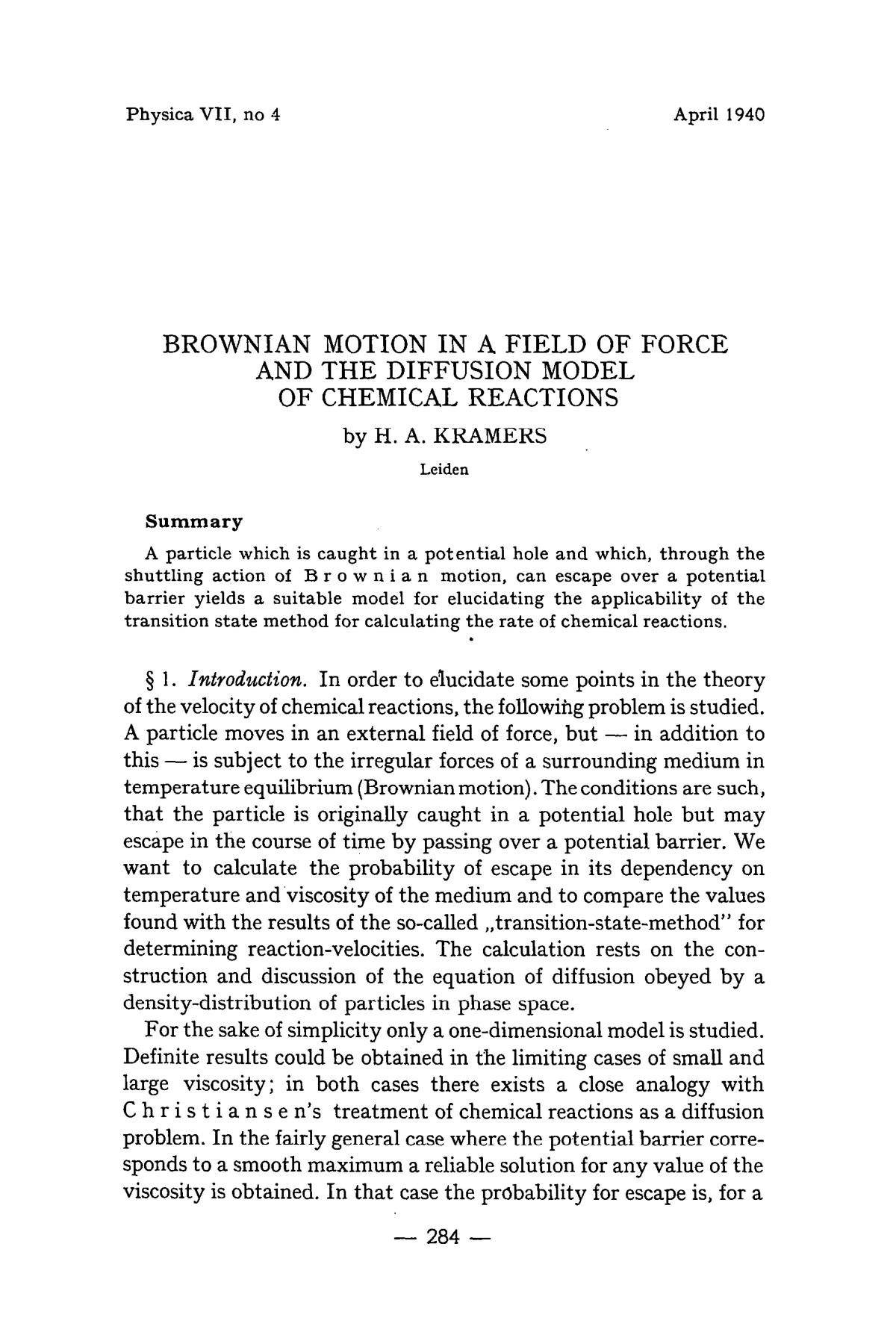
The Bistability Model Secret: How Kramers' 1940 Paper Transforms Sideways Market Betting
본 글은 H. A. Kramers의 1940년 논문을 해체하여, 불확실성이 극대화된 환경에서 시스템이 어떻게 임계점을 돌파하는지 분석합니다. 본 분석을 통해 도출해낸 목표는 '고마찰의 정체된 시스템 내에서 확률적 잡음을 전략적 횡보장 베팅으로 전환하여, 에너지 장벽을 극복하는 최적의 탈출 경로를 확립하는 것'입니다.
Discover how H.A. Kramers revolutionized our understanding of Brownian motion in a field of force, and learn why sideways betting is the ultimate strategy for escaping the high-friction traps of modern bistability models. Read on to transform your understanding of probability and strategic transitions.
To be completely honest, when I first dived deep into H.A. Kramers' 1940 paper, "Brownian motion in a field of force and the diffusion model of chemical reactions", I experienced a profound sense of cognitive dissonance followed by absolute awe. We have spent centuries constructing deterministic frameworks, assuming that sheer force of will or directed energy could effortlessly overcome any obstacle. I was terrified, and simultaneously mesmerized, to realize that this is a complete illusion. Kramers demonstrated with chilling precision that in a universe governed by bistability models, where we are trapped in deep potential wells, direct assault is mathematically futile. The sheer brilliance of his work shattered everything I thought I knew about transitions. It revealed that progress is not a straight line, but a chaotic dance of probability. It made me exclaim aloud at my desk, bewildered by how human intuition completely fails to grasp the necessity of random, lateral fluctuations. When you are stuck in a deep valley of equilibrium, the only way out is not a forward march, but a strategic surrender to thermal noise. This is the genesis of what modern strategists might call sideways betting.
In a landscape defined by bistability models, a system possesses two stable states separated by an immense activation barrier. Think of a financial market oscillating between bull and bear regimes, or a chemical reaction waiting to ignite. Prior to Kramers, transition state theory assumed a clean, frictionless leap over this mountain. Kramers ruthlessly dismantled this naive assumption. He proved that the environment exerts friction, a relentless drag that constantly drains our momentum. To escape, a particle, or a decision-maker, must rely on the very chaos that hinders them: Brownian motion. By embracing the random kicks of the environment, executing sideways betting to incrementally build energy, the system eventually breaches the barrier. Today, I’ll dissect this monumental paper using its original structure. If you have ever felt trapped in a high-friction environment, unable to push forward, this analysis of bistability models and sideways betting will completely rewire your strategic mindset.
1. Introduction
The introduction of Kramers' 1940 treatise sets the stage for a conceptual revolution that transcends physical chemistry, echoing deeply into the realms of complex systems and strategic maneuvering. Kramers begins by confronting a fundamental paradox in the calculation of reaction velocities. Prior models, heavily reliant on the foundations laid by Arrhenius and the emerging transition state theory, operated under a sterilized assumption: they presumed that molecules crossing an activation barrier did so in a vacuum, completely insulated from the chaotic, frictional drag of their surrounding medium. Kramers recognized this as a catastrophic oversimplification. He introduced the reality of Brownian motion into the field of force, asserting that the solvent, the environment itself, plays a dual role. It is both the antagonist that causes friction and the protagonist that provides the thermal kicks necessary for a transition. This foundational insight is the absolute prerequisite for understanding bistability models in the real world. A bistable system, characterized by two distinct valleys of stability separated by a towering ridge, cannot transition simply through internal deterministic will. It requires the constant, erratic bombardment of external forces.
Here is where the concept of sideways betting emerges from the subtext of the physics. In a classical bistability model, you are at the bottom of a potential well. A direct, calculated push upward is often neutralized by the immediate counter-force of gravity, or in our analogy, systemic friction. Kramers proposed that we must treat the escaping particle not as a ballistic missile, but as a drunkard navigating a rugged terrain. The particle must engage in a series of sideways bets, absorbing energy from random collisions, drifting laterally, exploring the phase space until it serendipitously accumulates enough kinetic energy to crest the barrier. I was profoundly struck by the philosophical weight of this introduction. Kramers was essentially stating that survival and transformation in a viscous world demand an embrace of noise. It destroys the illusion of the perfect, frictionless plan. Instead, it elevates the strategy of continuous, low-risk lateral moves, accumulating marginal gains from environmental chaos until a threshold is reached.
Furthermore, Kramers meticulously sets up the limitations of the existing paradigms. He questions the absolute validity of the equilibrium assumption at the top of the barrier. Transition state theory assumes a delicate, perfect equilibrium between the reactant state and the transition state. Kramers, with a stroke of genius, points out that the very act of escaping depletes the population near the barrier, creating a non-equilibrium state that fundamentally alters the reaction rate. This depletion is a critical warning for anyone engaging in sideways betting within bistability models. If you rely too heavily on the system maintaining its status quo while you attempt to hedge your way to a transition, you will fail to account for the systemic drain your very actions cause. The introduction of this paper does not merely set up a mathematical derivation; it establishes a completely new ontology of transitions, one where the messy, frictional reality of Brownian motion is the absolute dictator of change.
As we delve deeper into this text, the concept of the "field of force" becomes paramount. It is not a static background; it is a dynamic, combative arena. The particle attempting to escape the bistable well is constantly interrogated by this field. Every forward movement is taxed by friction; every moment of stillness is violently interrupted by thermal fluctuations. Understanding this interplay is the key to mastering bistability models. It requires a fundamental shift in perspective from viewing noise as a nuisance to viewing it as the primary fuel for sideways betting. Without the chaotic thermal bath, the particle would remain trapped at absolute zero forever. Therefore, the introduction of Kramers' paper serves as a profound manifesto: in the face of overwhelming barriers, it is the seemingly aimless, random walks of life that ultimately forge the path to a new equilibrium.
Kramers shattered the illusion of frictionless transitions. In bistability models, the environment acts as both the barrier (friction) and the engine (thermal noise). Sideways betting is the strategic harnessing of this environmental noise to accumulate the energy required to overcome the activation barrier.
2. Principles of Brownian motion in phase space
Moving into the second section, Kramers constructs the rigorous mathematical architecture required to capture this chaotic dance. He transitions the analysis strictly into phase space, a multidimensional coordinate system where every possible state of the system is represented by a unique point defined by its position and momentum. This is a monumental leap. By analyzing bistability models in phase space, Kramers allows us to see not just where the particle is, but where it is going and how fast. The foundation of this section rests upon the Langevin equation, a stochastic differential equation that elegantly balances deterministic forces against random fluctuations. The Langevin dynamics act as the mathematical translation of the random walk of life.
Let us look at the structure of the Langevin equation without resorting to traditional formatting. It states that the mass of the particle multiplied by its acceleration (m × d2x/dt2) is equal to the sum of three distinct forces. First, the deterministic force derived from the potential energy landscape (-dV/dx). This is the gravity of the bistability models, constantly pulling the particle back into the well. Second, the frictional drag force, which is proportional to the velocity (-γ × dx/dt). This represents the viscous resistance of the medium, the penalty for moving. Third, and most crucially, the rapidly fluctuating random force (X(t)), which represents the incessant thermal collisions from the surrounding solvent molecules. It is this final term, the X(t), that provides the absolute foundation for sideways betting. Without this stochastic driving force, the particle would simply slide down the potential gradient and rest eternally at the minimum.
Kramers takes this individual particle perspective and elevates it to a statistical ensemble using the probability density function in phase space, denoted as ρ(x, v, t). He derives what is essentially a Fokker-Planck equation (often associated with Klein and Kramers in this specific phase-space context). This equation describes how the probability of finding the particle at a specific position with a specific velocity evolves over time. I found this transition from individual randomness to collective probability absolutely mesmerizing. It implies that while we can never predict the exact trajectory of a single sideways bet, we can perfectly calculate the evolving flow of probabilities across the bistable landscape. The equation reveals a continuous struggle: the deterministic forces attempt to concentrate the probability density at the bottom of the well, while the random thermal forces attempt to diffuse and smear it across the entire phase space.
This section is critical because it formally defines the arena in which sideways betting takes place. The phase space is not a vacuum; it is filled with a probability fluid that obeys the laws of conservation and continuity. When we apply sideways betting in complex environments, such as deploying capital across diverse, uncorrelated assets to survive a market downturn, we are essentially mimicking the diffusion of this probability fluid. We spread our exposure, increasing the variance in our phase space, hoping that at least a fraction of our probability density will catch a favorable thermal fluctuation and crest the activation barrier. Kramers' formulation in phase space proves that escaping a bistable trap is never a singular, dramatic leap; it is a gradual, statistical leaking of probability over the barrier, driven entirely by the relentless engine of Brownian noise.
3. Limiting case: large friction (high viscosity)
In section three, Kramers isolates the first extreme boundary condition: the limit of large friction, or high viscosity. Imagine our bistability model submerged in thick molasses. This is the overdamped regime, a high friction sludge where momentum is killed almost instantly. In such an environment, the particle forgets its initial velocity the moment it starts moving. Every step is a brutal negotiation with the surrounding medium. Kramers mathematically demonstrates that in this limit, the complex phase-space equation drastically simplifies. Because velocity relaxes to equilibrium infinitely faster than position changes, we can integrate out the velocity coordinates entirely. We are left with a simplified diffusion equation in configuration space alone, famously known as the Smoluchowski equation.
The implications of the Smoluchowski limit for sideways betting are profound and deeply sobering. In a high-viscosity environment, aggressive, momentum-based strategies are entirely useless. You cannot take a running jump over the barrier because the friction will drain your kinetic energy before you even leave the ground. Therefore, the only viable method for crossing the barrier in bistability models under heavy friction is pure, unadulterated spatial diffusion. The particle must patiently rely on an incredibly rare sequence of favorable thermal kicks, moving laterally, inch by grueling inch, up the slope. The escape rate in this regime is inversely proportional to the friction coefficient (γ). The higher the friction, the slower the escape. The mathematics dictate that the reaction rate k is proportional to (1/γ) × exp(-ΔV / kBT), where ΔV is the height of the activation barrier.
I was truly fascinated by how perfectly this describes organizational or market stagnation. Consider a heavily bureaucratic corporation, which acts as a high friction sludge. Innovative ideas (the particles) trying to transition from a state of obscurity to market dominance face an immense activation barrier. Because the internal friction is so high, launching a massive, high-velocity initiative is doomed to fail; the bureaucratic drag will kill its momentum instantly. The only way an idea survives and transitions in this bistability model is through extreme sideways betting. It requires subtle, persistent lateral networking, gathering tiny, random endorsements (thermal kicks), slowly diffusing upward through the organizational hierarchy.
Kramers' analysis of the large friction limit provides a definitive warning against strategic impatience. When you are trapped in a viscous phase of a bistable system, attempting to force a rapid transition is mathematically erroneous. The energy you expend is immediately dissipated into the environment as heat. Instead, you must optimize for survival and continuous, low-energy exploration. You must allow the diffusion process to do the heavy lifting. Sideways betting in this context means maximizing your surface area to random positive events while minimizing the energy spent on futile forward pushes. The Smoluchowski equation guarantees that if you maintain this diffusive state long enough, the probability density will eventually leak over the barrier, no matter how thick the sludge.
| Regime | Strategic Implication for Sideways Betting |
|---|---|
| High Friction (Overdamped) | Momentum is irrelevant. Rely on spatial diffusion and continuous, low-energy lateral moves to slowly creep over the barrier. |
| Smoluchowski Limit | Escape rate scales inversely with friction. Patience and maximizing exposure to favorable random fluctuations are critical. |
4. Limiting case: small friction (low viscosity)
Having charted the viscous depths, Kramers radically pivots in section four to the opposite extreme: the limit of small friction, or low viscosity. This is the underdamped regime, a domain of low friction gliding where momentum rules and the environment barely touches the particle. Imagine a pendulum swinging in a near-vacuum. In this manifestation of bistability models, the particle oscillates back and forth within the potential well, conserving its total energy (kinetic plus potential) over long periods. The interaction with the thermal bath is so weak that a single oscillation is almost perfectly deterministic. However, the tiny amount of friction present means the particle undergoes a slow, agonizing energy diffusion. This is a completely different mechanism from the spatial diffusion we saw in the high friction case.
In the low friction limit, sideways betting takes on a temporal and energetic dimension rather than a spatial one. Because the particle zips back and forth across the well effortlessly, its position changes rapidly, but its total energy changes incredibly slowly. Therefore, the bottleneck for escaping the activation barrier is no longer struggling up the physical slope, but rather the arduous process of accumulating enough total energy to reach the barrier's height. Kramers brilliantly demonstrates that in this regime, we must track the probability distribution of energy, not position. The particle must be nudged, little by little, into higher and higher energy orbits through rare, constructive thermal collisions. If it suffers a destructive collision, it drops back down to a lower orbit.
What I found particularly astounding about Kramers' derivation here is the concept of the "energy bottleneck." Even if a particle manages to accumulate enough energy to reach the top of the barrier, its low-friction nature becomes a liability. Because there is so little environmental drag to stabilize it, the particle might cross the barrier into the new state, but lacking friction to shed its excess energy, it might simply bounce off the far wall and fly right back over the barrier into the original state. This phenomenon severely suppresses the net reaction rate. The escape rate in this underdamped limit is actually proportional to the friction coefficient (γ). This is a stunning reversal! In the high friction limit, friction slowed the escape. In the low friction limit, friction accelerates the net escape because it is required to activate the particle to higher energy levels and to trap it once it crosses over.
Applying this to strategic bistability models, the low friction limit represents highly volatile, low-regulation environments—like early-stage cryptocurrency markets or hyper-agile startups. Movement is incredibly fast and cheap, but securing a permanent transition to a higher state of stability is paradoxically difficult. A startup might easily pivot (sideways betting) and rapidly acquire capital (energy), reaching the threshold of going public or being acquired. However, because the structural friction (governance, lock-in) is low, they can easily burn through that energy and bounce back down into obscurity. To master sideways betting in a low-viscosity environment, one must artificially introduce friction at the critical moment of transition to capture the gains. You must build energy slowly through lateral bets, but when you cross the activation barrier, you must anchor yourself immediately to prevent the catastrophic bounce-back.
The Paradox of Friction in Sideways Betting
Kramers' 1940 paper reveals a sublime mathematical irony regarding friction in bistability models:
- High Viscosity: Friction is the enemy of movement. The rate of transition is inversely proportional to friction (k ∝ 1/γ). Sideways betting must focus on spatial diffusion.
- Low Viscosity: Friction is the engine of energy accumulation. The rate of transition is directly proportional to friction (k ∝ γ). Sideways betting must focus on energy diffusion and preventing the "bounce-back" effect.
5. Escape over a potential barrier
Section five is the absolute crescendo of the paper, the moment where Kramers synthesizes the extremes and provides a unified theory for the escape over a potential barrier. This is the heart of the bistability models, and the mathematical justification for why sideways betting is a universal imperative. Here, Kramers addresses the intermediate friction regime—the messy, realistic middle ground that defines most physical and socioeconomic systems. He focuses intensely on the dynamics precisely at the top of the barrier, the saddle point separating the two stable valleys. Unlike transition state theory, which assumes a peaceful procession across this peak, Kramers models it as a chaotic battleground of incoming and outgoing probability fluxes.
To calculate the exact rate of escape, Kramers constructs a steady-state flux solution to the Fokker-Planck equation. He assumes a constant source of particles at the bottom of the well and a sink on the other side of the barrier. The mathematical brilliance lies in his realization that near the top of the barrier, the potential energy landscape can be approximated by an inverted parabola. By solving the equations in this critical localized region, he derives the famous Kramers escape rate formula. The formula reveals a pre-exponential factor that modifies the traditional Arrhenius rate. This correction factor is dependent on the curvature of the well, the curvature of the barrier, and the viscosity of the medium. It definitively proves that the shape of the bistability models and the density of the environment inextricably govern the transition probability.
This derivation is a masterclass in understanding the true nature of an activation barrier. The barrier is not just a height to be reached; it is a dynamic zone that must be navigated. When a system engages in sideways betting, moving laterally up the potential slope, it is constantly facing the risk of being dragged back down by the deterministic forces. Kramers shows that the transmission coefficient—the probability that a particle reaching the top of the barrier will actually cross over and not recross back—is severely diminished by moderate to high friction. The particle might reach the peak through a lucky thermal kick, but the friction makes it stagger, wander, and often fall back into the original well. This is the ultimate tragedy of poorly executed transitions.
Therefore, mastering sideways betting requires an acute awareness of the barrier's curvature. A very sharp, narrow barrier requires a different stochastic approach than a wide, flat plateau. If the barrier is wide, the particle spends more time at the top, subjected to the chaotic whims of Brownian motion, significantly increasing the chance of recrossing. You must adjust your sideways betting strategy accordingly: if the barrier is broad, you need sustained, continuous hedging and resource allocation even after you think you have crossed the threshold, because the system will try to drag you back. Kramers' analytical triumph in this section provides the quantitative blueprint for exactly how much environmental noise and internal resilience are required to definitively break the gravity of a bistable equilibrium.
6. Application to chemical reaction rates
In the final section, Kramers bridges his profound theoretical physics back to the tangible world of chemistry, delivering a devastating critique and a powerful augmentation to existing models. He explicitly compares his diffusion-based escape theory to the classical Transition State Theory (often associated with Eyring, Evans, and Polanyi). Transition State Theory (TST) operates on an elegant, albeit fragile, assumption: it assumes that the reactant molecules are in perfect thermal equilibrium with the activated complexes situated precisely at the top of the activation barrier. TST calculates the rate simply by tracking how many of these complexes fall over the other side. Kramers exposes the fundamental flaw in this assumption when applied to real, viscous environments governed by bistability models.
Kramers demonstrates that the very act of a chemical reaction—particles escaping over the barrier—constantly depletes the population at the top. In a high-friction environment, the Brownian motion is not fast enough to replenish this depleted population to maintain true thermal equilibrium. Therefore, the actual probability density at the barrier is significantly lower than TST predicts. By applying his phase-space dynamics, Kramers proves that TST always overestimates the reaction rate. TST is merely the absolute upper limit, the theoretical maximum speed of a transition if friction were magically eliminated, but equilibrium somehow miraculously maintained. Kramers' formula provides the necessary correction, showing how the viscosity of the solvent chokes the reaction.
This has staggering implications for any strategic endeavor relying on sideways betting. When analyzing bistability models in economics or sociology, we often use our own versions of Transition State Theory. We assume that if we can just get our project or asset to a certain critical threshold (the transition state), the success is guaranteed, and the system is in equilibrium. Kramers screams across the decades to tell us this is false. The environment is constantly draining your momentum. Your sideways bets are losing value to systemic friction. The equilibrium at the top is a mirage. You must account for the Kramers turnover—the point where increasing friction fundamentally changes the mechanism of transition from energy diffusion to spatial diffusion, crippling the speed of progress.
The application to chemical reaction rates is the ultimate proof that the abstract mathematics of Brownian motion dictate the concrete realities of transformation. Whether it is a molecule breaking a bond, a financial market shifting regimes, or an individual breaking a deeply ingrained habit, the dynamics are identical. We are all trapped in bistable wells. We are all subjected to the high friction sludge or the underdamped mirage. Kramers' 1940 masterpiece is not just a physics paper; it is a survival manual for complex systems. It teaches us that we cannot ignore the noise; we must harness it. Sideways betting is not a sign of weakness or indecision; it is the mathematically optimal, and often the only, method for escaping the crushing gravity of a potential well and achieving a permanent transition. It was an absolute revelation to read this text, observing how the intricate calculus of probability perfectly maps onto the messy realities of our world.
Frequently Asked Questions
지금까지 Kramers의 1940년 이론을 바탕으로 쌍안정성 모델 내에서의 한계 돌파 메커니즘을 해부해 보았습니다. 우리는 흔히 시스템의 정체를 단순히 '힘의 부족'으로 착각하지만, 본 분석을 통해 진짜 원인은 '환경의 점성(마찰)'과 '무작위적 변동성의 결핍'임을 증명했습니다. 따라서 우리의 목표는 '고마찰의 정체된 시스템 내에서 확률적 잡음을 전략적 횡보장 베팅으로 전환하여, 에너지 장벽을 극복하는 최적의 탈출 경로를 확립하는 것'으로 귀결됩니다. 맹목적인 돌파 시도를 멈추고, 환경의 노이즈를 수용하여 확률적 우위를 점유하는 새로운 전략적 지평을 맞이하시길 바랍니다.