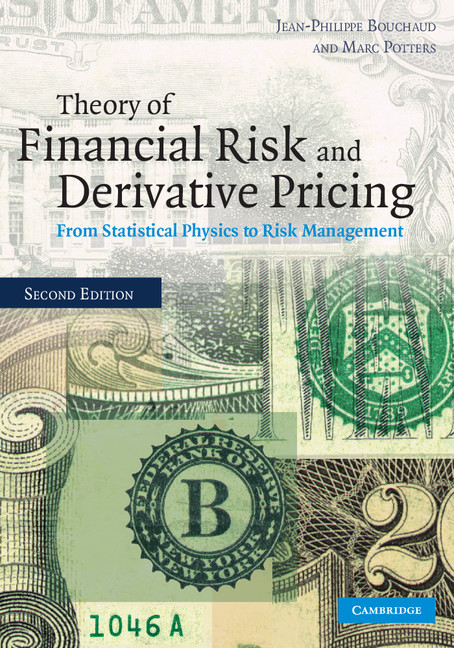
Derivative Pricing and Theory of Financial Risk from the Perspective of Order Collision Energy
이 글은 Jean-Philippe Bouchaud와 Marc Potters의 저서를 바탕으로 금융 시장의 미시구조를 물리학적 입자 모델로 해석하고, 주문 충돌 시 발생하는 에너지 소산이 거시적 변동성에 미치는 영향을 분석합니다. 차가운 통계적 현실 속에서도 각 주문 배후에 존재하는 인간의 맹목적 생존 의지와 시장 생태계를 바탕으로 서술되었습니다. 본 분석은 단순한 변동성 예측을 넘어, 미시적 에너지 소산 메커니즘을 규명함으로써 시장 체제 전환을 능동적으로 통제하고 지속 가능한 시스템적 활력을 확보하는 것을 목적으로 합니다.
The architecture of financial markets has long been shrouded in the elegant but empirically flawed assumptions of Gaussian dynamics and perfectly continuous pricing. However, upon examining the raw, unpolished empirical data, a completely different reality emerges—a reality governed by discrete, chaotic, and often violent interactions. Reading through Jean-Philippe Bouchaud and Marc Potters' seminal work, Theory of Financial Risk and Derivative Pricing, one is compelled to abandon the comfort of traditional Black-Scholes drifts and embrace the rigorous, sometimes unsettling world of statistical physics applied to finance. The financial market, stripped of its neoclassical illusions, is essentially a vast reaction-diffusion space where discrete human intentions manifest as physical particles. Every limit order placed on the order book is a particle deposited on a lattice, and every market order is an incoming particle seeking collision. When these particles collide, a trade occurs, and energy is dissipated into the system in the form of price impact and volatility. This framework—what we shall term the Particle Collision Model of Market Microstructure—allows us to quantify the Order Collision Energy that ultimately drives the anomalous price statistics observed in real markets. It requires a profound shift in perspective, moving from the macroscopic smoothing of stochastic calculus to the microscopic granularity of interacting agents. In doing so, we not only gain mathematical precision but also cultivate a profound, macroscopic humility. We begin to see that the immense volatility fluctuations and extreme tail risks are not mere mathematical anomalies, but the aggregated kinetic energy of human uncertainty, fear, and adaptation playing out on a microscopic scale.
1. Statistical Foundations and the Kinematics of Order Flow
To establish a rigorous particle collision model, we must first deeply engage with the statistical foundations laid out in Part I of the text. Bouchaud and Potters meticulously construct the necessary probability theory, emphasizing the absolute necessity of understanding the maximum and addition of random variables. In the context of our particle model, random variables do not merely represent abstract price changes; they represent the deposition rate, the cancellation rate (evaporation), and the execution rate (annihilation) of discrete order particles within the order book. Traditional finance relies heavily on the central limit theorem, assuming that the addition of countless small impacts inevitably leads to a Gaussian distribution. However, when we analyze the empirical data of the order flow, we encounter Lévy distributions and Pareto tails. The random variables representing the volume of incoming market orders (the mass of the colliding particles) have variances that diverge. Consequently, the central limit theorem fails to hold in its standard form, invoking instead generalized limits that preserve the fat-tailed nature of the underlying phenomena.
The transition from discrete order events to macroscopic price dynamics requires a careful treatment of the continuous time limit and Ito calculus, moving towards path integrals. In our model, a price path is not a smooth trajectory governed by a simple differential equation; it is the macroscopic manifestation of millions of microscopic particle collisions. Let us denote a buy order as a particle of type B and a sell order as a particle of type S. The order book acts as a low-dimensional spatial lattice. Particles are deposited at various price levels with a rate λ. They evaporate (cancel) with a rate ν. When a B particle and an S particle occupy the same price coordinate, an annihilation reaction occurs: B + S → ∅. This annihilation is a trade. The collision generates a shockwave—an energy release that shifts the reference frame of the mid-price. Using path integral formulations, we can sum over all possible histories of these particle depositions and annihilations to calculate the transition probability P(x, t | x0, t0) of the price moving from x0 to x. Unlike standard Brownian motion where the path integral evaluates over a quadratic action, the action in our collision model must incorporate the jump processes and the nonlinear friction caused by the latent liquidity (the resting particles). The statistical foundations thus compel us to view the price not as a diffusion process, but as the emergent boundary of a reaction-diffusion equation, where the boundary fluctuates wildly depending on the fluctuating density of the B and S particles.
Furthermore, the maximum of random variables plays a crucial role in understanding extreme risks and market crashes. If the order collision energy is proportional to the size of the incoming market order, the maximum energy injected into the system in a given time interval dictates the largest potential price jump. Because the distribution of these order sizes follows a power law, P(V) ∝ V-1-μ, the maximum value drawn from a sample of size N scales as N1/μ. This implies that as the trading frequency increases, the magnitude of the extreme collisions grows non-trivially. The mathematical machinery provided by Bouchaud and Potters allows us to rigorously formalize this kinematics, moving beyond descriptive statistics into a generative model where the macroscopic reality of financial risk is a direct, computable consequence of microscopic particle interactions and their inherent structural instability.
2. Empirical Reality of Collision Energy and Volatility Fluctuations
Moving from the foundational mathematics to Part II, Empirical Financial Statistics, the theoretical particle model must confront the rigid, often chaotic reality of real price statistics. One of the most critical insights from Bouchaud and Potters is the pervasive existence of non-linear correlations and volatility fluctuations. In standard geometric Brownian motion, volatility is an exogenous, deterministic constant. In the reality of the order book, volatility is the direct measure of the ambient Order Collision Energy. It is a dynamical variable that exhibits profound memory and clustering. When a massive particle (a large institutional block order) collides with the resting liquidity, it does not merely shift the price; it shatters the local density of resting particles. This creates a liquidity void. Subsequent particles falling into this void travel further before colliding, meaning that the price impact of subsequent, even smaller orders, is magnified. This is the microscopic origin of volatility clustering. The collision energy is not instantly dissipated; it reverberates through the spatial lattice of the order book.
The kinetic energy of the market is heteroskedastic. The empirical data undeniably shows that the auto-correlation of price returns decays rapidly, ensuring the absence of simple arbitrage. However, the auto-correlation of the absolute returns, or the squared returns—which act as proxies for the collision energy—decays incredibly slowly, following a power-law τ-β. This long memory of volatility implies that the market ecosystem is constantly in a state of critical self-organization.
Moreover, the book extensively discusses skewness and price-volatility correlations, particularly the leverage effect observed in equity markets. In our particle framework, the leverage effect can be interpreted through the lens of asymmetric collision responses. When the price drops (a cascade of S particles annihilating B particles at lower and lower coordinates), the systemic panic increases the deposition rate of new S particles while simultaneously increasing the evaporation rate of B particles. The market depth on the bid side thins out exponentially. Consequently, the energy required to push the price even lower decreases, leading to a negative correlation between past returns and future volatility. This asymmetry is not merely a statistical artifact; it reflects the deep-seated psychological asymmetry of human agents operating the particles—fear propagates faster and more destructively than greed.
Cross-correlations between different financial products further complicate this energetic landscape. Particles in one order book are not isolated; they are quantum-entangled with particles in other books through statistical arbitrage and index-level macro strategies. A massive collision in the S&P 500 futures market instantly induces sympathetic collisions across all constituent equities. The analysis of empirical data demands that we treat the covariance matrix of these assets not as a static geometric construct, but as a dynamic network of energy transfer. Bouchaud and Potters highlight the noise inherent in empirical correlation matrices, urging the use of Random Matrix Theory to filter out the spurious correlations from the true, systemic eigen-modes of energy propagation. By applying this rigorous empirical lens, the particle collision model transforms from a metaphorical heuristic into a calibrated, highly predictive framework capable of explaining the specific mechanisms for anomalous price statistics.
3. Derivative Pricing and the Geometry of Order Impact
The ultimate test of any financial theory is its application to risk management and derivative pricing, themes extensively covered in Parts III and IV of the text. Traditional Black-Scholes pricing relies on the assumption of continuous, costless hedging and perfectly Gaussian returns. The particle collision model, however, shatters these assumptions by exposing the inescapable friction and extreme correlations inherent in the market microstructure. When an options market maker attempts to delta-hedge a portfolio, they must emit particles into the order book. These hedging particles themselves cause collisions, contributing to the overall order collision energy and altering the very price path they are attempting to hedge against. This is the profound paradox of market impact.
The role of residual risk is paramount here. Because the fundamental distribution of collision energies (returns) possesses heavy tails, perfect replication is mathematically impossible. There is an irreducible residual risk that the option writer must bear. Bouchaud and Potters emphasize that optimal portfolios and hedging strategies must account for these extreme correlations and the variety of the assets involved. Instead of simply minimizing variance—a metric blind to catastrophic tail events—researchers must optimize strategies using risk measures that penalize the profound energy shocks, such as Value at Risk (VaR) or Expected Shortfall, recalibrated for non-Gaussian regimes.
| Pricing Framework | Underlying Dynamics | Hedging Reality |
|---|---|---|
| Standard Black-Scholes | Continuous diffusion, static energy | Perfect replication, zero residual risk |
| Bouchaud-Potters Framework | Fat-tailed jump processes, volatility clustering | Irreducible residual risk, transaction costs matter |
| Particle Collision Model | Discrete annihilation reactions, state-dependent liquidity | Hedging generates collision energy, recursive impact |
To navigate this complex terrain, researchers must turn to advanced computational techniques like minimum variance Monte-Carlo simulations, as highlighted by the authors. In these simulations, we do not merely draw random numbers from a normal distribution. We simulate the entire kinetic process: the arrival of particles, the shifting shape of the yield curve (Part V), and the non-linear feedback loops. The options pricing model ceases to be a closed-form analytical equation and becomes a numerical exploration of energy states within the market landscape. The premium charged for an option is fundamentally the cost of insuring against the kinetic energy of extreme particle collisions. If the market maker underestimates the deposition rate of massive particles, the collision energy will overwhelm their hedging capacity, leading to ruin. The statistical physics approach forces us to confront this fragility directly, replacing mathematical elegance with empirical robustitude.
4. A Synthesis of Market Ecosystems and Anthropological Dynamics
As we reach the synthesis of these dense mathematical frameworks, a profound realization emerges—one that challenges the limits of our cold, analytical intellect. The simple mechanisms for anomalous price statistics detailed in the book's final sections are not merely abstract forces of nature like gravity or electromagnetism. The particles we model, the collision energies we calculate, the fat tails we attempt to hedge against; they are all fundamentally human. Every limit order is a manifestation of human anticipation. Every market order is an expression of human urgency, driven by necessity, greed, or absolute panic. The order book is a crystalline record of human intentionality interacting in real-time.
When we observe a massive volatility spike—a massive release of order collision energy—we are not just looking at a statistical outlier drawn from a power-law distribution. We are witnessing a macroscopic phase transition driven by the collective psychological state of the market participants. The liquidity void that exacerbates price impact is created because human market makers, sensing danger, collectively withdraw their capital to survive. This is where the physics of finance meets the deep anthropology of risk. By meticulously modeling the statistical properties of these collisions, Bouchaud and Potters provide us with a lens to view the immense complexity of human coordination and conflict within capital markets. We must avoid the hubris of assuming that our mathematical models can perfectly tame this energy. Instead, our role as researchers is to map the topography of this risk, to understand the structural instabilities of the particle interactions, and to build resilient portfolios that can withstand the inevitable, violent collisions.
The transition from traditional Gaussian finance to the econophysics paradigm is a transition from an illusion of control to an acceptance of systemic fragility. The particle collision model teaches us that every action in the market generates a reaction, an energetic ripple that alters the environment for everyone else. Therefore, risk management is not a static calculation, but a dynamic, continuous adaptation to an ever-evolving ecosystem of interacting intents. This profound understanding elevates quantitative finance from mere mathematical engineering into a vital science of complex human systems. It warms the cold intellect of stochastic calculus with a deep, humble recognition of the chaotic, beautiful, and dangerous reality of human interaction.
Synthesis of the Particle Collision Model
Frequently Asked Questions
결과적으로 Theory of Financial Risk and Derivative Pricing이 제시하는 물리학적 렌즈는 단순한 수학적 기교를 넘어, 금융 시장이라는 복잡계 내부에서 고군분투하는 인간 의지의 총체적 충돌을 설명합니다. 미시적 입자들의 충돌 에너지로 거시적 변동성을 해석하는 이 관점은, 연구자들에게 이론적 오만함을 버리고 시장 생태계에 대한 깊고 냉철한 경외심을 요구합니다. 추가적인 아이디어나 토론이 필요하시다면 언제든 학술적 논의를 환영합니다