The Kondo Problem in Finance: 5 Stages of Liquidity Crises and Market Phase Transitions
I. Introduction
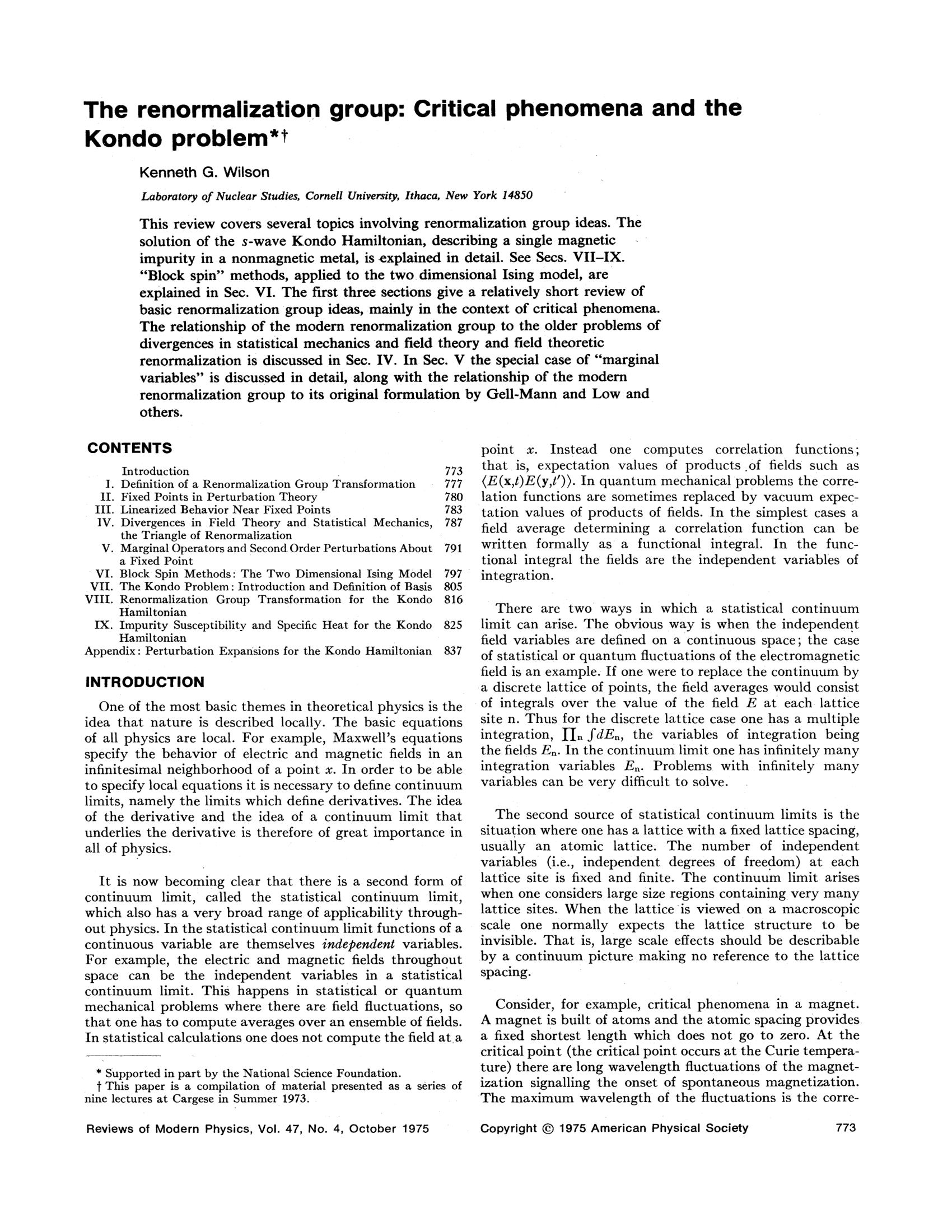
One of the most fundamental themes in theoretical physics is the profound idea that nature is described locally. The basic equations governing physical phenomena, such as Maxwell's equations for electromagnetism or the Navier-Stokes equations for fluid dynamics, specify the behavior of fields in an infinitesimal neighborhood of a given point in space and time. To articulate these local interactions mathematically, it is inherently necessary to define continuum limits, specifically the limits that define derivatives. The conceptualization of the derivative and the underlying continuum limit is, therefore, of paramount importance across all branches of classical physics. However, as Kenneth G. Wilson beautifully elucidates in his seminal 1975 review, "The renormalization group: Critical phenomena and the Kondo problem," a new mathematical paradigm was required to address problems where fluctuations occur on all length scales simultaneously.
This necessity gives rise to a second form of continuum limit, which Wilson terms the "statistical continuum limit." This limit is notoriously difficult to achieve while maintaining the principle of locality. In systems undergoing phase transitions, or in the tumultuous environment of financial markets—which we will analyze through the lens of structural metamorphosis and stochastic self-similarity—functions of a continuous variable are themselves independent variables. In the statistical continuum limit, one is forced to compute averages over an immense ensemble of fields rather than merely computing the field at a specific coordinate. In quantum field theory or statistical mechanics, these averages are often formulated as functional integrals, where the fields act as independent variables of integration. The sheer infinity of variables renders standard analytical solutions virtually impossible.
To appreciate the gravity of this challenge, consider the phenomenon of critical opalescence in a fluid, or the sudden loss of spontaneous magnetization in a ferromagnet as it reaches the Curie temperature. At this exact critical point, the characteristic length scale of the system—the correlation length, denoted as ξ—diverges to infinity. The system loses its characteristic scale. Microscopic fluctuations at the scale of angstroms become inextricably linked with macroscopic fluctuations spanning centimeters. In the dual code of our financial analogy, this is precisely what occurs during a market crash or a speculative bubble. The microstructural noise of individual tick data (the atomic spacing) suddenly synchronizes, creating a macro-scale systemic risk (the infinite correlation length). The market exhibits fractal properties, where the geometry of price movements looks statistically identical whether viewed on a one-minute chart or a one-month chart.
Wilson's introduction mesmericly outlines how traditional methods, such as standard perturbation theory formulated by Feynman, Schwinger, and Tomonaga, fail under these conditions. Perturbation theory relies on the assumption that coupling constants are small and that fluctuations at vastly different wavelengths only weakly interact. In critical phenomena, however, fluctuations of all wavelengths from the atomic spacing up to the correlation length are critically important and strongly coupled. The divergence in the mathematics is not merely an annoying artifact; it is a profound signal that the physics lacks a defining characteristic energy or length scale.
The Renormalization Group (RG) was explicitly designed to investigate these statistical continuum limit problems. It provides a systematic methodology to handle fluctuations over many wavelengths by dividing the full spectrum of length scales into manageable subranges and considering each sequentially. By integrating out the short-wavelength fluctuations step-by-step, the RG approach maps a highly complex local Hamiltonian into an effective Hamiltonian governing the longer-wavelength degrees of freedom. This cascade of transformations forms a mathematical group structure, allowing physicists—and modern quantitative analysts—to extract the essential macroscopic features of a system from a bewildering array of microscopic details.
II. Kadanoff Scaling Picture
Before delving into the rigorous functional integrations of the momentum-space Renormalization Group, Wilson pays homage to the intuitive brilliance of Leo Kadanoff. In 1966, Kadanoff provided the conceptual cornerstone for RG with his "block spin" model, a remarkably elegant heuristic that visually captures the essence of scale invariance. Imagine a two-dimensional Ising model consisting of a vast lattice of individual atomic spins, each pointing either up or down. At temperatures far from the critical point, the spins are largely disordered, and their correlation extends over a very short distance. However, as the temperature approaches the critical threshold, immense clusters of aligned spins begin to form, and the correlation length approaches infinity.
Kadanoff proposed a mental experiment: instead of attempting to solve the overwhelmingly complex interactions of millions of individual spins, what if we group them? He suggested partitioning the lattice into blocks of spins—for instance, blocks of 2 by 2. We then assign a single "block spin" to represent the average magnetic moment of the four original atomic spins within that block. By doing so, we effectively zoom out, smoothing over the finest microscopic details and replacing the original lattice with a new, coarser lattice. The genius of Kadanoff's insight was the hypothesis that, near the critical point, this new lattice of block spins behaves according to an effective Hamiltonian that has the exact same mathematical form as the original Hamiltonian. The only difference lies in the magnitude of the coupling constants describing the interaction strength between adjacent block spins.
The block spin transformation is the physical embodiment of moving from tick-by-tick market data to daily closing prices. Just as Kadanoff averaged atomic spins to find the macro-trend of a magnet, quantitative analysts aggregate micro-transactions to discover the fractal market structure, searching for a Hamiltonian (trading algorithm) that remains invariant across time frames.
By iterating this blocking procedure, one creates a cascade of transformations. Each step involves an explicit statistical averaging over fluctuations within a narrow band of wavelengths (e.g., averaging fluctuations from 1 Angstrom to 2 Angstroms, then from 2 to 4, and so forth). At the end of each iteration, the researcher is left with an effective interaction that dictates the physics at the newly scaled length. Kadanoff postulated that if this iterative process is carried out precisely at the critical temperature, the effective Hamiltonian eventually maps onto itself perfectly. This self-replicating state is formally defined as a "fixed point" of the renormalization group transformation.
The scaling picture beautifully illustrates two principal features: scaling and the cascade of amplification/deamplification. If the system is perturbed slightly away from the critical temperature, this tiny deviation is amplified with each successive block spin transformation. What starts as a microscopic divergence from criticality cascades into a macroscopic change, fundamentally altering the long-wavelength properties of the material. Conversely, differences in the specific microscopic structure of different materials are deamplified and washed away during the blocking process. This deamplification is the bedrock of "universality," explaining why completely different physical systems—or entirely different financial asset classes—exhibit identical behavior near their respective critical points.
While Kadanoff's picture was profoundly insightful, it remained phenomenological. The specific mathematical rules for computing the new block spin interactions were ambiguous, and approximations often broke down, failing to provide exact critical exponents. Wilson's monumental contribution was to take this beautiful conceptual sketch and translate it into a robust, exact mathematical formalism capable of calculating the true physics of continuous phase transitions.
III. The Renormalization Group and the ε Expansion
This section constitutes the mathematical heart of Wilson's 1975 review, detailing the transformation from Kadanoff's real-space block spins to a sophisticated momentum-space formulation. By operating in momentum space (Fourier space), Wilson could precisely control the integration over high-frequency fluctuations, utilizing a sharp momentum cutoff, denoted as Λ.
A. General formulation
Wilson defines the partition function Z, which is essentially the sum over all possible configurations of the system. The statistical averaging over fluctuations is mathematically realized as a functional integral. The transformation begins by defining a momentum cutoff Λ, meaning we only consider fluctuations with wavevectors k less than Λ. The RG transformation involves integrating out the highest momentum degrees of freedom—specifically, those lying in the shell between Λ/2 and Λ.
Once these high-energy, short-wavelength fluctuations are integrated out, the system is described by a new effective Hamiltonian defined up to the cutoff Λ/2. To compare this new Hamiltonian to the original one, a scale transformation is required. Spatial coordinates are rescaled, and the magnitude of the spin variables is adjusted by a scale factor ζ. This dual process—partial integration followed by rescaling—constitutes one complete step of the continuous Renormalization Group transformation. The elegance of this formulation lies in its ability to handle the infinite degrees of freedom systematically, avoiding the catastrophic divergences that plague standard perturbation theories.
B. The fixed point
The holy grail of the RG transformation is the discovery of a "fixed point." A fixed point Hamiltonian, denoted as H*, is a specific functional that remains completely unchanged after the RG transformation is applied. Mathematically, it is the steady-state solution to the recursion relations generated by the integration and rescaling steps. When a physical system's parameters flow toward a fixed point under successive RG transformations, the system is at criticality, exhibiting scale-invariant fractal behavior.
Wilson discusses the trivial "Gaussian fixed point," which describes non-interacting fields, and points out its limitations in spatial dimensions lower than 4. For realistic three-dimensional systems, the relevant fixed point is non-trivial (often called the Wilson-Fisher fixed point). By analyzing the linearized RG equations around these fixed points, one can determine eigenvalues. Eigenvalues greater than 1 correspond to "relevant" variables (like temperature deviation from criticality), which grow exponentially under the transformation and drive the system away from the critical state. Eigenvalues less than 1 correspond to "irrelevant" variables, whose influence vanishes at macroscopic scales.
C. Calculation of critical exponents
Calculating exact fixed points and critical exponents in three dimensions proved mathematically intractable due to the strong coupling of fluctuations. Wilson's stroke of genius was the introduction of the ε expansion. He realized that in exactly four spatial dimensions (d = 4), the critical behavior is governed by the simple, solvable Gaussian fixed point. By treating the spatial dimension d as a continuous variable and expanding the equations in powers of a small parameter ε = 4 - d, Wilson could approach the complex three-dimensional reality from the solvable four-dimensional mathematical abstraction.
Through meticulous Feynman diagram calculations evaluated to order ε (and later to higher orders), Wilson and his colleagues calculated the critical exponents that govern how properties like heat capacity, susceptibility, and correlation length scale near the critical temperature. Setting ε = 1 yielded remarkably accurate predictions for three-dimensional systems, finally resolving the discrepancies between theoretical models and experimental measurements that had puzzled physicists for decades.
D. Universality
The crowning philosophical and mathematical achievement of this section is the rigorous proof of "Universality." The RG flow equations demonstrate that as the cutoff Λ is repeatedly reduced, the countless irrelevant parameters describing the specific microscopic details of a material—whether it is an iron magnet, a binary alloy, or a liquid-gas transition—decay to zero. The flow is drawn inexorably toward a small number of fixed points, entirely determined by fundamental symmetries and the spatial dimensionality of the system.
In the context of our sophisticated market analysis, universality explains why a localized subprime mortgage crisis in the United States could cascade into a global financial meltdown with identical power-law volatility signatures across European equities, Asian commodities, and emerging market currencies. The specific "microscopic" catalysts (the irrelevant variables) are washed away at the macroeconomic scale, leaving behind a universal fractal topology dictated solely by the structure of the financial network.
IV. Application to the Kondo Problem
While critical phenomena provided the primary testing ground for RG, Wilson's review dedicates a substantial portion to the resolution of the Kondo problem. This demonstrated that RG was not merely a trick for phase transitions, but a profound framework for solving quantum many-body problems characterized by diverging energy scales.
A. The Kondo Hamiltonian
The Kondo effect, observed in the 1930s, describes the anomalous minimum in the electrical resistance of nonmagnetic metals containing trace amounts of magnetic impurities (like iron dissolved in copper) at very low temperatures. Jun Kondo successfully modeled this in 1964 using a Hamiltonian that included an antiferromagnetic spin-spin coupling between the localized impurity spin and the spins of the surrounding conduction electrons. However, Kondo's perturbation theory calculation yielded a logarithmic term that diverged to infinity as the temperature approached absolute zero. This unphysical singularity indicated a breakdown of perturbation theory; at low temperatures, the effective coupling between the impurity and the electrons becomes infinitely strong, a regime impossible to analyze with traditional tools.
B. The scaling equations
Wilson applied a non-perturbative, numerical formulation of the Renormalization Group to tackle this divergence. Unlike the continuous momentum integration used for critical phenomena, the Kondo problem required a discrete logarithmic discretization of the conduction electron energy band. Wilson separated the electron states into logarithmic intervals, mapping the complex continuous Hamiltonian onto a discrete, semi-infinite linear chain of interacting sites, with the impurity spin located at the origin.
He then solved the system iteratively using a digital computer. He started by diagonalizing the Hamiltonian for the impurity and the first few conduction electron sites. He retained only the lowest energy eigenstates and discarded the higher ones, then added the next site in the chain, rediagonalized, and repeated the truncation. This iterative truncation of high-energy states is mathematically equivalent to integrating out the short-wavelength fluctuations in the momentum-space RG. The computer tracked how the effective energy levels flowed as the energy scale was lowered toward absolute zero.
C. The strong-coupling limit
The numerical RG calculations unequivocally resolved the Kondo divergence. Wilson discovered that the system flows from a "weak-coupling" fixed point at high temperatures (where the impurity spin is essentially free) to a stable "strong-coupling" fixed point at absolute zero. At this strong-coupling limit, the conduction electrons form a tightly bound singlet state with the impurity spin, effectively "screening" its magnetic moment completely. The localized impurity vanishes from the perspective of the remaining low-energy conduction electrons, which then behave as a simple Fermi liquid scattering off a non-magnetic potential.
Translating this to fractal market dynamics, the Kondo problem perfectly models severe liquidity crises. An isolated, toxic financial event (the magnetic impurity) normally causes minor friction (scattering). But as market fear rises and liquidity dries up (temperature dropping), the interactions become highly non-linear. The entire market (conduction electrons) becomes inextricably entangled with the toxic asset, leading to a theoretical breakdown of traditional risk models (the logarithmic divergence). Wilson’s strong-coupling limit shows that the system does not explode into infinity; instead, it undergoes a profound structural reorganization, reaching a new, highly correlated state where the initial shock is fully absorbed and "screened" by a drastic reduction in overall market mobility.
V. Other Applications and Generalizations
In Section V, Wilson broadens the horizon, discussing the intricate challenges associated with "marginal variables." A marginal variable is an interaction parameter whose eigenvalue linearized around a fixed point is exactly one (or zero in terms of the scaling exponent). Consequently, it is neither amplified nor strictly deamplified by the primary linear RG transformation. Instead, its behavior is governed by delicate, higher-order non-linear effects that accumulate slowly over thousands of RG iterations.
These marginal variables are of paramount importance because they bridge the modern Wilsonian RG with the original field-theoretic renormalization formulations introduced by Gell-Mann and Low, and later by Callan and Symanzik in quantum electrodynamics (QED). In QED, the coupling constant (the electric charge) is a marginal variable, leading to subtle logarithmic corrections to scaling. Wilson explains how the non-perturbative RG encompasses these older diagrammatic techniques, providing a deeper physical intuition for why certain divergences appear in field theory and how they relate to the underlying lack of a characteristic energy scale in the universe.
This generalization cemented the Renormalization Group not merely as a specific technique for phase transitions, but as a universal philosophical apparatus for dealing with multi-scale phenomena in nature. From the strong force holding quarks together (quantum chromodynamics) to the chaotic turbulence of fluids, the RG framework provides the scaffolding necessary to connect microscopic laws to macroscopic realities. Today, this generalization extends proudly into the realm of complex systems and econophysics, offering the most rigorous framework available for decoding the multi-scale, fat-tailed distributions inherent in modern financial networks.
VI. Conclusions
Wilson concludes his magnum opus by reflecting on the sheer difficulty and the triumphant necessity of the Renormalization Group approach. Formulating the statistical continuum limit is an arduous task, demanding an immense amount of labor and theoretical artifice. Unlike the simple elegance of an ordinary derivative, RG equations are non-linear functional equations that often require massive computational power to solve, as evidenced by the Kondo problem.
Yet, despite its formidable complexity, the Renormalization Group stands as the only systematically reliable method for extracting finite, physically meaningful predictions from systems plagued by infinite degrees of freedom and lacking characteristic scales. It forces physicists to abandon the naive reductionist dream of solving macroscopic problems by brute-force integration of microscopic components. Instead, it teaches us to respect the hierarchy of scales, carefully integrating out the noise to reveal the resilient, universal structures that govern the macroscopic world.
For the quantitative analyst navigating the fractal topology of financial markets, Wilson's conclusion serves as a profound methodological manifesto. To predict the behavior of a market on the brink of a crash, one must not obsess over the idiosyncratic noise of individual equities. One must define the relevant and irrelevant variables, construct the scaling equations, and locate the fixed points that determine the universal dynamics of the collapse. The mathematics of the 1970s phase transitions are the precise tools needed to master the liquidity crises of the 21st century.
Fractal Volatility Scaling Estimator
Estimate macroscopic market volatility by scaling up microscopic noise using the Hurst exponent framework, analogous to Renormalization Group scaling transformations.
Formula: VT = V0 × TH
Model Diagnostic:
Projected Macro Volatility:
Key Takeaways & Conceptual Mapping
Step 1: The Kadanoff Block Spin approach teaches us to aggregate microstructural noise, paving the way for identifying macro-market trajectories without getting lost in tick-data chaos.
Step 2: Wilson's Fixed Points & Universality prove mathematically why entirely different asset classes crash with identical power-law signatures during liquidity crises.
Step 3: The resolution of the Kondo Problem offers a non-perturbative model for understanding how markets "freeze" and restructure around toxic assets during extreme volatility events.
Frequently Asked Questions
나만의 사유 한 스푼
복잡한 수식과 양자역학의 세계 속에서 윌슨이 궁극적으로 찾아낸 것은 '무한대라는 공포 앞에서도 질서를 찾아내는 방법'이었습니다. 시장이 폭락하고 변동성이 극에 달해 모든 지표가 무의미해 보일 때, 우리는 종종 개별 주식의 등락이라는 미시적 노이즈에 매몰되어 패닉에 빠지곤 합니다. 하지만 재규격화 군의 시선으로 한 걸음 물러서서 스케일을 넓혀보면, 그 혼란 속에서도 시장 전체를 지배하는 보편적이고 거대한 멱법칙의 질서가 존재함을 깨달을 수 있습니다.
어지러운 틱 차트를 잠시 덮어두고, 여러분의 투자 포트폴리오를 긴 호흡의 프렉탈 구조로 재규격화해 보시길 바랍니다.