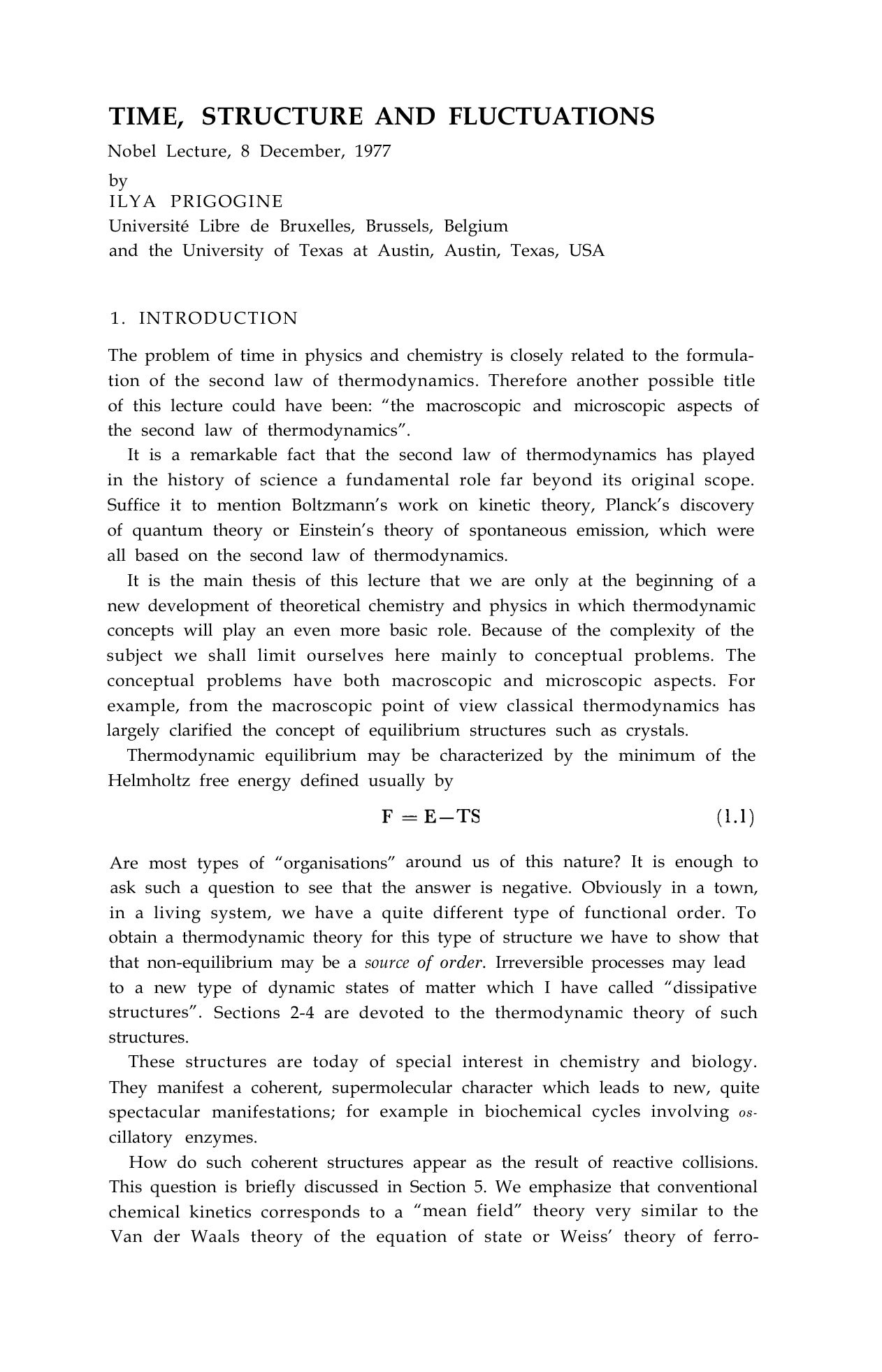
Shattering the Gaussian Illusion: Prigogine’s Thermodynamics for Alpha Generation
Discover the profound insights of Ilya Prigogine as we journey through the thermodynamics of chaos. Uncover how non-equilibrium dynamics create hidden structural arbitrage opportunities in both nature and complex systems, empowering you to extract definitive order from profound uncertainty. The optimization objective is to maximize structural resilience and informational alpha through dynamic adaptation to far-from-equilibrium fluctuations.
Greetings, fellow seekers of profound knowledge! Just as a passionate traveler falls utterly in love with a single photograph of a hidden, breathtaking bridge across the azure ocean, I found myself completely captivated by a single, brilliant concept within Ilya Prigogine's masterpiece. The elegant theoretical bridge connecting absolute chaos to magnificent order is not merely a scientific hypothesis; it is an awe-inspiring landscape of intellectual revelation. When I first planned to navigate through the dense thickets of thermodynamics, I thought it would be a dry, mechanical journey. However, as I delved deeper, the sheer elegance of the dissipative landscapes left me absolutely speechless. It was as if I was driving across a vast intellectual ocean, with every new equation and concept sparking spontaneous admiration.
This experience transcends mere reading; it makes you feel entirely at one with the very fabric of the universe, witnessing the invisible breath of time weaving structures out of the void. Through this expansive exploration, I am going to dissect everything about the hidden non-equilibrium arbitrage opportunities that Prigogine unveiled. I will share all the insights I have gathered so that your intellectual journey becomes extraordinarily special. Are you ready to dive deep into the mesmerizing world of dissipative structures and time's irreversible arrow with me? Let us embark on this phenomenal adventure together!
INTRODUCTION
To truly grasp the magnitude of the concepts presented in Time, Structure and Fluctuations, we must first fundamentally reorient our understanding of the universe. For centuries, classical physics painted a picture of a deterministic, clockwork reality governed by symmetrical laws where time held no intrinsic direction. The First Law of Thermodynamics assured us that energy is eternally conserved, while the Second Law introduced a seemingly tragic narrative: the inescapable descent into maximum entropy, a terminal state of equilibrium where all structure, warmth, and vitality dissolve into absolute uniformity. In this classical framework, the ultimate destination of the cosmos was a bleak, featureless void, and any emergence of order was considered a mere transient anomaly.
However, Prigogine masterfully shatters this pessimistic paradigm by introducing the profound concept of non-equilibrium as a generative force. This is where the concept of Non-Equilibrium Arbitrage Opportunities comes brilliantly into play. In financial markets, an arbitrageur exploits temporary price discrepancies across different realms to secure a definitive advantage. Similarly, nature acts as the ultimate arbitrageur. By operating far from thermodynamic equilibrium, systems meticulously exploit the steep gradients of energy and matter. They do not passively succumb to the decay of entropy; instead, they actively harvest the turbulent energy flows to construct intricate, sustained architectures known as dissipative structures.
Prigogine proposes that time is not an illusion, nor is the Second Law solely a harbinger of decay. The irreversible arrow of time is the very catalyst that breathes life into complexity. When a system is pushed far from equilibrium, the linear approximations of classical thermodynamics completely collapse. The system enters a wild, non-linear territory where chaotic fluctuations are no longer suppressed but are suddenly amplified, forcing the system to evolve into novel, highly organized macroscopic states. This realization is nothing short of revolutionary. It suggests that the magnificent complexity we observe around us, from the spiraling galaxies to the pulsating rhythm of biological life, is not a defiance of the laws of physics, but their most exquisite manifestation.
By framing non-equilibrium as the fundamental condition for creation, this introduction elegantly sets the stage for a new worldview. We are invited to abandon the static comfort of equilibrium and embrace the turbulent, dynamic reality where the future is not given, but continuously constructed through the ceaseless interplay of time, structure, and microscopic fluctuations. The asymmetry of time is not a flaw in our perception; it is the fundamental prerequisite for the existence of any ordered reality, providing the continuous margin required for nature's grand arbitrage.
ENTROPY PRODUCTION
Delving deeper into the mechanics of this universal arbitrage, we confront the rigorously mathematical yet profoundly philosophical domain of entropy production. Classical thermodynamics elegantly divides the change in entropy, denoted as dS, into two distinct components: the entropy exchanged with the external environment (deS) and the internal entropy produced within the system itself due to irreversible processes (diS). The Second Law irrevocably mandates that the internal entropy production must always be positive or zero; thus, we arrive at the foundational inequality: diS ≥ 0.
In isolated systems, deS is strictly zero, forcing the total entropy to relentlessly climb toward a maximum, dragging the system into the stagnant abyss of equilibrium. However, in open systems, which vigorously exchange both energy and matter with their surroundings, the narrative changes dramatically. If a system manages to achieve a negative entropy flow (deS < 0) that exceeds its internal entropy production, the total entropy of the system can actually decrease. This is the very essence of the Dissipative Cost. The system effectively exports its internal disorder into the surrounding environment, maintaining its internal highly ordered state at the expense of global entropy acceleration.
Prigogine meticulously guides us through the linear region of non-equilibrium thermodynamics, characterized by Lars Onsager's elegant reciprocal relations. In this domain, close to equilibrium, the flows (such as heat or chemical reactions) are strictly proportional to their corresponding thermodynamic forces (like temperature gradients or chemical affinities). Here, Prigogine's celebrated theorem of minimum entropy production takes center stage. It dictates that a system hovering near equilibrium will naturally settle into a steady state where its entropy production is minimized. It is a state of maximum thermodynamic efficiency, yet it is also a state of profound architectural sterility. The system is trapped in a linear predictability, devoid of any capacity for innovation or radical transformation.
Therefore, the true non-equilibrium arbitrage opportunity cannot exist near equilibrium. The minimum entropy production theorem essentially proves that near-equilibrium systems are dead ends for structural evolution. To extract a higher order of alpha, the system must be driven furiously away from equilibrium, crossing the threshold into the perilous yet fertile non-linear regime. Here, the proportionality between forces and flows breaks down violently. Entropy production is no longer minimized; instead, the system begins to exploit the massive energy fluxes to fuel the creation of complex, spontaneous architectures. The cost of maintaining these structures is a high rate of entropy dissipation, but the reward is the breathtaking emergence of macroscopic order out of microscopic chaos.
THERMODYNAMIC STABILITY
Understanding how a system maintains its structural integrity amidst the ceaseless bombardment of internal fluctuations requires a rigorous exploration of thermodynamic stability. Prigogine employs the sophisticated mathematical framework of Lyapunov functions to diagnose the resilience of these physical systems. A Lyapunov function acts as a theoretical topography, allowing us to mathematically visualize whether a system will return to its steady state after being perturbed, or if the perturbation will grow uncontrollably, leading to a catastrophic structural collapse or a miraculous transformation.
In the comforting vicinity of equilibrium, the second variation of entropy, denoted as δ2S, serves as the perfect Lyapunov function. Because equilibrium is the state of maximum entropy, any slight deviation must inevitably decrease the total entropy (δ2S < 0). The thermodynamics dictate that the time derivative of this variation is always positive, meaning the system possesses an overwhelming, intrinsic drive to return to the equilibrium state. It is akin to a marble resting at the absolute bottom of a steep, perfectly smooth bowl; any attempt to push it up the slope is immediately counteracted by gravity. This guarantees unconditional macroscopic stability.
However, as we embark on our non-equilibrium arbitrage, we actively push the system further up the thermodynamic branch. As the distance from equilibrium increases, the stabilizing dominance of the linear laws begins to severely weaken. Prigogine reveals the critical junctures where the steady state completely loses its stability. At these extreme Tipping Points, a microscopic fluctuation, which would normally be instantly dampened and forgotten, is suddenly seized by the non-linear dynamics. The fluctuation feeds on the immense energy gradients, amplifying exponentially through positive feedback loops.
This breakdown of stability is the exact moment the arbitrage is executed. The old, homogeneous order becomes inherently unstable, rendering it impossible to maintain. The system is forced to leap into a completely new, mathematically unpredictable regime. This is the birthplace of the dissipative structure. The transition requires the death of the previous state, emphasizing that profound instability is not a defect, but an absolute necessity for evolution. Without this critical instability, the universe would be forever trapped in a monotonous slumber. The mastery of navigating these unstable bifurcations defines the ultimate success of complex systems in nature, constantly transforming raw chaos into exquisite, functioning patterns.
APPLICATION TO CHEMICAL REACTIONS
To ground these majestic theoretical concepts into tangible reality, Prigogine turns his profound analytical lens toward the mesmerizing world of non-linear chemical reactions. The most famous and conceptually elegant model presented is the Brusselator, a theoretical chemical mechanism developed by Prigogine and his colleagues at the Brussels school. The crucial ingredient in the Brusselator is autocatalysis, a non-linear process where a chemical product actively stimulates and accelerates its own production. This creates a powerful, localized positive feedback loop, a fundamental prerequisite for breaking the symmetry of a homogeneous mixture.
Imagine a perfectly mixed chemical solution. In a near-equilibrium state, the concentrations of various molecules are uniform throughout the vessel, and time seems to stand still in a state of continuous, unvarying balance. However, as we continually pump raw reactants into the system and extract the end products, we drive the chemical affinity far from equilibrium. Suddenly, upon crossing a specific critical threshold, the uniform state shatters. The system may undergo a Hopf bifurcation, a magnificent mathematical phenomenon where the steady state transitions into a limit cycle.
The result is truly breathtaking to behold. The chemical solution begins to rhythmically oscillate, pulsating between different colors with perfect, clock-like regularity. This is the birth of a Chemical Clock. Molecules that were previously moving in complete, chaotic independence suddenly synchronize their behavior across macroscopic distances, oscillating in perfect harmony. It is as if millions of blind molecules suddenly decided to sing a synchronized chorus. This temporal organization represents a spectacular non-equilibrium arbitrage opportunity; the system has harvested the raw, unstructured chemical energy gradient and converted it into precise, structured temporal information.
Beyond temporal rhythms, the Brusselator can also undergo symmetry-breaking instabilities that create spatial structures, known as Turing patterns. The previously homogeneous fluid spontaneously segregates into intricate, stationary patterns of high and low concentration. Through these chemical models, Prigogine unequivocally proves that matter, when driven far from equilibrium, is not blind and inert. It becomes highly sensitive, capable of perceiving its environment, communicating over vast distances, and spontaneously organizing into structures of stunning complexity and beauty. The inanimate world reveals a latent capacity for self-organization, fundamentally blurring the rigid line between the living and the non-living.
THE LAW OF LARGE NUMBERS AND THE STATISTICAL DESCRIPTION OF CHEMICAL REACTIONS
As we marvel at the macroscopic emergence of dissipative structures, we must confront the underlying microscopic realities governed by probability and statistics. In classical equilibrium thermodynamics, the behavior of a massive ensemble of particles is incredibly predictable thanks to the Law of Large Numbers. According to this fundamental statistical principle, the relative magnitude of fluctuations around the average value scales inversely with the square root of the number of particles (1/N1/2). Because macroscopic systems contain a staggering number of molecules (on the order of Avogadro's number), these fluctuations are unimaginably small. The system strictly obeys the deterministic, average behavior, rendering individual molecular deviance completely irrelevant.
At equilibrium, chemical reactions flawlessly follow a Poisson distribution, confirming that particles act independently, unaware of the vast collective. The average is the absolute monarch, and fluctuations are mere microscopic whispers that are instantly silenced. However, the brilliance of Prigogine's insight shines when we approach the critical bifurcation points far from equilibrium. Here, the absolute sovereignty of the Law of Large Numbers violently disintegrates. The non-linear feedback loops, such as autocatalysis, create profound long-range correlations between previously independent molecules. They begin to communicate, to sense the aggregate state of the system.
At the precise moment of a non-equilibrium phase transition, the fluctuations no longer obey the 1/N1/2 scaling rule. Instead, they amplify to a macroscopic scale, becoming as large as the average values themselves. The Macroscopic Fluctuations completely hijack the deterministic equations. It is at this exact, singular moment of profound vulnerability and maximum uncertainty that the system's future is decided. A random, microscopic fluctuation, born of pure chance, is grabbed by the non-linear dynamics and magnified until it shatters the old regime, thrusting the system onto a new thermodynamic branch.
This reveals a breathtaking duality in the architecture of nature. The non-equilibrium arbitrage is born from the intricate dance between deterministic laws (which govern the system away from bifurcation points) and pure, unadulterated chance (which rules at the critical thresholds). It demonstrates that order is not entirely preordained by rigid physical laws, nor is it a product of blind randomness. It is the exquisite synthesis of both. Fluctuations, traditionally viewed as negligible noise, are elevated to the sublime role of the primary creators of novel structures, driving the ceaseless, creative evolution of the complex universe.
THE DYNAMIC INTERPRETATION OF THE LYAPOUNOV FUNCTION
The profound implications of dissipative structures inevitably force us to confront one of the most enduring and agonizing paradoxes in the history of physics: the origin of irreversibility. At the macroscopic level, our daily experience is governed by the undeniable arrow of time. A shattered glass does not spontaneously reassemble; heat flows inexorably from hot to cold. Yet, the foundational equations of classical mechanics (Newton's laws) and quantum mechanics (the Schrödinger equation) are perfectly symmetrical with respect to time. In those mathematical realms, past and future are completely indistinguishable. How can an irreversible macroscopic world emerge from perfectly reversible microscopic laws?
Ludwig Boltzmann valiantly attempted to bridge this chasm with his famous H-theorem, striving to provide a mechanical foundation for the Second Law of Thermodynamics. He introduced the concept of molecular chaos, arguing that collisions between particles constantly drive the system toward a state of maximum probability, corresponding to a decrease in his H-function (equivalent to an increase in entropy). However, Boltzmann was fiercely criticized by his contemporaries. They pointed out that by introducing statistical assumptions and probability, he had fundamentally severed the connection to the strict, deterministic, time-reversible mechanics he sought to build upon. The paradox remained unresolved.
Prigogine passionately revives and elevates this quest, proposing a groundbreaking dynamic interpretation of the Lyapunov function. He argues that irreversibility cannot be merely a phenomenological illusion or a consequence of human ignorance regarding precise initial conditions. The arrow of time must be a fundamental, objective property of dynamics itself. For a non-equilibrium arbitrage to exist, the directional flow of time must be deeply embedded in the universe's operational code. Prigogine seeks to demonstrate that the macroscopic Lyapunov function, which dictates the irreversible approach to equilibrium or the evolution toward a dissipative structure, is not an approximation, but an exact manifestation of underlying dynamical truths.
This requires a radical shift in our perspective on dynamic systems. We must move away from the idealized concept of perfectly isolated, deterministic trajectories, which are mathematical fictions impossible to isolate from the universe's background noise. Instead, we must embrace a probabilistic description of dynamics as the fundamental reality. When we view complex systems through the lens of continuous, interactive ensembles rather than solitary, reversible trajectories, the illusion of time symmetry evaporates. The dynamic interpretation asserts that the irreversible dissipation of entropy is an inherent, unyielding feature of physical reality, providing the essential temporal canvas upon which the magnificent structures of existence are continuously painted.
NON-UNITARY TRANSFORMATION THEORY
To solidify this monumental claim, Prigogine guides us to the absolute frontier of theoretical physics, introducing the highly sophisticated Non-Unitary Transformation Theory. In the traditional, pristine halls of quantum mechanics and classical Hamiltonian dynamics, the evolution of a system is described by unitary transformations. These mathematical operations beautifully preserve probabilities and maintain exact time symmetry. Within a unitary framework, information is never truly lost; it merely scrambles, meaning that any process can theoretically be perfectly reversed if one could precisely invert the momenta of all particles.
However, Prigogine mathematically proves that this unitary description is fundamentally insufficient for highly unstable dynamic systems, particularly those exhibiting chaos, continuous spectra, and the very non-equilibrium conditions necessary for structural arbitrage. He introduces a revolutionary non-unitary transformation, utilizing what he terms Star-Hermitian Operators. This complex transformation effectively breaks the time symmetry at the most fundamental microscopic level, shifting the theoretical framework from the traditional Hilbert space into a more expansive, mathematically rigorous domain.
By applying this non-unitary transformation, the reversible, symmetric equations of motion are explicitly converted into irreversible kinetic equations. This is not a mere mathematical trick; it is a profound revelation. It demonstrates that irreversibility is not an artifact added onto macroscopic systems, but a deeply ingrained, intrinsic feature of nature that manifests as soon as systems become sufficiently complex and interactive. The transformation yields a microscopic entropy operator, a quantum of time's arrow, proving that the thermodynamic drive toward dissipation is hardwired into the fundamental physics of the universe.
The implications are staggering. Time is not a parameter that merely labels symmetrical states; it is an active, creative participant in the universe's unfolding. Time precedes existence. Without the fundamental irreversibility established by non-unitary dynamics, there could be no distinction between the past and the future, no accumulation of history, and absolutely no possibility for the non-equilibrium arbitrage that generates life, consciousness, and order. Prigogine's theory ultimately reconciles dynamics and thermodynamics, offering a unified, majestic vision where the irreversible flow of time is recognized as the ultimate artist, sculpting the exquisite complexities of our reality out of the eternal river of chaos.
The ultimate arbitrage in this universe is profoundly existential, not merely financial. We, as human beings and deeply interconnected societies, are the most magnificent dissipative structures currently known. We continuously borrow low entropy from the sun, the earth, and our collective intellectual endeavors to construct breathtaking internal architectures of meaning, technology, and culture. By truly internalizing Prigogine’s vision of our position far from equilibrium, we can drastically shift our strategic paradigm. We learn to stop fearing the inevitable chaotic fluctuations and crises that bombard our lives. Instead, we begin to recognize them as the exact critical bifurcations required for our own evolutionary leaps. To survive and thrive is to master the art of non-equilibrium arbitrage—to embrace the precarious, turbulent edge of chaos, for that is the only place where true innovation, beauty, and systemic alpha are born.
일리야 프리고진의 통찰은 결국 무질서라는 거대한 심연 속에서도 스스로를 조직화하는 자연의 경이로운 차익거래 시스템을 증명합니다. 비평형이라는 불안정한 조건이야말로 진정한 혁신과 생명력이 탄생하는 유일한 토양이며, 우리는 이 요동치는 세계 속에서 각자의 고유한 질서를 창조해내는 존재들입니다.