이 분석을 통해 미시적 양자 상태의 거시적 발현 과정을 해체하여 초전도 현상과 유동성 저항 소멸의 본질적 메커니즘을 규명합니다.
우리가 매일 사용하는 전자기기 속에는 항상 '저항'이라는 불청객이 존재합니다. 에너지를 갉아먹고 열을 발생시키는 이 골칫거리를 영원히 사라지게 할 수는 없을까요? 1911년 카메를링 오네스가 수은에서 처음으로 전기 저항이 완벽히 사라지는 현상을 발견했을 때, 전 세계의 물리학자들은 환호성과 동시에 깊은 절망에 빠졌습니다. 현상은 눈앞에 있는데, 그 어떤 기존의 이론으로도 이 마법 같은 '초전도체 상전이와 유동성 저항'의 소멸을 설명할 수 없었기 때문입니다. 반세기가 넘는 시간 동안 수많은 천재들이 이 난제에 도전했고 번번이 고배를 마셨습니다.
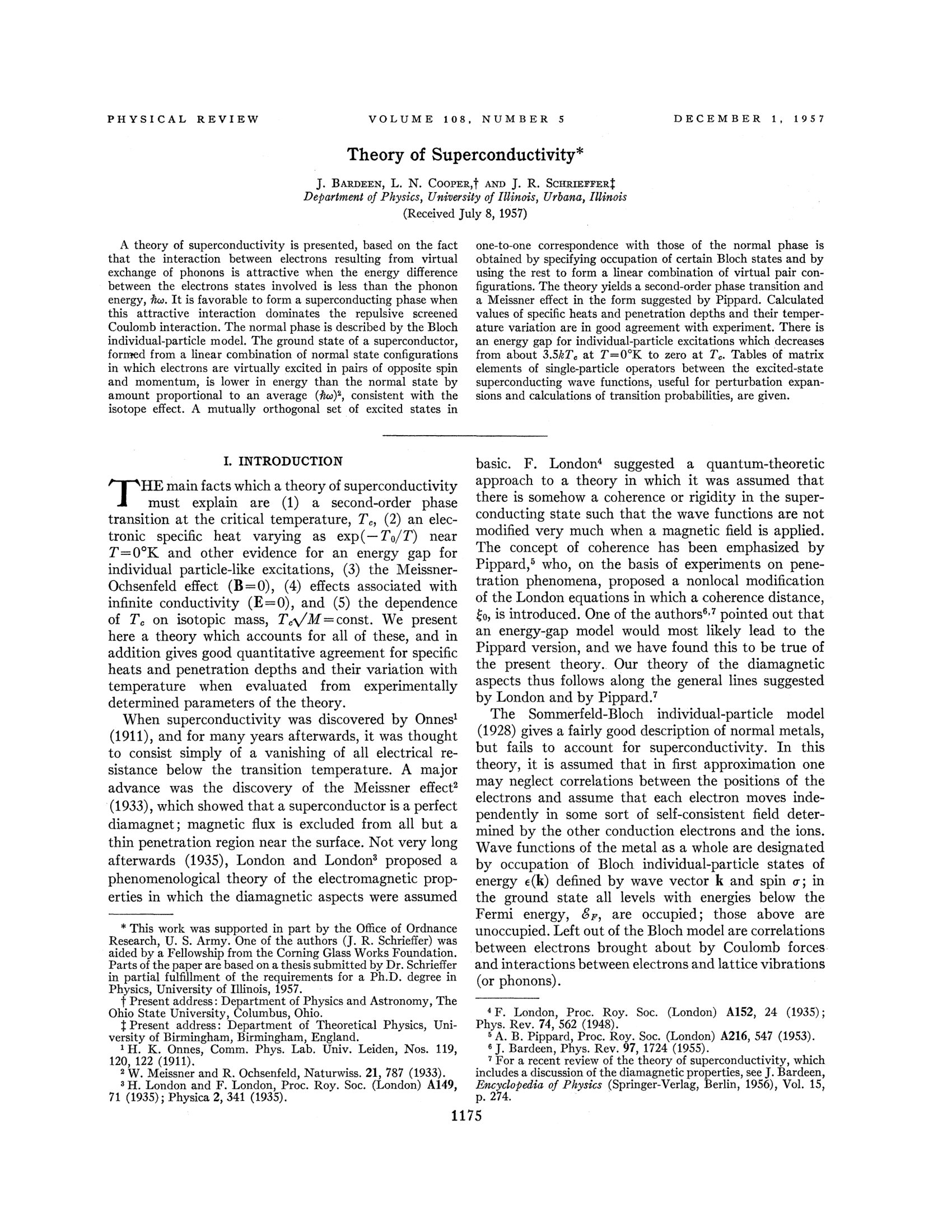
그러던 1957년, 존 바딘, 리언 쿠퍼, 존 로버트 슈리퍼라는 세 명의 학자가 마침내 이 거대한 미스터리의 자물쇠를 부수고 맙니다. 그들이 발표한 논문은 단순한 수식의 나열이 아니었습니다. 그것은 미시 세계의 입자들이 어떻게 거대한 스케일에서 하나의 완벽한 오케스트라처럼 움직이는지를 보여주는 경이로운 교향곡이었습니다. 이제부터 차가운 금속 내부에서 벌어지는 뜨겁고 역동적인 양자들의 춤사위를 따라가 볼 준비가 되셨나요?
Part I: The Pre-BCS Landscape and the Call for a Microscopic Paradigm
To truly appreciate the monumental achievement of Bardeen, Cooper, and Schrieffer in their 1957 treatise on the theory of superconductivity, one must first navigate the conceptual wilderness that preceded it. For nearly half a century following Heike Kamerlingh Onnes's serendipitous discovery of zero electrical resistance in mercury at 4.2 K, the theoretical physics community found itself in a state of profound epistemological crisis. The phenomenon of the superconductor phase transition and fluid resistance elimination defied the classical and early quantum mechanical frameworks. Phenomenological models, such as the London equations and the macroscopic Ginzburg-Landau theory, provided elegant mathematical descriptions of the macroscopic electrodynamics and thermodynamics—most notably the Meissner-Ochsenfeld effect, which demonstrated that a superconductor is not merely a perfect conductor but a perfect diamagnet. However, these models were purely descriptive. They illuminated the "how" but remained spectacularly silent on the "why." They could not articulate the underlying microscopic mechanics driving this phase transition.
The quest for a fundamental microscopic theory was fraught with false dawns. The central enigma lay in the extremely small energy difference between the normal and superconducting states—on the order of 10-8 electron volts per atom. Attempting to isolate this minuscule condensation energy from the colossal background noise of the electron gas's zero-point kinetic energy and the profound Coulomb interactions seemed an insurmountable analytical challenge. The crucial paradigm-shifting clue emerged in 1950 with the independent discoveries by Maxwell and Reynolds of the isotope effect. They observed that the critical temperature, Tc, of a superconductor varied inversely with the square root of its isotopic mass. This empirical revelation acted as a Rosetta Stone; it incontrovertibly implicated the crystal lattice vibrations—the phonons—in a phenomenon that had previously been considered an exclusive property of the conduction electron fluid.
Herbert Fröhlich simultaneously and presciently formulated a Hamiltonian demonstrating that an interaction between electrons and lattice phonons could yield an effective attractive force between electrons. Yet, Fröhlich's approach, based on perturbation theory, collapsed under mathematical divergence when applied to the actual calculation of the superconducting state. The profound limitation was that the superconductor phase transition is not a mere perturbative adjustment of the normal state; it requires a radical structural reorganization of the Fermi sea. The stage was thus perfectly set for BCS. They recognized that the solution demanded not a refinement of existing perturbation techniques, but a completely novel way of conceptualizing the many-body quantum mechanics of the electron fluid. The objective was clear: to construct a coherent mathematical architecture that naturally incorporated this subtle phonon-mediated attraction to yield a macroscopic, fundamentally stable quantum state immune to the fluid resistance of scattering.
Part II: Decoding Electron-Phonon Interactions and Effective Attraction
The architectural foundation of the BCS theory relies upon a counterintuitive physical mechanism: an effective attractive interaction between two fermions, particles that fundamentally repel one another due to their negative electrostatic charges. To understand the superconductor phase transition, one must dive into the dynamic topology of the crystalline lattice. Imagine a high-velocity conduction electron charting its course through a dense matrix of positively charged metal ions. As this negatively charged electron zips past, its electromagnetic field exerts a momentary pull on the heavy, sluggish ions, causing them to displace slightly inward toward the electron's trajectory. This localized, transient distortion of the lattice creates a microscopic region of enhanced positive charge density.
Because the lattice ions are tremendously more massive than the electron, their restorative movement is exceedingly slow compared to the electron's rapid transit. By the time the ions have congregated to form this positively charged acoustic wake, the original electron has long departed. However, a second electron, arriving milliseconds later, encounters this residual positive charge polarization. It is subsequently drawn into this region. Consequently, the second electron is effectively attracted to the path of the first electron. This phonon-mediated interaction is mathematically modeled in the BCS paper using a transformed Hamiltonian where the bare Coulomb repulsion is augmented by an attractive term dependent on the exchange of virtual phonons.
The brilliance of the BCS approach lies in establishing the criterion for which this attractive interaction outcompetes the repulsive screened Coulomb force. The condition necessitates that the energy transfer between the electrons be less than the typical phonon energy, ℏωD, where ωD is the Debye frequency. Under this strict energetic jurisdiction, the net interaction becomes undeniably attractive, setting the stage for a profound metamorphosis of the electron fluid.
The formulation of this effective interaction potential, denoted as V, is elegantly simplified in the BCS framework to a constant negative value for states lying within a narrow energy shell surrounding the Fermi surface, and zero elsewhere. This immense simplification, while abstracting away the geometric complexities of real metals, captured the indispensable physical essence required to catalyze the superconductor phase transition. It proved that fluid resistance could be vanquished not by altering the material's purity, but by changing the relational dynamics between the electrons themselves. The electrons, previously solitary actors scattering off every lattice imperfection to create fluid resistance, were now bound by an invisible, phonon-woven thread.
Part III: The Genesis of Cooper Pairs and Fermi Surface Dynamics
If the phonon-mediated attraction provided the requisite force, Leon Cooper's profound insight into the mechanics of the Fermi sea provided the geometric architecture. In 1956, Cooper isolated a conceptual problem that would serve as the linchpin for the entire theory. He posited a heavily populated Fermi sea of non-interacting electrons at absolute zero temperature, where all energy states up to the Fermi energy, EF, are rigidly occupied. He then introduced just two additional electrons into this system, placing them in states immediately above the Fermi surface, and allowed them to interact via the weak, attractive phonon-mediated potential.
Classical intuition suggests that a bound state between two particles only forms if the attractive potential well is sufficiently deep to overcome their kinetic energy. However, the presence of the Fermi sea fundamentally alters the rules of quantum mechanics. Due to the Pauli exclusion principle, the two added electrons are strictly forbidden from scattering into any of the states already occupied below the Fermi energy. They are kinetically restricted to the narrow shell of unoccupied states above EF. Cooper mathematically demonstrated that under these severe phase-space restrictions, the two electrons will form a bound state—a Cooper pair—no matter how infinitesimally weak the attractive potential V might be.
To maximize the binding energy, the paired electrons must have equal and opposite momenta (k and -k) and opposite spins (↑ and ↓). This highly specific anti-parallel configuration ensures that the center-of-mass momentum of the pair is precisely zero, allowing them to utilize the maximum possible number of available scattering states to lower their combined energy. The energy of this bound state drops below the energy of two independent electrons at the Fermi surface by an amount that would later evolve into the concept of the superconducting energy gap. This realization was explosive. It implied that the normal Fermi sea, previously considered the absolute ground state of a metal, was in fact intrinsically unstable in the presence of any attractive interaction. The superconductor phase transition and the subsequent eradication of fluid resistance begin with this catastrophic instability of the normal electron fluid, cascading into an entirely new quantum architecture.
Part IV: Constructing the BCS Wave Function and Macro-Quantum States
Cooper's revelation was restricted to a single pair interacting atop a rigid, unyielding Fermi sea. The monumental challenge facing Schrieffer and Bardeen was to generalize this concept to an astronomical number of electrons, all simultaneously forming pairs and interacting with one another. A mere superposition of independent Cooper pairs was insufficient; the pairs overlap significantly in spatial extent. The coherence length of a Cooper pair spans thousands of angstroms, encompassing millions of other pairs within its volume. This intense spatial overlap necessitates a highly correlated, collective many-body wave function.
Schrieffer's stroke of genius was the formulation of a variational ansatz for the ground state wave function that flawlessly captured these immense macroscopic quantum correlations. The BCS wave function is not constructed from definite particle numbers, but rather from a coherent superposition of states where specific momentum pairs (k↑, -k↓) are either entirely unoccupied or occupied by a bound pair. It represents a grand canonical ensemble where the exact total number of electrons is allowed to fluctuate slightly, a mathematical artifice that simplifies the profound complexities of pair phase coherence.
| State Characteristic | Normal Fermi Liquid | BCS Superconducting State |
|---|---|---|
| Electron Behavior | Independent fermions acting individually | Correlated Cooper pairs acting collectively |
| Fluid Resistance | High (due to impurity and phonon scattering) | Zero (macroscopic phase coherence prevents individual scattering) |
| Fermi Surface Topology | Sharp discontinuity at absolute zero | Smeared discontinuity replaced by an energy gap |
By applying the variational principle to minimize the expected energy of their reduced Hamiltonian, BCS derived the probability amplitudes vk (the probability that a pair state is occupied) and uk (the probability that it is empty). The resulting architecture is a macroscopic quantum state characterized by a single, system-wide phase. This global phase coherence is the ultimate destroyer of fluid resistance. In a normal conductor, individual electrons act as solitary wanderers, easily deflected by impurities, thus losing momentum and creating resistance. In the BCS state, the Cooper pairs act as a rigidly synchronized collective. To scatter a single pair and induce resistance, a collision must possess sufficient energy to simultaneously disrupt the phase coherence of the entire macroscopic ensemble—an energetically insurmountable task under the critical temperature.
Part V: Demystifying the Energy Gap and Thermodynamic Stability
The most profound and measurable consequence of the BCS wave function is the emergence of a finite energy gap, denoted as Δ, in the electronic excitation spectrum. Unlike a normal metal where infinitesimally small amounts of energy can excite electrons from the Fermi sea, the superconductor phase transition locks the electrons into a fundamentally distinct thermodynamic reality. To create an excitation—to break a Cooper pair into two independent quasi-particles—one must supply a minimum energy of 2Δ. This gap is not a static void in real space, but a forbidden region in momentum-energy space.
The magnitude of this gap is determined by the elegantly self-referential "gap equation." The energy gap at a specific momentum state depends intrinsically on the presence of the energy gap at all other momentum states. This non-linear, self-consistent feedback loop is the mathematical heartbeat of the theory. At absolute zero, the gap is at its maximum. As the ambient temperature rises, thermal fluctuations begin to violently agitate the lattice and the electron fluid. These thermal excitations systematically break apart Cooper pairs.
The destruction of pairs creates individual quasi-particles that clog the available momentum states needed for pair scattering. This reduces the effective strength of the pairing interaction, causing the energy gap Δ to shrink. This creates an accelerating, runaway effect: a smaller gap makes it easier for heat to break more pairs, which further shrinks the gap. At the precise critical temperature, Tc, the gap precipitously collapses to zero, and the macroscopic quantum state violently disintegrates. The material undergoes a second-order phase transition, reverting back to a normal Fermi liquid governed by classical fluid resistance.
The BCS theory brilliantly predicts that the ratio of the zero-temperature energy gap to the critical temperature (2Δ(0) / kBTc) should be a universal constant, approximately 3.52, for all weakly coupled superconductors. This profound theoretical prediction mapped flawlessly onto empirical data gathered from disparate elemental superconductors, cementing the theory's universal validity. It mathematically formalized how the superconductor phase transition acts as an impregnable fortress against entropy, preserving the frictionless flow of the electron liquid until the thermal siege becomes overwhelming.
Part VI: Excited States, Quasi-Particles, and Macroscopic Electrodynamics
The explanatory power of the BCS theory extends far beyond the absolute zero ground state; it provides a comprehensive epistemological framework for the excited states and the material's macroscopic response to external electromagnetic fields. When a Cooper pair is broken, the resulting entities are not simply normal electrons. They are mathematically described through Bogoliubov-Valatin transformations as "quasi-particles"—complex quantum superpositions of electron and hole states. The spectrum of these quasi-particles uniquely dictates the specific heat and thermal conductivity of the superconductor, exhibiting an exponential decay at low temperatures governed by the factor exp(-Δ/kBT), perfectly mirroring the thermodynamic signatures observed in laboratories.
Furthermore, the true crucible of any theory of superconductivity is its ability to naturally derive the Meissner-Ochsenfeld effect—the perfect expulsion of magnetic flux. Prior theories had to insert this property phenomenologically. BCS demonstrated that when their highly correlated, rigid wave function is subjected to a weak magnetic field (introduced via the vector potential using minimal coupling gauge invariant methods), the system responds collectively. The rigidity of the wave function against perturbations in momentum space implies that the electron fluid cannot seamlessly adjust to the applied field as a normal conductor would.
Instead, to maintain its energetic minimum, the macroscopic quantum state generates perpetual, frictionless screening currents on the surface of the material. These diamagnetic currents produce an exact counter-magnetic field that flawlessly cancels the external field within the bulk of the superconductor. The mathematics of the BCS electrodynamic response seamlessly transition into the London penetration depth equations at the macroscopic limit, whilst uniquely incorporating the non-local Pippard coherence length. By unifying the microscopic quantum mechanics of the superconductor phase transition with the macroscopic elimination of fluid resistance and perfect diamagnetism, Bardeen, Cooper, and Schrieffer achieved one of the most intellectually staggering syntheses in the annals of modern physics.
Frequently Asked Questions ❓
결론 및 나만의 사유 한 스푼
바딘, 쿠퍼, 슈리퍼가 구축한 거대한 양자 역학의 건축물을 거닐며 우리는 아주 특별한 진실 하나를 목격하게 됩니다. 그것은 서로 밀어내도록 운명 지어진 입자들조차, 특정한 환경과 미세한 매개체를 통해서는 서로를 강하게 끌어안고 하나가 될 수 있다는 사실입니다. 극저온의 가혹하고 차가운 환경 속에서 전자는 홀로 저항에 부딪혀 산란하는 대신, 다른 전자와 손을 맞잡고 춤을 추며 '쿠퍼 쌍'이라는 연대를 이룹니다. 이 거대한 양자적 연대는 결국 어떤 불순물이나 장벽 앞에서도 에너지를 잃지 않고 완벽하게 흘러가는 기적 같은 '초전도체 상전이와 유동성 저항'의 완전한 소멸을 만들어냅니다.
자연이 우리에게 보여주는 이 미시 세계의 기적은, 어쩌면 우리가 거시 세계를 살아가는 데에도 작지만 깊은 울림을 전해주는 것 같습니다. 혼자서는 넘을 수 없는 거대한 저항의 장벽도, 보이지 않는 연결과 강한 연대를 통해서라면 아무런 마찰 없이 매끄럽게 통과할 수 있지 않을까요? 가장 차가운 온도에서 피어난 가장 뜨겁고 완벽한 협력의 물리 법칙, 그것이 바로 1957년의 낡은 논문이 21세기를 살아가는 우리에게 건네는 무언의 메시지일지도 모릅니다. 물리학의 경계 너머에 대해 더 깊이 고민하고 싶으시거나, 혹은 새롭게 떠오른 궁금증이 있으시다면 언제든 아래 댓글로 남겨주세요!
'Tech & Science[기술과 과학] > Matter & Life' 카테고리의 다른 글
| 텅 빈 공간의 비밀 파인만의 물리학 강의 2 전자기학이 현대 과학을 뒤바꾼 결정적 순간들 (0) | 2026.05.14 |
|---|---|
| 이중 슬릿과 래칫이 증명하는 우주의 우아한 법칙 : 파인만 물리학 강의 1권 (5) | 2026.05.04 |
| 볼츠만 '기체분자운동론 강의' : 통계역학으로 푼 엔트로피와 시간의 화살 (2) | 2026.03.13 |
| 시냅스부터 정신 질환까지 에릭 칸델 '신경과학의 원리' (0) | 2026.03.03 |
| 뇌가 만든 거대한 착각, 시간의 실체를 파헤치다 (feat. 카를로 로벨리) (0) | 2026.03.01 |


